Saturday, March 31, 2012

Medical Device Marketing Don't Need No Stinkin' ROI!

"Standards for devices exist, they just don't make sense," industry critic Dr. Diana Zuckerman, president of the National Research Center for Women & Families, said in a Consumer Reports release (also read this CBS report "Investigation: Most medical devices implanted in patients without testing"; see video below).

"An investigation by Consumer Reports, which included interviews with doctors and patients and an analysis of medical research and a device-safety database maintained by the FDA, shows the following areas of concern:
  • Medical devices often aren’t tested before they come on the market. “What they’re doing is conducting clinical trials on the American public,” says Dan Walter, a political consultant from Maryland. His wife was left with heart and cognitive damage from a specialty catheter, cleared without testing, that malfunctioned during a procedure to treat an abnormal heartbeat.
  • There’s no systematic way for the government, researchers, or patients to spot or learn about problems with devices. “A coffeemaker or toaster oven has a unique serial number so if a problem is found, the company can contact you to warn you. Your artificial hip or heart valve doesn’t,” Zuckerman says. “Your doctor is supposed to notify you of a problem but may not be able to if he has retired or passed away.”
  • Without major changes in the system, there’s not much that patients can do to protect themselves.
According to Consumer Reports, the majority of medical implants are not tested to make sure they are safe. Most of the time device manufacturers only need to pay the Food and Drug Administration (FDA) a fee of about $4,000 with minimal testing in order to get approval for marketing. Compared to drug approval, this is a walk in the park.

In fact, sometimes device manufacturers bypass this minimal approval process altogether as did Johnson and Johnson's Ethicon unit (see "J&J Marketed Medical Device Without FDA Approval").

Not only is the approval of medical devices by FDA more lax than the process used to approve drugs, medical device marketing is worlds apart from Rx drug marketing as I learned from a presentation made by a Medtronic marketing VP. The presentation focused on a case study of a marketing campaign for the Prestige Cervical Disc.

That case study showed that out of an estimated 5 million spine surgery candidates (patients) in the US, Medtronic only needed to capture 125 of them to break even on a very successful marketing campaign that reached 6.2 million local TV viewers, 80.5 million radio (especially satellite radio) listeners, 4 million print readers, and 73 million Internet browsers. (Get more details about that case study by downloading this Pharma Marketing News article: "Medical Device Marketing: Worlds Apart from Rx Drug Marketing"; use discount code 'DEV444' BEFORE April 15, 2012 to get it FREE!).

While drug advertisers would sweat and moan over whether such a campaign would have a positive ROI (return on investment), medical device marketers don't need to worry about no stinkin' ROI because of such low numbers of conversions required AND also because very little resources need to go into premarket testing in order to get FDA approval.


Although the FDA has met most of its goals for fast-track medical device approvals, it's taking substantially longer to issue decisions on devices than it used to, concluded a report from the Government Accountability Office (GAO). The GAO said:
"FDA has begun to take steps to address GAO’s 2009 recommendation about high-risk devices that are allowed to enter the U.S. market through the less stringent 510(k) process, but progress has been limited. High-risk devices include those which are implantable or life sustaining. In 2009, GAO recommended that FDA expeditiously take steps to issue regulations for the device types classified as high risk that are currently allowed to enter the market via the 510(k) process. Since then, FDA has set strategic goals to address these device types, but has issued a final rule regarding the classification of only one device type. As of April 1, 2011, FDA’s action on the 26 remaining types of high-risk devices was incomplete. Thus, these types of devices—such as automated external defibrillators and implantable hip joints—can still enter the U.S. market through the less stringent 510(k) process. GAO found that, since its report was issued in January 2009, FDA has cleared at least 67 510(k) submissions that fall within these high-risk device types. FDA has taken some additional steps to enhance premarket device safety since GAO’s 2009 report was issued—for example, it commissioned the Institute of Medicine to conduct an independent review of the premarket review process—but it is too early to tell whether any forthcoming changes will enhance public health."
To get a copy of the GAO report, see the end of this post: "FDA Taking Longer to Approve Medical Devices, Says GAO"

Friday, March 30, 2012

Diabetes Opinion Leaders Paid by Roche to Curate Content on New Twitter-based Social Media Site

Diabetes Nest, according to its "About" statement, "is a Twitter-based diabetes network designed to help people discover the best conversations from the most meaningful voices. The Nest was created by Ignite Health and sponsored by Roche Diabetes Care, makers of ACCU-CHEK® products and services."

Ignite Health, an InVentiv Health agency, maintains the site. Fabio Gratton, chief experience officer at Ignite Health, said:
"Few argue that social media has transformed how patients and their caregivers share healthcare information and find support. But the sheer volume of content can be overwhelming. 
"So we asked ourselves how we could best help the diabetes community find and engage in the most timely, relevant and important conversations. The result is a simple, intuitive, compelling and ultimately self-sustaining diabetes social media community.” Diabetes Nest aggregates, sorts and ranks tweets from a curated list of diabetes experts" (read more here: "Roche Sponsors Diabetes Nest Twitter-Based Social Media Site").
All five of those "diabetes experts" are long-time patient bloggers who are "compensated for their time, effort and invaluable guidance." Caretakers include:
  • Amy Tenderich (Diabetes Mine blogger)
  • Gina Capone ("gina - your diabetes BFF" blogger)
  • Kerri Sparling ("six until me" blogger)
  • George Simmons (co-host of DSMA Live on BlogTalkRadio)
  • Scott K. Johnson (co-host of DSMA Live on BlogTalkRadio and blogger at Scott's Diabetes)
Roche "has no control or influence over the content or frequency of the Caretakers' tweets."

Roche Diabetes Care has long been wining and dining diabetes bloggers at yearly "Roche Social Media Summits" held in nice places like resorts in Orlando, Florida. When I learned of the first summit held in 2010, I blogged that "Some Social Media Patient Opinion Leaders Want to be Paid Pharma Professionals." Diabetes Nest is, to my knowledge, the first such time that bloggers have been paid to be "consumer opinion leaders" in a manner similar to how pharma often pays physicians to be "key opinion leaders."

At a patient panel discussion during a 2010 conference, Allison Blass (Patient Blogger, Diabetes Activist, Lemonade Life), said "You need to pay some one's full time salary," referring to the desire of some pharma companies to interact with patients in online communities. "The only way to sustain growth and involvement in a [online] community," said Allison, "is to have someone who actually does it [manage social media interactions with patients] as their job... to become the person who is known and loved by the community."

Not that there is anything wrong with being compensated for your time, but pharmaceutical companies have to be careful how they provide compensation. In the case of Diabetes Nest, Roche probably supplies an "unrestricted grant," which is supposed to specify that the grantor (Roche) has no control over the content created by the grantee. The "grantee" in this case is probably Ignite Health, which owns Diabetes Nest (see NOTE below). Ignite Health is an advertising agency that works with pharmaceutical companies.
NOTE: Doing some WHOIS snooping, I learn that the domain diabetesnest.com is registered to "TWTCLK" and the administrative contact is Fabio Gratton, both located at the same address in San Clemente, CA. 
A pharmaceutical company providing unrestricted grants or other funds to an advertising agency in support of a patient site related to a product line is a bit controversial, IMHO, especially if there intends to be a "Chinese" wall between the funding and advertising interests. This kind of thing got pharma companies into trouble with the likes of Senator Grassley when "unrestricted grants" were provided to ad agencies to run independent accredited CME programs for physicians. ACCME, which accredits CME, now requires that CME providers to be independent of ad agencies to avoid conflicts of interest.

Disclosure: Fabio Gratton is a friend of mine and a very nice guy who deserves a lot of credit for his high quality, ethical work with pharmaceutical clients. He has been a frequent guest on my BlogTalk Radio show (eg, listen to "Facebook Timelines for Brands: The Implications for Pharma Companies"). He is not a client of mine, but he could be in the future. Knowing Fabio, I am sure he would welcome a discussion of "conflict of interest" in pharma-sponsored social media. The timing of this post may be a problem for him as he and his wife are expecting their first child any day. He must be very busy. Any way, I hope some day I get to visit him in San Clemente! 

Thursday, March 29, 2012

Will Pharma Experience It's Own "Pink Slime" Social Media Crisis?

No doubt you have heard about "pink slime," the beef additive made from leftover trimmings. According to an article in today's Wall Street Journal (here), "the additive, which has long been used as a cheap filler in hamburger meat without anyone knowing or caring, has become the latest example of a product to fall prey to a social-media feeding frenzy after celebrity chef Jamie Oliver detailed how it is made in a TV special. Facebook, Twitter and other social media sites took it from there. Supermarkets and school districts across the country have been shunning it after mounting public pressure."

To counteract that "public pressure," which Tyson Foods Chief Operating Officer Jim Lochner said is merely a "two-week event," USDA and governors from several "pink slime" producing states (eg, Rick Perry, Texas) are mounting a counterattack. Iowa Gov. Terry Branstad said "We're going to consume it. We'll do everything we can to set the record straight."

"This is so clearly a movement that's been driven by consumers," said Willy Ritch, a spokesman for U.S. Rep. Chellie Pingree (D., Maine), who is pushing for a ban of the filler in school lunches.

USDA chief Tom Vilsack pointed to the difficulty of getting ahead of opposition to a product -- even if it is deemed safe by the government -- in a world fueled by social media. He also highlighted a disconnect that continues to grow between people and where their food comes from.


It's possible that the drug industry will one day face it own "pink slime" crisis because there is also a "disconnect" between consumers and where their drugs come from and the ingredients they contain.

Recently, we have seen cases where active ingredients in medicines have been replaced by miscellaneous substances having no medical benefit and cases where manufacturing problems have led to contamination such as Johnson and Johnson's problems with children's medicines (see, for example, "Unsafe Drugs: Is It Counterfeiters or the Supply Chain That's the Problem?").

These problems may be glitches in an otherwise safe drug supply chain, but did you know that up to 80 percent of the active ingredients in drugs used in the United States are made overseas? Hopefully, those ingredients meet high standards. Yet up to 149 Americans died in 2007 and 2008 after taking heparin, a blood thinner, contaminated during the manufacturing process in China.

What's often not mentioned, however, are the "inactive" ingredients in the pills we take. Viagra, for example, contains the following inactive ingredients:
  • microcrystalline cellulose
  • anhydrous dibasic calcium phosphate
  • croscarmellose sodium
  • magnesium stearate
  • hypromellose
  • titanium dioxide
  • lactose
  • triacetin
  • FD & C Blue #2 aluminum lake
Patients are warned to discontinue taking medicines if they are allergic to any of the ingredients.

These ingredients are the "pink slime" of the drug industry. But whereas "pink slime" only constitutes a small percentage of ground beef, these "inactive" ingredients comprise the bulk of the pill's weight and volume.  AND they are probably made overseas with very little FDA supervision.

One of these ingredients may be as controversial to patients as "pink slime" is to hamburger eaters. In fact, this was the case with Johnson and Johnson's baby shampoo that consumers learned contained cancer-causing chemicals. That issue was big on social media for a while until J&J promised to phase out the product in the U.S. (it has been completely pulled from the shelves in other countries).

The food industry is blaming "misinformation" amplified via social media as the main cause of the consumer backlash against "pink slime." They have launched a two-pronged campaign to deal with the crisis: (1) issue "corrective" information, and (2) warn of higher prices if "pink slime" is no longer used in hamburger meat.

This sounds similar to how drug companies view social media -- i.e., a vast network of "misinformation" about their products. The biggest argument social media advocates use to convince pharma to "engage" with consumers on social media is so that they can be "part of the conversation" and provide "scientifically correct" information about their products to counterbalance all the "misinformation" out there.

The first step is to learn what consumers are actually saying about drugs on social media. The drug industry is actively engaged in that kind of monitoring right now.

Wednesday, March 28, 2012

FDA Says No to Importation of Drugs That Save Lives, But Yes to Drugs That End Lives

In the FAQs section of FDA's consumer web site (here), it answers the question: "Why can’t I import some drugs that are approved and sold in the United States?" thusly:
"Many drugs obtained from foreign sources that claim or appear to be the same as U.S.-approved drugs are, in fact, of unknown quality and may even be counterfeit. There is also a possibility that drugs coming to U.S.consumers through Canada, or that claim to be from Canada, may not actually be Canadian drugs. FDA cannot assure the authenticity, safety, or effectiveness of drugs from foreign countries."
However it does allow an exception at its discretion: "FDA, however, has a policy explaining that it typically does not object to personal imports of drugs that FDA has not approved under certain circumstances, including the following situation:
  • The drug is for use for a serious condition for which effective treatment is not available in the United States;
  • There is no commercialization or promotion of the drug to U.S. residents;
  • The drug is considered not to represent an unreasonable risk;
  • The individual importing the drug verifies in writing that it is for his or her own use, and provides contact information for the doctor providing treatment or shows the product is for the continuation of treatment begun in a foreign country; and
  • Generally, not more than a 3-month supply of the drug is imported."
Certainly, that exception does NOT apply to sodium thiopental, an anesthetic used to put inmates to sleep before other lethal drugs are administered. Obviously, inmates are not importing this drug for "their own use."

However, the FDA has allowed prison officials in various states to import sodium thiopental after the drug’s U.S. manufacturer announced last year that it would no longer produce it.

As reported in the Washington Post (see here), U.S. District Judge Richard Leon blocked the importation of sodium thiopental on grounds the Food and Drug Administration "ignored the law in allowing it into this country." The Obama administration argued it had discretion to allow unapproved drugs into the U.S. Leon said the FDA’s actions were "contrary to law, arbitrary, capricious, and an abuse of discretion." He said that plain language of the law says that an article that appears to be misbranded or unapproved "shall be refused admission."

FDA cites safety concerns when it enforces the law of which Judge Leon speaks. A case in point, was the importation of tainted cancer drug Avastin (see "The Fake Avastin Supply Chain: China, Syria, Denmark, Switzerland, UK, US, Doctors").

Ironically, Judge Leon cited the same safety concerns:
"By opening up the 'closed' drug system by allowing an unapproved drug — thiopental — into the United States, defendants jeopardize their own system and threaten the public health by creating a risk that thiopental could incorrectly end up in the hands of the general public," he wrote.
AMEN!

An App for Troubled Sleepers that Lunesta Would Love... Maybe.

What makes a mobile app effective?

That was the question posed by Jim Dayton (@JimDayton), Snr Dir Emerging Media at Intouch Solutions, at the iPharmaCONNECT conference this past Monday. As I suggested in a previous post, Dayton was not able, IMHO, to answer the most important questions about effectiveness; namely, provide truly useful KPIs (see "Pharma Social Media Religion Versus Science").

Today, I can explore what makes an app effective based on my personal experience with an app called "Sleep Cycle." Available in the iTunes store (here), Sleep Cycle is "an alarm clock that analyzes your sleep patterns and wakes you in the lightest sleep phase - a natural way to wake up where you feel rested and relaxed." After setting the alarm to the time you wish to wake up, you put your iPhone under your pillow (actually, next to it as shown in the photo below) and the app collects data about your sleep pattern during the night.


The app uses the iPhone's accelerometer to detect and measure your movements during the night. According to the developers, Sleep Cycle calculates the optimal time to wake you up during a 30 minute window that ends at your set alarm time.

It was amazingly simple to use. That's the first characteristic of an effective app.

But does it work? I must admit I had my doubts. It could be like those pads that draw out bad karma from the soles of your feet while you sleep. Yeah, sure. After my first use last night, I can say that it definitely worked!

Here's the chart showing how I slept last night:


The app DID wake me at a deep sleep point at 4:57 AM - 3 minutes before 5 AM, which was the time I set it to.

But could the chart just be faked? The app could have generated a random series of peaks. How would I know? Here's why I know it is for real. At about 1 AM in the morning we experienced a power failure that lasted only a minute or so. It was enough to wake me and my wife. The red arrow indicates the highest peak in my sleep cycle because I (and my wife) definitely woke up after hearing alarms from other digital devices in the bedroom -- such as beeps from the cable box as it turned back on.

What's the utility of such an app? First of all it's fun! Secondly, it records real data that I can use to help me get a better night's sleep. If I were being treated by my doctor for insomnia, I could send the data by email to my doctor. If I was being treated with a drug like Lunesta, I could determine if it really helped (although I should know it helped or not without charting my movements during sleep).

The third reason why this is an effective app is the most important one. I will use it every night. The novelty won't wear off because it fits into my routine of charging my iPhone every night when I sleep -- right there next to me on the night stand. This is an app that keeps your phone charging while it works instead of wasting battery life!

One last thing. The app is NOT free -- it costs $0.99, which is practically free, but makes me feel that I have a stake in using it. No matter how much money you make, you not likely to toss a dollar bill into the trash.

Sunovion Pharmaceuticals (formerly Sepracor), which markets Lunesta (a sleep aid drug), could have developed this app, but here's a better suggestion: SPONSOR it through advertising. I'm not quite certain how advertising works on smartphones, but I have seen free apps that include ads that pop up when the app is started or during its use. It's not usual for ads to appear in apps that you pay for, but Sunovion can pay the developers $0.99 for each app download that includes its ad -- the app would be free to users.

Sleep Cycle is one the top apps in terms of downloads all over the world. It claims "We are now helping more than 1 000 000 people to wake up rested!

#1 Top Paid app in Japan
#1 Top Paid app in Germany
#1 Top Paid app in France
#1 Top Paid app in Russia
#1 Top Paid app in Netherlands
#1 Top Paid app in Taiwan
#1 Top Paid app in South Korea
#1 Top Paid app in Sweden
#1 Top Paid app in Norway"

While number of downloads is not a KPI for developing a successful app (except for a paid app, that is!), it is a metric that advertisers love to use to judge where they should place ads.

How are branded drug ads within smartphone apps monitored by the FDA? What PhRMA DTC guidelines are applicable? How could this be done in countries that don't allow DTC advertising?

Those are all good questions to ponder. First of all, I'm not aware of any direct-to-consumer (DTC) drug ads running within apps. There are no PhRMA or FDA guidelines for advertising drugs on smartphones. But I can imagine that "reminder ads" would pass muster. For example, a simple ad that just mentions Lunesta with the green moth logo and link to lunesta.com would seem to be OK (in the U.S.) although I personally don't like reminder ads. Another option is to run ads that do not mention the drug at all - like this Google ad that links to lunesta.com:


I'm not sure how much Sunovion pays for this ad every time someone searches for "insomnia." It could be less than $0.99.

P.S. One fly in the ointment: I'm not completely sure that Sleep Cycle measured just MY movements during the night or the combined movements of me and my wife. If it's the latter, that would make the data useless for diagnosis by my physician.

This illustrates a major problem with health apps like this; ie, Garbage In, Garbage Out. It's similar to problems I have already noted in apps that are not vetted by being FDA-regulated or by independent testing (see "Some Unregulated Physician Smartphone Apps May Be Buggy"). I probably can make a lot of money being the "Consumer Reports" of health apps!

Tuesday, March 27, 2012

Pharma Social Media Religion Versus Science

My goal in attending conferences like CBI's iPharmaCONNECT, which is currently in progress in Philadelphia, is to come away with at least one new topic worthy of discussion. Thanks to yesterday's session on "What Makes a Health App Effective?" presented by Jim Dayton (@JimDayton), Snr Dir Emerging Media at Intouch Solutions, I have a topic I think worthy: Are we getting too much religion (preaching to the faithful) versus science (useful data) at these conferences?

Dayton was reviewing the story and "success" of GoMeals, the iPhone/iPad/Android app developed by Sanofi Aventis that is intended to help people with diabetes count their calories whether at home or eating out at restaurants. I have reviewed this program in a previous post (read "The iPad as a Pharma Marketing Platform").

One piece of data that Dayton presented was the fact that the GoMeals app has been downloaded about 415,000 times since it was launched in November 2009. Of course, it is widely known that nearly 85% of the people who download apps use them maybe once or twice and then never use them again. I did that with GoMeals. I stopped using it when my favorite local restaurants were not included in the database.

Also, like me, maybe many people downloaded the GoMeals app to multiple devices (eg, iPhones and iPads).

Thus, the number of downloads of an app is NOT a useful KPI (Key Performance Indicator), IMHO.

Dayton did mention that GoMeals enjoyed an abandon rate slightly less than the 80-85% average I mentioned above. But he couldn't (or wouldn't) give the audience any hard data regarding that or practically anything else that might be considered a true KPI.

Dayton, of course, is limited in what he can reveal about his client's product. It's obvious, however, that Sanofi considers GoMeals a success because it has continued to update the program and supports it with a web site and a twitter account. All of this requires a certain commitment of resources. But is this commitment justified by relevant data or just because the faithful believe in the program? Do you justify money spent by science or by religion?

Sanofi obviously collects useful data from GoMeals users. For example, the application includes a survey that asks questions such as:

  1. Do you or anyone in your household who uses GoMeals have diabetes?
  2. How often do you use GoMeals?
Answers to these critical questions would provide some true KPIs. Unfortunately, we don't know what the answers are unless Sanofi chooses to reveal them.

That lead me to ask an unusual question during the panel session yesterday; namely, why doesn't Sanofi reveal these data? The only answer I got was that GoMeals was considered an important part of the marketing plan and therefore that information was proprietary.

I understand that there is a lot of competition among pharma companies in the Type 2 diabetes arena and a lot of this has to do with diets, meals, and menus rather than the benefits of the drugs being marketed (see "Three Companies Compete for Diabetes Market Share Using Recipes Rather Than Product Efficacy"). If competing on helping diabetics with meal planning is the most important part of your marketing plan, then sure, you got to keep this stuff secret.

But how important are mobile apps in pharma's integrated marketing approach? It's got to be a very small part of the pie in terms of resources. If Sanofi revealed what percent of the GoMeals users actually had diabetes, would that be giving too much away?

Why should pharma companies reveal more hard data that can prove (or disprove) the effectiveness of social media and mobile apps? If the SM and mobile evangelists want to convince us that pharma should be doing more in this area, they need to give us some hard data in support of that. If they hide these data and just report "soft," meaningless numbers, I think they are preaching, not teaching.

Monday, March 26, 2012

Will Drug Samples Soon Be a Thing of the Past?

We all know that the number of pharmaceutical sales representatives have declined significantly since the high point in 2007 when approximately 105,000 members of this species were alive and well in the U.S.


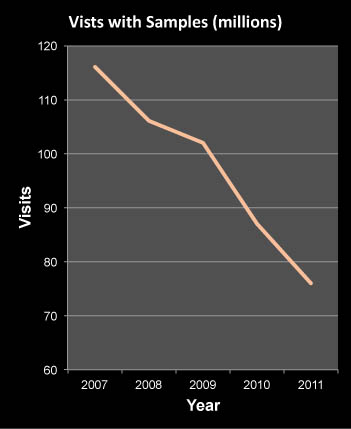
Sales rep visits that included samples have dropped even faster. According to Cegedim Strategic Data (SD), the number of detailer visits that included samples has decreased 35% from 116 million in 2007 to 76 million in 2011 (see " Spending on Drug Samples Continues to Decline").


There are lots of reasons why sales rep visits that include drug samples is declining. For one thing, many physicians are refusing samples because they think they promote more expensive treatments. However, it's more likely due to cutbacks to the sales force. "If we're seeing a decline in samples at this point, today one of the major drivers is the drop in the overall number of sales calls being delivered," Jerry Maynor, director of marketing and business development for CSD's U.S. division. eSampling, where physicians can order samples without the sales rep, is a very minor activity that does not account for the trend (only 5% of doctors want to receive samples by mail only).

What percent of total details include samples? That gets complicated because numbers are all over the place. In 2008, there were 92.93 million details according to data reported here. But CSD says 106 million details in 2008 included samples. Of course, that's a mathematical impossibility. I will have to track down more compatible numbers.

How much do drug companies spend on samples? That's a number in dispute, depending on how you calculate the value of samples (ie, retail value of samples vs. Average Wholesale Price; see here). By CSD's estimate, in 2007, drugmakers spent nearly $8.4 billion on samples. That figure fell to about $6.3 billion in 2011, the most recent data available.