Con Artist Reveals All About Google Drug Ad Sting - How FDA May Have Entrapped Google Using Those 14 "Infamous" Notice of Violation Letters
In an interesting article in today's Wall Street Journal, a convicted con artist details how he was employed by federal agents -- including agents of the FDA's Office of Criminal Investigation -- to lead a sting operation against Google's illegal drug ad operation (see story here). Recall that last summer Google agreed to pay $500 million to settle DOJ charges that it helped illegal online pharmacies target ads through its AdWords platform. It was one of the largest forfeitures ever paid in the U.S. (see "Google Settles with DOJ - Admits Aiding Illegal Online Drug Sales").
"It was very obvious to Google that my website was not a licensed pharmacy," said David Whitaker, the prisoner who acted in the sting. "There was a part of me that felt bad," Mr. Whitaker wrote in his account of the undercover operation viewed by The Wall Street Journal. "I had grown to like these people." But, he said, "I took ease in knowing they.. knew it was wrong."
What is of interest to me is the timeline revealed in the WSJ article. I added a couple of events to this timeline shown below (click on the image to enlarge it for better readability).
Mr. Whitaker made first contact with Google in March 2009. On April 2, 2009, FDA made public those "infamous" 14 notice of violation (NOV) letters that effectively shut down Rx drug search advertising on Google. In October 2009, comScore data was released that documented this "prompt, precipitous, and prolonged" drop in paid search advertising (see the chart here).
At the time of the announcement of the Google settlement, I suggested that because of FDA's involvement in the case, the agency delayed issuing guidance relating to the proper use of Google Adwords for branded Rx advertising. I suggested that the FDA did this to force Google to the bargaining table and to ultimately accept the draconian settlement terms mentioned above. In other words, FDA was holding Google's pharma Adword business "hostage" until a settlement was reached. See my argument here.
Looking at the above timeline, however, I now believe the 14 letters were sent so that Google might be more easily persuaded to run illegal drug ads to make up for the revenue lost from legitimate Rx drug ads. If true, this looks like a form of entrapment.
Keep in mind that the type of ads targeted in those 14 letters had been running for many years and that I, for one, maintained they were illegal starting way back in 2006 (see The "Girl from Google"). At the time, I submitted a written complaint to the FDA. Why did the FDA wait almost 3 years before getting around to stopping these ads? The answer, I believe, is what I surmised above -- it was simply a ploy to incentivize greedy Google ad executives to fall for the sting. According to the WSJ article, Google's ad executives "worked with Mr. Whitaker to find a way around Google rules."
P.S. Google may have tried an "end run" around the entrapment by coming up with a new ad format for Rx drugs that addressed the issue cited in the 14 FDA letters. This format was announced at the November, 2009, public hearings (see "Is Google the New FDA?"). The ad was actually "beta" tested by Bayer, but to date the FDA still has not formally approved the format and not many other drug companies have used it.
Showing posts with label search marketing. Show all posts
Wednesday, January 25, 2012
Wednesday, January 11, 2012
Despite Increase in DTC Ad Spending, WebMD Suffers
2011 is shaping up to be a good year for pharma direct-to-consumer (DTC) advertising -- that is, broadcast advertising, NOT Internet advertising.
According to Nielsen data prepared for DTC Perspectives Magazine, total pharma DTC ad spending -- excluding Internet advertising -- increased 3.2% for the first 3 quarters of 2011 vs. the same period in 2010 ($3.045 billion in Q1-Q3 2011 vs. $2.951 in Q1-Q3 2010).
A chart of the top 25 or so drugs promoted in Q1-Q3 2011 in shown below (click on the chart for an enlarged view).
This is good news for TV, which raked in 64% of the broadcast DTC ad dollars during that period and magazines, which raked in 30%. Newspapers and radio shared the scraps left over.
What about Internet DTC spending?
Recall that in October I reported that a representative of Google said "pharma needs to leverage the Internet" and that "pharma was not considered a key client by Google because of pharma's low spend" (see "Double Dip in DTC Ad Spend!").
Of course, Google is concerned primarily with search advertising, which is often said to represent about 40% of the industry's total online advertising spending. But what about online display ads, which are major sources of income for health portal sites such as WebMD?
The Wall Street Journal reported that WebMD's Chief Executive Wayne T. Gattinella resigned, and the health-website operator "called off a search for a buyer as it braces for weaker financial results this year. A key issue, the company said, is pharmaceutical companies holding back on spending as they deal with expiring drug patents." (see "Dip in Drug Ad Spending Leads to WebMD Woes").
According to Nielsen data prepared for DTC Perspectives Magazine, total pharma DTC ad spending -- excluding Internet advertising -- increased 3.2% for the first 3 quarters of 2011 vs. the same period in 2010 ($3.045 billion in Q1-Q3 2011 vs. $2.951 in Q1-Q3 2010).
A chart of the top 25 or so drugs promoted in Q1-Q3 2011 in shown below (click on the chart for an enlarged view).
This is good news for TV, which raked in 64% of the broadcast DTC ad dollars during that period and magazines, which raked in 30%. Newspapers and radio shared the scraps left over.
What about Internet DTC spending?
Recall that in October I reported that a representative of Google said "pharma needs to leverage the Internet" and that "pharma was not considered a key client by Google because of pharma's low spend" (see "Double Dip in DTC Ad Spend!").
Of course, Google is concerned primarily with search advertising, which is often said to represent about 40% of the industry's total online advertising spending. But what about online display ads, which are major sources of income for health portal sites such as WebMD?
The Wall Street Journal reported that WebMD's Chief Executive Wayne T. Gattinella resigned, and the health-website operator "called off a search for a buyer as it braces for weaker financial results this year. A key issue, the company said, is pharmaceutical companies holding back on spending as they deal with expiring drug patents." (see "Dip in Drug Ad Spending Leads to WebMD Woes").
Tuesday, February 15, 2011
Google's New OneBox Rx "Ads" Steal Clicks from Organic Branded Rx Search Results
At last week's ePharma Summit, John Mangano, comScore's Marketing Solutions Vice President, presented data suggesting that Google's OneBox NIH Rx ads "effectively reduces organic search visitation driven to pharma sites pushing the traffic to NIH content instead" (see chart below).
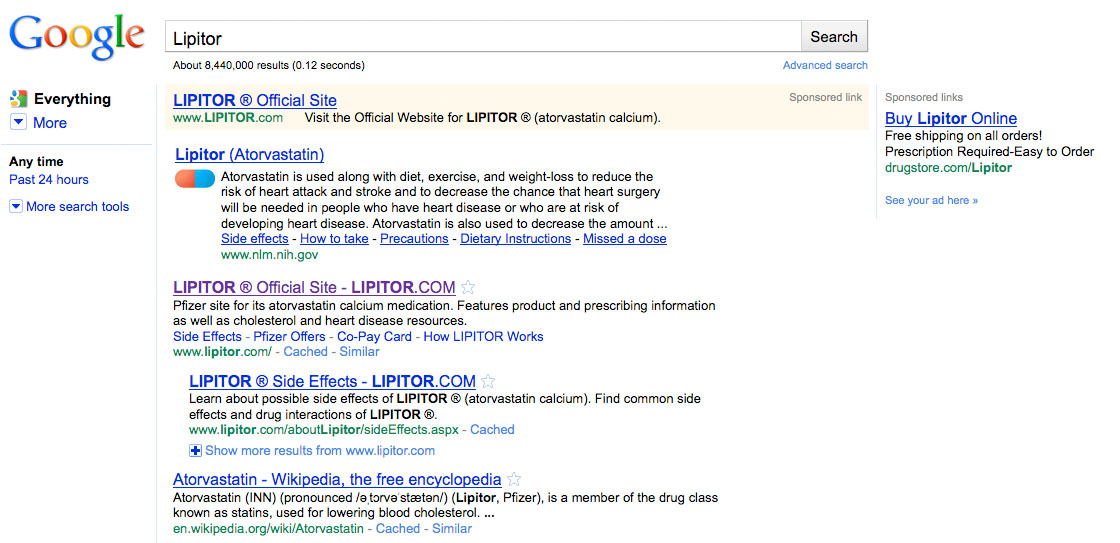
To illustrate the OneBox format, I did a search on Lipitor and the result is shown below (click on image for an enlarged view):
Just below the paid Lipitor ad at the top is the NIH OneBox "ad," which is not really an ad because it is not a paid placement. But I'll just call it an ad because it looks like one and perhaps Google users may think it's an ad.
When the OneBox "ad" format was introduced in June, I asked "Will these NIH ads compete with drug company's paid search drug ads, not to mention natural search results? Or can the two work in concert to increase the clickthrough rate on the paid ads?" (see "Finally, A Google Drug Search Ad Format That Has All FDA Could Want... But Pharma Can't Use It!").
Mangano did not mention any effect that OneBox Rx ads may have on paid search Rx ads. But it is logical to conclude that Google stands to gain paid ad revenue when pharma marketers have to compete with OneBox ads by buying more paid search placements to make up for the loss of organic search visits.
To illustrate the OneBox format, I did a search on Lipitor and the result is shown below (click on image for an enlarged view):
Just below the paid Lipitor ad at the top is the NIH OneBox "ad," which is not really an ad because it is not a paid placement. But I'll just call it an ad because it looks like one and perhaps Google users may think it's an ad.
When the OneBox "ad" format was introduced in June, I asked "Will these NIH ads compete with drug company's paid search drug ads, not to mention natural search results? Or can the two work in concert to increase the clickthrough rate on the paid ads?" (see "Finally, A Google Drug Search Ad Format That Has All FDA Could Want... But Pharma Can't Use It!").
Mangano did not mention any effect that OneBox Rx ads may have on paid search Rx ads. But it is logical to conclude that Google stands to gain paid ad revenue when pharma marketers have to compete with OneBox ads by buying more paid search placements to make up for the loss of organic search visits.
Friday, August 6, 2010
Who's in Charge of Your "Invisible" Metadata? WARNING: Don't Invoke the "Invisibility Rule"
My Twitter pals are all atwitter over FDA's recent letter to Novartis citing violative content in a Facebook "Share Widget" that Novartis created (see "Implications of FDA’s Warning Letter to Novartis Regarding Facebook Share Widget" for the back story).
At the center of the controversy is "metadata." If you are a pharmaceutical marketer asking yourself, "What the hell IS metadata?", then you need to read this because some junior web developer on your team (internal or agency side) may be playing fast and loose with your metadata unbeknown to you and your legal/regulatory people. The Novartis letter is a warning that FDA, however, is looking at metadata.
Metadata is usually "invisible" content inserted within the header of the HTML code that creates a Web page. This includes a "description" of the page or Web site and keywords. Some of this information is used by search engines to find the page and include a description of the page in the natural search result.
When you do a Google search on "Viagra," for example, you will find a "sponsored" link (ie, paid search ad) like this:
You will also find this unpaid natural search result:
BOTH the paid ad and the search result contain content that is written and controlled by Pfizer. The natural search result content that begins with "Learn about..." is exactly the content that Pfizer included in its "description" meta tag within the HTML code for the viagra.com home page. Google just lifted that content. Users cannot control this content, only Pfizer can -- by editing the meta tag.
This was exactly the point that the FDA made in its letter to Novartis regarding the Facebook Share widget. That widget includes meta tag content created and controlled by Novartis. It's not content that users of the Facebook widget can change.
Let's look at Viagra.com's meta tag content. You can easily do this by choosing "Page Source" in the View menu of your browser (eg, Firefox). It may be called something else in other browsers. Here's what you can find in the source within the "description" meta tag:
"Learn about prescription VIAGRA ® (sildenafil citrate), an erectile dysfunction (ED) treatment option that may help your ED."
This content is exactly the same content you see in the natural search result above.
The problem is that this content is in violation of FDA regulations that require fair balance -- ie, presentation of major risk information -- whenever a pharma company controlled communication to consumers includes a product trade name and its indication. The meta tag does NOT include this fair balance.
The lack of fair balance was one of the violations that FDA cited in the Novartis letter that concerned the Facebook widget.
Pharma people have often invoked what I will call the "Invisibility Rule" with regard to metadata. According to the "Invisibility Rule," meta tag content is NOT intended to be visible or read by consumers; its function is to provide information to search engines and improve the visibility of the site in search engines. Consequently, meta tag content should not be regulated by the FDA.
The problem with the "Invisibility Rule" is that metadata is not really invisible to consumers searching the Internet or using social media because both search engines and social media make the metadata visible.
Digitas Health made this recommendation (see previous post):
It is more important than ever that the FDA come out with some guidance relating to this issue, which falls under the heading "Regulatory Solutions to Overcoming Space Limitations in Pharma Social Media Communications" (read more about that here).
Without specific guidance, pharma marketers must rely on "received precedent" and the Novartis letter is such a precedent. It clearly warns pharma advertisers that the FDA is looking at metadata content when that content is controlled by the marketer AND becomes visible to consumers as in Facebook Share widgets. It's only a short step from widget to natural search result as in the Viagra.com example above. BOTH make metadata content visible and render the "Invisibility Rule" defense questionable.
P.S. Back in the day (prior to 2001) when I worked as a consultant helping pharma companies design and build product Web sites, I had a personal experience with a pharma client who attempted to manipulate meta tag content. Specifically, someone on the client side suggested that competitor product trade names be included within the "keyword" tag of their product's web page in order to "hijack" searches on their competitor's trade names. That is, if someone searched for "Brand Y," the search engine would dutifully offer up the client's site as a result. I pointed out that this may be illegal and certainly was unethical. The scheme was never enacted and I soon found myself out of work as a consultant.
I tell this story for two reasons:
(1) It offers some evidence that as far back as 2001 at least some pharma marketers knew how to craft metadata content to their benefit; and
(2) It demonstrates how difficult it is to point out that the Emperor has no clothes when you are paid by the Emperor.
At the center of the controversy is "metadata." If you are a pharmaceutical marketer asking yourself, "What the hell IS metadata?", then you need to read this because some junior web developer on your team (internal or agency side) may be playing fast and loose with your metadata unbeknown to you and your legal/regulatory people. The Novartis letter is a warning that FDA, however, is looking at metadata.
Metadata is usually "invisible" content inserted within the header of the HTML code that creates a Web page. This includes a "description" of the page or Web site and keywords. Some of this information is used by search engines to find the page and include a description of the page in the natural search result.
When you do a Google search on "Viagra," for example, you will find a "sponsored" link (ie, paid search ad) like this:
You will also find this unpaid natural search result:
BOTH the paid ad and the search result contain content that is written and controlled by Pfizer. The natural search result content that begins with "Learn about..." is exactly the content that Pfizer included in its "description" meta tag within the HTML code for the viagra.com home page. Google just lifted that content. Users cannot control this content, only Pfizer can -- by editing the meta tag.
This was exactly the point that the FDA made in its letter to Novartis regarding the Facebook Share widget. That widget includes meta tag content created and controlled by Novartis. It's not content that users of the Facebook widget can change.
Let's look at Viagra.com's meta tag content. You can easily do this by choosing "Page Source" in the View menu of your browser (eg, Firefox). It may be called something else in other browsers. Here's what you can find in the source within the "description" meta tag:
"Learn about prescription VIAGRA ® (sildenafil citrate), an erectile dysfunction (ED) treatment option that may help your ED."
This content is exactly the same content you see in the natural search result above.
The problem is that this content is in violation of FDA regulations that require fair balance -- ie, presentation of major risk information -- whenever a pharma company controlled communication to consumers includes a product trade name and its indication. The meta tag does NOT include this fair balance.
The lack of fair balance was one of the violations that FDA cited in the Novartis letter that concerned the Facebook widget.
Pharma people have often invoked what I will call the "Invisibility Rule" with regard to metadata. According to the "Invisibility Rule," meta tag content is NOT intended to be visible or read by consumers; its function is to provide information to search engines and improve the visibility of the site in search engines. Consequently, meta tag content should not be regulated by the FDA.
The problem with the "Invisibility Rule" is that metadata is not really invisible to consumers searching the Internet or using social media because both search engines and social media make the metadata visible.
Digitas Health made this recommendation (see previous post):
"Because website metadata is used both by search engines in generating organic search listings and by social media channels, such as the Facebook Share functionality, Digitas Health advocates that all site metadata should be included in internal medical/legal/regulatory review and as part of mandatory FDA submissions."While many pharma marketers may claim not to know about metadata and who creates it -- it's "too technical for me" may be the excuse -- the metadata content is carefully crafted by someone on the team as is evident in the Viagra.com example. And that content is directed to the consumer; why else begin with the words "Learn about..." and end with the words "...may help your ED."?
It is more important than ever that the FDA come out with some guidance relating to this issue, which falls under the heading "Regulatory Solutions to Overcoming Space Limitations in Pharma Social Media Communications" (read more about that here).
Without specific guidance, pharma marketers must rely on "received precedent" and the Novartis letter is such a precedent. It clearly warns pharma advertisers that the FDA is looking at metadata content when that content is controlled by the marketer AND becomes visible to consumers as in Facebook Share widgets. It's only a short step from widget to natural search result as in the Viagra.com example above. BOTH make metadata content visible and render the "Invisibility Rule" defense questionable.
P.S. Back in the day (prior to 2001) when I worked as a consultant helping pharma companies design and build product Web sites, I had a personal experience with a pharma client who attempted to manipulate meta tag content. Specifically, someone on the client side suggested that competitor product trade names be included within the "keyword" tag of their product's web page in order to "hijack" searches on their competitor's trade names. That is, if someone searched for "Brand Y," the search engine would dutifully offer up the client's site as a result. I pointed out that this may be illegal and certainly was unethical. The scheme was never enacted and I soon found myself out of work as a consultant.
I tell this story for two reasons:
(1) It offers some evidence that as far back as 2001 at least some pharma marketers knew how to craft metadata content to their benefit; and
(2) It demonstrates how difficult it is to point out that the Emperor has no clothes when you are paid by the Emperor.
Labels:
#fdasm,
FaceBook,
FDA,
metadta,
search marketing,
social media
Wednesday, June 23, 2010
Finally, A Google Drug Search Ad Format That Has All FDA Could Want... But Pharma Can't Use It!
Google just launched a NEW Rx drug ad format that includes everything FDA requires that a drug company include in its direct-to-consumer advertising: fair balance, and direct links to side effects, precautions, dietary information, etc. It even includes a logo that identifies it as a special ad sanctioned by a trusted authority! Unfortunately, the new format is only for the National Institutes of Health (NIH) and NOT available to pharmaceutical advertisers.
Below is the result shown on Google after a search on "Lipitor" (click on image for an enlarged view):
At the very top is the typical AdWord that Pfizer paid for. It's puny and uninformative and does not mention what medical condition Lipitor is approved for. Just below it is the NIH ad, which has all the required and interesting information. It even includes a little colorful pill that draws your attention to the ad and marks it as special. When you click on the NIH ad [actually, it's not technically an ad, but a natural search result that ALWAYS appears at the top of the natural search results; in that sense it's an UNPAID ad]. although not a paid ad] you are taken to a page on the NIH site set up especially for atorvastatin, the active ingredient in Lipitor.
This new drug ad format is the latest initiative of Google Health, which last year launched "Health OneBox" that offered easy-to-read details on illnesses and conditions with a single search.
Will these NIH ads compete with drug company's paid search drug ads, not to mention natural search results? Or can the two work in concert to increase the clickthrough rate on the paid ads?
Either way, Google stands to increase revenue from pharma paid ads. The NIH ads are just another instance of pharma losing share of voice on search engines. They must counteract that with even more advertising. Hopefully, Google's new ad format specifically designed for pharma (see here) will win FDA approval. That format can compete more effectively with the NIH ads. Not that there's anything wrong with the NIH ads!
Below is the result shown on Google after a search on "Lipitor" (click on image for an enlarged view):
At the very top is the typical AdWord that Pfizer paid for. It's puny and uninformative and does not mention what medical condition Lipitor is approved for. Just below it is the NIH ad, which has all the required and interesting information. It even includes a little colorful pill that draws your attention to the ad and marks it as special. When you click on the NIH ad [actually, it's not technically an ad, but a natural search result that ALWAYS appears at the top of the natural search results; in that sense it's an UNPAID ad]. although not a paid ad] you are taken to a page on the NIH site set up especially for atorvastatin, the active ingredient in Lipitor.
This new drug ad format is the latest initiative of Google Health, which last year launched "Health OneBox" that offered easy-to-read details on illnesses and conditions with a single search.
Will these NIH ads compete with drug company's paid search drug ads, not to mention natural search results? Or can the two work in concert to increase the clickthrough rate on the paid ads?
Either way, Google stands to increase revenue from pharma paid ads. The NIH ads are just another instance of pharma losing share of voice on search engines. They must counteract that with even more advertising. Hopefully, Google's new ad format specifically designed for pharma (see here) will win FDA approval. That format can compete more effectively with the NIH ads. Not that there's anything wrong with the NIH ads!
Thursday, May 13, 2010
Should Google Allow Pharma an Exception to Its Ban on Redirect URLs? (UPDATED)
Back in April 2009, I suggested that FDA might go after pharma marketers for using paid search redirects in Google Adwords (see "The Next FDA Concern May be the Use of 'Redirect' URLs"). Such ads use visible URLs such as "flaccidmember.com" but, when clicked, lead to viagra.com or cialis.com. Such an is considered to be "unbranded" and beyond FDA regulation. That is, it can say "Stay harder longer with this treatment for erectile dysfuntion" and lead directly to the branded website.
The problem with that strategy is that Google's Adword policy forbids the use of redirect URLs -- for most advertisers. It appears that Google was making an exception for the pharmaceutical industry (see "Redirect URLs in Adwords: Who Knew What When?").
Last week I thought Google may have rescinded this exception. Tyler Ransburgh of What's Your Digital IQ Blog wrote about his problem using a redirect URL in a pharma ad. "I work in pharma," said Tyler, "I have an exception to the rule. Right? Well, I reached out to Google to get an answer on why I am getting caught in this web" (see "Google blocks Pharma paid search redirects")
When Tyler did reach out to Google, here's the reply he got:
Since then we've gotten some feedback indicating that Google has NOT changed its policy regarding pharma's use of URL redirects in Adwords. See this Pharma and SEM Marketing Blog post by SEM Dave Anderson who indirectly received this comment from Google: "Our policy has not changed: pharmaceutical manufacturers continue to have an exception to allow a URL redirect, which is not currently recognized by our automated system." Which seems to directly contradict the comment received by Tyler Ransburgh from a Google Adword support team person who advised Tyler to "be assured that you have reached the appropriate AdWords support team for your AdWords related concern and I’ll be unable to escalate your issue further." Tyler, you see, had asked to speak to this person's supervisor and was rebuffed!
I also received an email from Aaron Stein, someone who claims to be part of Google's PR department. I present the full email message:
The question, however, is Should Pharma Advertisers Use Redirect URLs in Search Engine Ads? I ask you help to answer this question in a NEW survey, which asks your opinion of this practice. It asks specifically to indicate your level of agreement/disagreement with the following statements about Pharma's use of paid search engine ads:
Your comments are confidential (anonymous) unless you specifically provide your contact information at the end of the survey and allow us to attribute comments to you personally.

Take the survey Now!
The problem with that strategy is that Google's Adword policy forbids the use of redirect URLs -- for most advertisers. It appears that Google was making an exception for the pharmaceutical industry (see "Redirect URLs in Adwords: Who Knew What When?").
Last week I thought Google may have rescinded this exception. Tyler Ransburgh of What's Your Digital IQ Blog wrote about his problem using a redirect URL in a pharma ad. "I work in pharma," said Tyler, "I have an exception to the rule. Right? Well, I reached out to Google to get an answer on why I am getting caught in this web" (see "Google blocks Pharma paid search redirects")
When Tyler did reach out to Google, here's the reply he got:
"In response to advertiser and user feedback, and in an effort to provide relevant results and a high quality experience for our users, we have made the decision to no longer allow certain exceptions to our display URL policy. Please note that this amendment to our policy applies to all advertisers, regardless of previous exceptions for, or acceptance of, any campaigns. To provide a quality experience for our users and partners, the display URL policy will be strictly enforced."I'd like to think that my blog posts were part of the "feedback" that Google considered.
Since then we've gotten some feedback indicating that Google has NOT changed its policy regarding pharma's use of URL redirects in Adwords. See this Pharma and SEM Marketing Blog post by SEM Dave Anderson who indirectly received this comment from Google: "Our policy has not changed: pharmaceutical manufacturers continue to have an exception to allow a URL redirect, which is not currently recognized by our automated system." Which seems to directly contradict the comment received by Tyler Ransburgh from a Google Adword support team person who advised Tyler to "be assured that you have reached the appropriate AdWords support team for your AdWords related concern and I’ll be unable to escalate your issue further." Tyler, you see, had asked to speak to this person's supervisor and was rebuffed!
I also received an email from Aaron Stein, someone who claims to be part of Google's PR department. I present the full email message:
Hi John,
This is Aaron Stein from Google PR. I noticed your post this morning and wanted to reach out to you because it is not accurate. If you do a search for cholesterol you'll see that our policy has not changed. I've attached a screenshot to show this as well.
If you wouldn't mind, can you add a correction to your post with the statement below? Happy to chat further about this.
"Our policy has not changed: pharmaceutical manufacturers continue to have an exception to allow a URL redirect, which is not currently recognized by our automated system. All pharmaceutical manufacturers' search ads campaigns continue to run, unchanged, today."
Thanks John, I'll be in touch.
Aaron Stein
Google | Global Communications & Public Affairs
The question, however, is Should Pharma Advertisers Use Redirect URLs in Search Engine Ads? I ask you help to answer this question in a NEW survey, which asks your opinion of this practice. It asks specifically to indicate your level of agreement/disagreement with the following statements about Pharma's use of paid search engine ads:
- Regardless of search engine rules that may allow pharma advertisers to use redirect URLs ("vanity URLs"), pharma should ONLY use display URLs in ads that ACCURATELY reflect the landing page URLs of the websites being advertised (ie, pharma should obey the rules established for all other advertisers).
- Pharma advertisers should be allowed an exception to search engine rules regarding redirect URLs because FDA regulations prevent them from displaying a drug brand name in short ads, even when the brand name is only part of the display URL.
- Redirect URLs should NEVER be used by pharma advertisers because they mislead the consumer into believing that the links will take them to independent disease information websites, not branded drug sites.
Your comments are confidential (anonymous) unless you specifically provide your contact information at the end of the survey and allow us to attribute comments to you personally.
Take the survey Now!
Subscribe to:
Posts (Atom)