Showing posts with label AstraZeneca. Show all posts

Wednesday, August 8, 2012

Is Type 2 Diabetes Drug Marketing Responsible for Misdiagnosis of Type 1 Diabetics?

A Wall Street Journal article documents several cases of people being misdiagnosed by general practitioners as having Type 2 diabetes when they actually have Type 1 diabetes, "a substantially different condition" (see "Wrong Call: The Trouble Diagnosing Diabetes"). According to the article:

"An incorrect diagnosis usually occurs in the offices of primary-care doctors, many of whom haven't received adequate education in medical school about rising rates of Type 1 in adults and how to diagnose it. 'It is not on their radar because they see so much diabetes and it is by far mostly Type 2,' said Irl B. Hirsch, professor of medicine at the University of Washington Medical Center in Seattle."

As I continued reading, I couldn't help but wonder if the current competition among drug companies to sell Type 2 diabetes drugs has something to do with this. Fierce marketing of these drugs - see box below - may be contributing to emphasizing Type 2 diabetes on GP's "radar screens."

The Three Type 2 Diabetes Drug "Amigos"
  1. Januvia - marketed by Merck
  2. Onglyza - marketed by Bristol-Myers Squibb/Astrazeneca
  3. Victoza - marketed by Novo Nordisk
See "Three Companies Compete for Diabetes Market Share"

In each case cited in the article, misdiagnosed patients were taking oral drugs, none of which were mentioned by name, and none of which are effective or approved by the FDA for treating Type 1 diabetes. "For six years, Mr. Jones [a patient] treated what had been diagnosed as Type 2 diabetes. He changed his diet and took three oral medications daily." It's likely that at least one of those drugs was one of the "Three Type 2 Diabetes Drug 'Amigos'" mentioned above.

Of course, many GPs would probably misdiagnose patients as having Type 2 diabetes when they actually have Type 1 diabetes even without being bombarded with marketing for Type 2 treatments. But having multiple pills available to prescribe makes it easier, in my opinion, to avoid taking the patient down the path to a possible Type 1 diagnosis.

The ultimate responsibility for misdiagnosis, however, must rest with the physician and not the pharmaceutical marketer, unless of course, the marketer offers physicians inducements (ie, money or non-monetary rewards) for prescribing products.

On that note, I also read a story in today's WSJ about Pfizer and other drug companies bribing doctors to prescribe their drugs. Pfizer settled with the DOJ -- admitting nothing -- but paid $60.2 Million to "Resolve U.S. Allegations That It Used Illegal Payoffs to Win Business Overseas."

Of course, such things do NOT happen here in the U.S.

Monday, July 23, 2012

Meet “Ceyockey,” an Astrazeneca Pharma Wikipedian

The most visible and most accessed example of crowd-sourced “creative commons” information is Wikipedia where “wikipedians” – i.e., people who write and edit the pages for Wikipedia – create drug information pages such as the one about rosuvastatin (“marketed by AstraZeneca as Crestor”).

“Nearly 75% of US physicians going online for professional purposes are visiting Wikipedia for medical information according to Manhattan Research,” says Eileen O'Brien, Director, Search & Innovation at Siren Interactive. “And 36% of US consumers searched for health info on Wikipedia according to Rodale's DTC Study. This is because Wikipedia dominates the search results for health. As Wikipedia plays such a key role, I think it's essential that pharma help to provide accurate information.” O'Brien made her comment in response to the this survey: Should Pharma Edit Wikipedia Articles? You can take the survey here -- afterward you will be able to see a summary of the results to date.

There may in fact be several “wikipedians” responsible for a single page of drug information on Wikipedia. The rosuvastatin page, for example, was edited by over 175 people as of 21 July 2012. The top three “editors” were:
  1. “Ceyockey” (who made 35 edits),
  2. “Jfdwolff” (who made 29 edits), and
  3. “MALvis” (who made 23 edits).
The person who is number 4 on the list with 15 edits is "anon."

Who are these “wikipedians” and what credentials do they have as credible sources of drug information? We may never know who "anon" is, but we have some information about identified contributors.

“Jfdwolff” is a a "Dutch doctor living and working in the United Kingdom." “MALvis” is a US physician, "specializing in preventive, non-invasive and invasive cardiology and internal medicine in San Antonio." Both seem to be well-qualified to write about rosuvastatin, but their Wikipedia profiles tell us nothing about possible conflicts of interest (COI).

“Ceyockey,”  however, does have a COI. He is Courtland Yockey, an “informatics scientist” who lives in Delaware and works for a “top-10 multi-national pharmaceutical company,” according to his profile on Wikipedia.

Yockey has nothing to hide. You can find his Wikipedia profile here,  his LinkedIn page here, his Twitter account  here, and his Facebook page here.

According to his LinkedIn page, the pharmaceutical company that Yockey works for is Astrazeneca, which markets rosuvastatin as CRESTOR.

“I believe that my editing of Wikipedia is generally beneficial,” says Yockey in his Wikipedia profile, “and I have no regrets or concerns about anything that I have or will create or revise here, which is why I am willing to provide my real name.”

Whether or not it is “beneficial” for individual pharma company employees such as Yockey to be editing Wikipedia information about their own company’s products is difficult to know for certain. Transparency, however, is crucial for judging credibility of drug information on Wikipedia. Yockey addressed transparency head on in a straight-forward fashion, although he failed to state unambiguously  in his Wikipedia profile that he works for “Astrazeneca.”

Did Astrazeneca empower Yockey or give him permission to edit Wikipedia pages about AZ drugs? That is, is Yockey an "official" Wikipedia spokesperson appointed by Astrazeneca to perform all Wikipedia article edits on behalf of the company? I doubt it. Yockey's profile specifies that he works on edits from home.

Official pharma employee Wikipedia editors and related issues were discussed during a recent Pharma Marketing Talk podcast titled “Pharma Wikipedians: The Pros and Cons of Pharma Employees Editing Wikipedia Articles” (listen here).

It's possible to determine the exact edits Yockey has made to the Wikipedia rosuvastatin page, but I do not have the time or resources to find that needle in a haystack of thousands of edits Yockey has made to Wikipedia articles over the years. Wikipedia is not user-friendly enough to allow ordinary citizens to ferret out that kind of information, IMHO. For all I know, Yockey could have written or edited the section titled "Debate and criticisms."

Another problem with Wikipedia drug information pages is that they are not consumer-friendly -- i.e., not written at a level that is understandable by non-physicians. The Wikipedia rosuvastatin page, for example, says "as with all statins, there is a concern of rhabdomyolysis, a severe undesired side effect." Unfortunately, the article does not explain what rhabdomyolysis is in layperson terms.

Tuesday, July 3, 2012

The DOJ v Pharma Settlement Planetary System

The Department of Justice (DOJ) just released a commemorative poster highlighting the six most-recent multi-million dollar settlements that drug companies have agreed to pay for inappropriately, and in some cases illegally, promoting prescription drugs. The poster represents just the latest version of the "DOJ v Pharma Settlement Planetary System," which still has room for additional members (see unidentified objects in the poster).


Here's a description of the planets and how they were "discovered" as reported by ProPublica (here):
  • The smallest "planet" in DOJ's System is AstraZeneca, which was fined $520 million to resolve allegations that it illegally promoted the anti-psychotic drug Seroquel. The drug was approved for treating schizophrenia and later for bipolar mania, but the government alleged that AstraZeneca promoted Seroquel for a variety of unapproved uses, such as aggression, sleeplessness, anxiety, and depression. AstraZeneca denied the charges but agreed to pay the fine to end the investigation. NOTE: The size of the AZ settlement "planet" is so small in comparison to the others in the System that many experts do not consider it a true "planet" at all. (The AZ planet was "discovered" in April 2010).
  • Next is Merck, which agreed to pay a fine of $950 million related to the illegal promotion of the painkiller Vioxx, which was withdrawn from the market in 2004 after studies found the drug increased the risk of heart attacks. The company pled guilty to having promoted Vioxx as a treatment for rheumatoid arthritis before it had been approved for that use. The settlement also resolved allegations that Merck made false or misleading statements about the drug's heart safety to increase sales. (The Merck planet was "discovered" in November 2011).
  • The fourth largest planet is the DOJ System is Eli Lilly, which was fined $1.42 billion to resolve a government investigation into the off-label promotion of the anti-psychotic Zyprexa. Zyprexa had been approved for the treatment of certain psychotic disorders, but Lilly admitted to promoting the drug in elderly populations to treat dementia. The government also alleged that Lilly targeted primary care physicians to promote Zyprexa for unapproved uses and “trained its sales force to disregard the law.” (The Lilly planet was "discovered" in January 2009).
  • Next largest in size is Abbott, which was fined $1.5 billion in connection to the illegal promotion of the anti-psychotic drug Depakote. Abbott admitted to having trained a special sales force to target nursing homes, marketing the drug for the control of aggression and agitation in elderly dementia patients. Depakote had never been approved for that purpose, and Abbott lacked evidence that the drug was safe or effective for those uses. The company also admitted to marketing Depakote to treat schizophrenia, even though no study had found it effective for that purpose. (The Abbott planet was "discovered" in May 2012).
  • Pfizer, which up until recently was the largest planet in the DOJ System, was fined $2.3 billion in September 2009, then the largest health care fraud settlement and the largest criminal fine ever imposed in the United States. Pfizer pled guilty to misbranding the painkiller Bextra with "the intent to defraud or mislead", promoting the drug to treat acute pain at dosages the FDA had previously deemed dangerously high. Bextra was pulled from the market in 2005 due to safety concerns. The government alleged that Pfizer also promoted three other drugs illegally: the anti-psychotic Geodon, an antibiotic Zyvox, and the anti-epileptic drug Lyrica.
  • GlaxoSmithKline is currently the largest planet in the DOJ v Pharma Settlement Planetary System. GSK agreed to pay a fine of $3 billion to resolve civil and criminal liabilities regarding its promotion of drugs, as well as its failure to report safety data (see "GSK Guilty of Off-Label Marketing from 1999 to 2010: Will Pay $3 Billion Settlement"). This is the largest health care fraud settlement in the United States to date. The company pled guilty to misbranding the drug Paxil for treating depression in patients under 18, even though the drug had never been approved for that age group. GlaxoSmithKline also pled guilty to failing to disclose safety information about the diabetes drug Avandia to the FDA. (The GSK planet was "discovered" in July 2012).

Tuesday, May 29, 2012

AZ Posts "Reminder Drug Ad" to Its Corporate Blog

Last week I reported that AstraZeneca (AZ) posted an ad for CRESTOR on its "AZ Health Connections" corporate blog (see "AstraZeneca's Timely CRESTOR Branded Blog Post: Did It Violate Its Own Policy?"). The post included the indication for CRESTOR and also the "Important Safety Information" (ISI) that is required by the FDA whenever a drug company talks about a brand and its approved indication.

I wrote about that only because it was the first time -- to my knowledge -- that a pharma corporate blog promoted a branded product and I wondered if such posts violated AZ's own posting policies (turns out that it may or may not depending upon what you mean by "may" -- see the post for details).

Today, I noticed an AZ Health Connections blog post that talked about another AZ drug - ARIMIDEX, which is approved for "adjuvant treatment (treatment following surgery with or without radiation) of postmenopausal women with hormone receptor-positive early breast cancer."


This time, however, the post (find it here; see screen capture above) did NOT mention the approved indication. It is, by FDA definition, a "reminder ad." According to the Pharma Marketing Network Glossary:
Reminder advertisements are identified as an exemption to the advertisement regulations, including provisions to provide a brief summary. Reminder advertisements " . . . call attention to the name of the drug product but do not include indications or dosage recommendations for use of the drug product. . . . and, optionally, information . . . containing no representation or suggestion relating to the advertised drug product." Reminder advertisements cannot make a representation about the product or suggest a use for the product.
The AZ Health Connections post does "call attention to the name of the drug," but it also directs readers to ARIMIDEX Direct, which is a program that "allows eligible patients to receive ARIMIDEX delivered to their homes for $40 a month, including shipping and handling." Sounds like a good deal, although I did not investigate what the eligibility requirements were.

AZ deserves credit for reaching out to the online community to learn more about how it can make its drugs more accessible. Recall that AZ was the first pharma company to host a Twitter chat "to raise awareness about helping patients save money through prescription savings programs" (see "OMG! AstraZeneca Hosts Twitter Chat & World Does NOT End!").

PhRMA "forbids" Reminder Ads, But Not on Internet!
AZ's post raises some interesting questions regarding the promotion of Rx drugs on the Internet that neither the FDA nor the pharma industry has addressed. For example, PhRMA's "Guiding Principles for Direct-to-Consumer Advertising" (here) prohibit reminder ads on TV but NOT on the Internet:
Principle #10: "DTC television advertising that identifies a product by name should clearly state the health conditions for which the medicine is approved and the major risks associated with the medicine being advertised." [Alos see "Reminder Ads - Pharma's Dodo?"]
AZ, I believe, is a signatory to these voluntary guidelines. Since these guidelines only apply to TV advertising, AZ is not in violation. It's still the "wild west" on the Internet with regard to reminder ads; i.e., It's perfectly fine to run "reminder ads" on the Internet. This is usually the case when pharma companies buy Adwords (paid search ads) from Google, especially after the FDA came down on Adwords that included the indication with the brand name.

Another interesting issue is how pharma companies can manipulate "natural" (aka "organic") Google search results to display what is essentially a branded product ad that includes the brand name and indication, but no ISI.

Search Google for "arimidex" as I just did and you will find this:


The #4 (or #3, depending on how you count) search result leads you to the home page of the www.arimidex.com Web site. Note that the search result looks like an ad with copy that mentions the indication of the drug: "Learn about IN YOUR CORNER, an online breast cancer support resource for women with early breast cancer and the people who care about them."

How did that copy get there? Simple, AZ included the following "meta tags" in the "header" of the HTML code that generates the home page:


Google mindlessly reads the META NAME tag to display the description of the site in the search result. The information contained in that tag, of course, was written by AZ with the full realization that a Google search will include it in the search result. From there, it is only necessary to ensure that the site gets good placement in the natural results list and BINGO! You've got a branded "ad" that mentions the drug name and the indication WITHOUT the required ISI.

P.S. The Arimidex search result shown above may actually be what's called "paid inclusion," which refers to a sponsored "organic" search result (see, for example, "Paid Inclusion: Too Hot for Pharma Marketing?").

Sunday, May 13, 2012

AstraZeneca's Timely CRESTOR Branded Blog Post: Did It Violate Its Own Policy?

It's unusual for a pharmaceutical company to mention a product by brand name on its corporate blog. It's even more unusual to mention BOTH the product AND its indication -- because that would be promotion regulated by the FDA. But AstraZeneca (AZ) has done just that on its "AZ Health Connections" corporate blog.

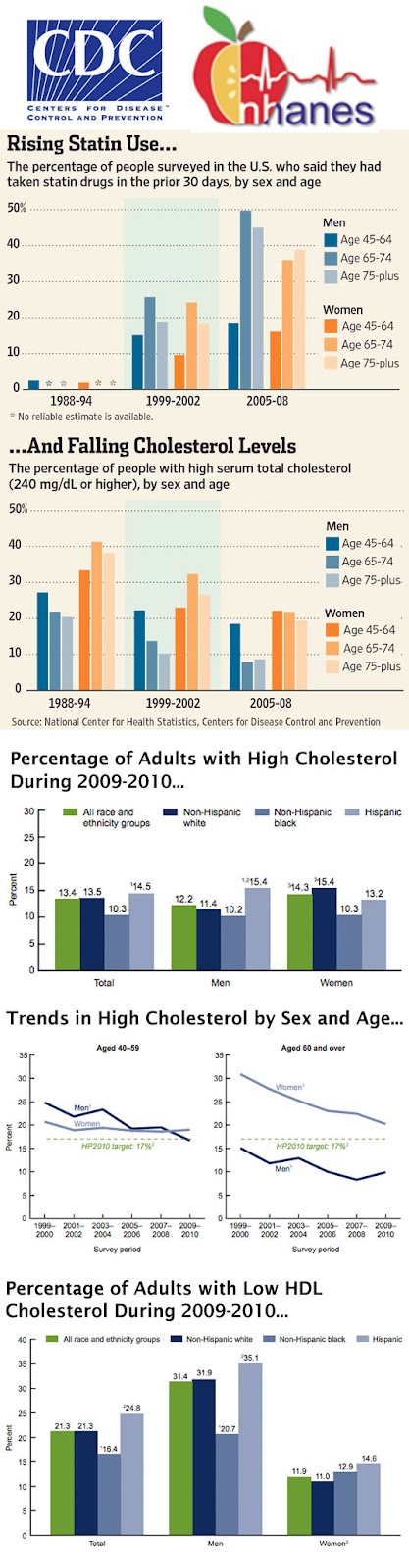
The majority of the post "New CDC data shows drop in number of adults with high cholesterol" submitted by Tom Hushen, AZ's External Communications Manager, talks about CRESTOR, AZ's anti-cholesterol drug. The post may have been ghostwritten for "Dr Philip de Vane, Executive Director of Clinical Development at AstraZeneca," whose name appears at the bottom.

After briefly citing the results of the CDC (Centers for Disease Control) study (see below) in the first paragraph, Hushen dedicates the most of the remaining 309 words of the 377-word post to CRESTOR as in:
"AstraZeneca applauds this progress and we are proud that when diet and exercise alone aren’t enough, prescription medications like CRESTOR® (rosuvastatin calcium) are able to help patients reach their cholesterol goals. In adults, CRESTOR is prescribed along with diet to lower high cholesterol and to slow the buildup of plaque in arteries."
Included in the post is the "fair balance" information required by law:
"CRESTOR is not right for everyone─like people with liver disease or women who are nursing, pregnant or may become pregnant. Tell your doctor about other medicines you are taking. Call your doctor right away if you have muscle pain or weakness; feel unusually tired; have loss of appetite, upper belly pain, dark urine, or yellowing of skin or eyes─these could be signs of rare but serious side effects. See www.CRESTOR.com"
Although this is not earth-shaking or in violation of any law that I know of, it nevertheless is the FIRST time a pharmaceutical company has promoted a prescription drug on its official corporate blog -- ie, talked about the drug's benefits.

It's even more interesting considering the AZ Health Connections "Comment Policy" seems to preclude any comments about specific products:
"We want to make sure AZ Health Connections provides a good experience for all visitors. Therefore, we want to keep the content focused on the specific topics being addressed. Comments that don’t directly relate to AstraZeneca or the topics currently being discussed, or comments or questions about specific products (whether or not AstraZeneca products) or ongoing legal or regulatory matters may not be published or may be removed."
Could it be that what's good for the "goose" (AZ) is not good for the "gander" (everyone else)? It seems that AZ has relaxed its comments policy, at least this one time. As proof of this, I submitted the following comment, which AZ published:
"I am one of those U.S. adults with high cholesterol that is having problems controlling it with just diet and exercise, which I don’t even try to do :-). But I am worried about taking powerful medicines such as CRESTOR because of the side effects that you mention."
AZ published that comment made by this "gander." It is the only comment published so far, so I have no idea if other people have submitted comments that were NOT published. Maybe Tony Jewell, Senior Director of External Communications at AstraZeneca US, will tell us. NOTE: Jewell received the coveted "Pharmaguy Social Media Pioneer Award" in 2011 (see here).
Note: In a personal email, Jewell said: "This post was reviewed, as are all others that mention medicines or disease states. There have been many on the blog, Twitter and Facebook." Upon searching the AZ blog site for other posts that mention CRESTOR, I could not find any post that mentioned the product name AND the disease state (high cholesterol) it is approved to treat. There were, however, a couple of posts that mentioned CRESTOR without its indication. 
Why did AZ do this at this time? It seems to be very opportunistic considering that it coincides with the release of CDC data that shows improvement to cholesterol levels for many Americans. Also, Pfizer just announced it is no longer promoting Lipitor (see "Pfizer Throws In the Lipitor Marketing Towel" and "Lipitor R.I.P. Infographic").

Obviously, now is a good time for AZ to ramp up the promotion of CRESTOR, as it is positioned to take over the number one (or virtually ONLY) statin TOP sales spot (see chart below):


It's also obvious that AZ wants to take some credit for the results reported by the CDC, which are summarized in the following "infographic" (creating infographics is a new obsession of mine):


Some interesting conclusions can be made from the data in this CDC report, which you can find here.

For one thing, women are not doing as well as men in terms of lowering their total cholesterol. This is especially true for women aged 60 and over. Women in that age group have consistently higher percentages of high total cholesterol than men.

The percentage of adults with low HDL cholesterol was higher for men (31.4%) than for women (11.9%).

Although the CDC does study the use of statin drugs by adults and breaks this down by sex and age (see top chart in the infographic), the CDC's analysis that is highlighted in AZ's blog post is based "only on measured cholesterol and does not take into account whether medications are taken."

That's too bad. It would have been interesting to see the correlation between statin use and lowered measured cholesterol.

More important than managing cholesterol levels, however, is whether or not statins actually improve health outcomes such as heart disease. There are results from clinical trials that indicate such a benefit, but how does that correlate with results in the real world?

Just curious.

Monday, February 20, 2012

How the Placebo Effect & Marketing Can Improve Health & Increase Pharma Profits

Big pharmaceutical companies are drastically cutting back on research and development. The economics just do not support the model that has been the driving force of the drug industry over the past 15 years.

According to a Forbes analysis reported by Matthew Herper, "The average drug developed by a major pharmaceutical company costs at least $4 billion, and it can be as much as $11 billion" (see "The Truly Staggering Cost Of Inventing New Drugs").

Some pundits suggest that lowering the cost of performing clinical trials will help get more drugs to market faster. Andrew von Eschenbach, former FDA Commissioner and now employed as chairman of conservative think tank Manhattan Institute's Project FDA initiative, suggested that instead of the FDA asking pharma companies to complete "laborious clinical trials proving efficacy, after proof of concept and safety testing, the product could be approved for marketing with every eligible patient entered in a registry so the company and the FDA can establish efficacy through post-market studies" (see here).

However, Herper points out that the "main expense is failure. AstraZeneca (AZ) does badly by this measure because it has had so few new drugs hit the market." AZ spent about $59 billion on R&D between 1997 and 2011, but only managed to get 5 new drugs approved. According to simple arithmetic, that means each of these 5 drugs cost about $11.8 billion to develop.

That's an interesting number. A very similar number came up during last night's 60 Minutes segment on "Treating Depression: Is there a placebo effect?" (see it here). It turns out that antidepressants sales in the U.S. bring in $11.3 billion a year to pharmaceutical companies that sell them -- including AstraZeneca!

Could it be that the drug industry is merely "breaking even" in the anti-depressant market?

I suspect they are probably making a pretty good profit -- but that profit may be diminishing as more and more anti-depressants go off patent. In fact, it has been suggested that 60 Minutes dared to air this expose -- four years after the research was first published -- because the "news" can no longer harm the drug companies that CBS depends upon for advertising -- most of the drugs mentioned are off patent (see “You’re telling me this now?” Why the news is suddenly critical of statins and antidepressants).

I did a blog post about antidepressants and the placebo effect two years ago in January 2010 (read "A Common Goal of Research and Marketing: Fool the Doctor"). In that post, it was noted that clinical evidence suggests these drugs are not any more effective than a placebo in patients with less severe depression. But drug company marketing to physicians does not mention this. Thus, physicians are led to believe that the drugs ARE effective for all patients with depression.

As pointed out in the 60 Minutes piece, "a clinician who cares, who takes the time, who listens to you, who asks questions about your condition and pays attention to what you say, that's the kind of care that can help facilitate a placebo effect." That goes double if the clinician actually believes what he or she is prescribing is a drug with proven efficacy.

Consequently, marketing to physicians along with direct marketing to consumers can play a huge role in "facilitating" a placebo effect. Which leads me to this idea: pharmaceutical companies should be in the business of developing placebos rather than dangerous, ineffective chemical compounds. There would be no need for expensive clinical trials and it would be easy for FDA to adopt von Eschenbach's idea to approve these new "drugs" before they are proven effective. It will be up to marketing to make them effective by facilitating the placebo effect!

Of course, to be successful, this new approach to drug development must be done surreptitiously and the FDA must conspire with the drug industry (not too much of a stretch there). After all, if everyone knows that the drug industry is manufacturing placebos, the game is up -- doctors will know that they are prescribing placebos and so would patients. That knowledge will render the placebo ineffective. This is a case where a knowledgeable patient is at a disadvantage.

It should be noted, however, that many physicians in some countries knowingly prescribe placebos. Results of a survey published in the British Medical Journal (BMJ) indicate that "about half of the surveyed internists and rheumatologists reported prescribing placebo treatments on a regular basis. Furthermore," say the researchers, "physicians who use placebo treatments most commonly describe them to patients as a potentially beneficial medicine or treatment not typically used for their condition; only rarely do they explicitly describe them as placebos" (read this).

Wednesday, December 14, 2011

Crestor Grapples to Compete with Lipitor: #Fail!

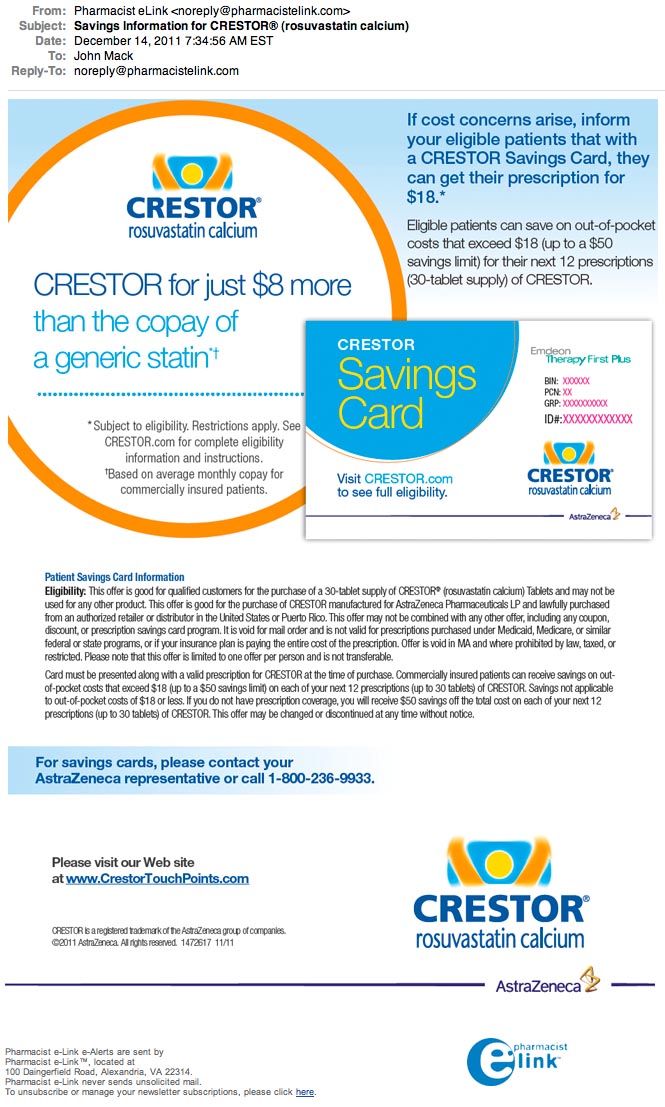
I just got this email from AstraZeneca via Pharmacist eLink, which is a National Community Pharmacists Association site sponsored by the pharmaceutical industry (click on image for an enlarged view):


As readers of this blog know, my doctor once recommended I switch to Crestor from my generic pravastatin, which costs me about $7 per month via mail order (it would cost me $4 if I weren't so lazy and got it at Wall Mart). After my doctor received "speaking fees" and food from Pfizer, she recommended I switch to Lipitor because it was going off patent.

My personal experience is just one example of how Pfizer's "Save Lipitor" strategy is upsetting the statin apple cart these days.

Back to the Crestor email ad I received. First of all, this email is supposedly aimed at pharmacists who signed up to be members of the Pharmacist eLink Web site. Of course, I was able to sign up without proving that I was a pharmacist. I suggest that savvy healthcare consumers would do the same. Consequently, this ad may reach many consumers.

But AstraZeneca is trying to offer pharmacists an alternative to Pfizer's deal with PBMs that encourages pharmacists to provide "generic Lipitor" when fulfilling prescriptions for generic statins such as pravastatin. To grease the wheels of that deal, Pfizer is offering consumers a rebate that in many cases would drive the copay down to $4 per month.

But the Crestor offer doesn't sound too competitive to me: It offers a "Savings" card that promises consumers can get "CRESTOR for just $8 more than the copay of a generic statin." That is, the maximum copay would be $18 ($8 more than the average $10 copay for generics).

What consumer would be impressed by offers that cost more than what they are already used to paying? And $18 is considerably more than the $4 they would pay for generic Lipitor.

One mitigating factor, however, is that the Crestor "Savings" card will cover a 12-month supply, whereas Pfizer's savings plan expires in 6 months.


After I posted this, I received the following clarification from a Media Relations person at Pfizer: "I read your post today, and I think you may be confusing the Lipitor For You co-pay card with our brand loyalty programs with PBMs and health plans during the 180 exclusivity period that make the branded Lipitor available to patients at a total cost that is lower than the generic alternative. The only inaccuracy was saying the co-pay card was good for 6 months. It is actually good until the end of next year. It did appear you were blurring the lines between the two programs."

IMHO, the Crestor offer seems likely to fail and will have absolutely no impact on keeping Crestor competitive.

BTW, Pharmacist eLink has a lousy privacy policy and a bogus opt-out mechanism. When I click on the link to unsubscribe, what I get is merely a form to "Update your account settings" (see below), which does NOT have any "unsubscribe" option.


Meanwhile, the Pharmacist eLink privacy policy regarding opting out merely states "You may request not to be contacted by Pharmacist e-Link in connection with any new services, updates, or promotions. Requests not to be contacted by e-Link should be sent to info@pharmacistelink.com."

This is not a very user-friendly opt-out process. I will contact "info@pharmacistelink.com" and notify them of my displeasure -- as if I didn't have more important things to do!

Wednesday, October 19, 2011

AZ's Tony Jewell Receives 2nd Annual Pharmaguy Social Media Pioneer Award

Yesterday, I figuratively gave the Hawaiian shirt off my back to Tony Jewell (@tonyjewell), Senior Director of External Communications at AstraZeneca US, for his pioneering use of Twitter. I picked Tony specifically because AZ was the first pharmaceutical company to host a Twitter chat (#rxsave; see "OMG! AstraZeneca Hosts Twitter Chat & World Does NOT End!").

This memorable event was captured on video by the Pixels & Pills/Zomega people at the Digital Pharma East conference in Philadelphia:


Pharma Guy Gives Tony Jewell the Shirt Off His Back from Zemoga on Vimeo.

There were several other contenders worthy of this honor, including
  • Brad Pendergraph, Novartis
  • Dennis Urbaniak, Sanofi
  • Kevin Nalty, Janssen
  • Ray Kerins, Pfizer
  • John Pugh, Boehringer Ingelheim
  • Craig DeLarge, Novo Nordisk
Over 100 readers of this blog voted for their candidate in an unofficial poll (see "2nd Annual Pharmaguy Social Media Pioneer Award Goes to..."). Although Tony did not garner the most votes in this poll, I still picked him as MY favorite -- after all, this is the PHARMAGUY award, which is not a popularity contest.

Tony received many kudos via Twitter, but at least one fellow blogger -- PharmaGossip -- was not pleased because of Tony's PR role in defending Seroquel against critics (see "What a week for AstraZeneca's Tony Jewell!").

The open #rxsave chat was a pioneering event not just because it was the first ever pharma chat. It was pioneering because AZ did it even though it knew that Seroquel critics might try and "hijack" the discussion. In a Twitter chat it is not possible to "edit" or "not publish" comments made by participants. And the conversation can actually be hijacked by "disgruntled" patients or employees (see here).

As I noted previously, two critics were by far the most prolific tweeters during the chat. These 2 people made 256 posts -- about 30% of the total -- during the one hour chat session. @AstrazenecaUS made just 37 tweets and mostly listened and learned. AZ (ie, Tony Jewell) did not ignore the "critics," who posted off-topics tweets about Seroquel.

Despite the volume of off-topic, critical, and branded tweets made by a few people during the chat, the conversation about how AZ can help more consumers save money on prescription drugs went on and was, IMHO, successful.

So, even though Tony may be a PR person whose job is to promote good news about AZ and "spin" bad news, he deserves my award and I hope his pioneer social media effort is emulated by other pharmaceutical companies.

Thursday, September 8, 2011

Physician Bailout: On Average, Pharma Pays Every US Physician Over $750 Per Year

The pharmaceutical industry has been very generous in making payments to physicians. Last year (2010), for example, a mere dozen pharmaceutical companies paid $760 million to physicians and other health care providers for consulting, speaking, research and expenses, according to ProPublica's "Dollars for Docs" project. ProPublica has taken "translucent" -- ie, difficult to analyze -- data reported by pharmaceutical companies and created a single database that makes comparisons simple (see here).

The database contains information about payments made to about 500,000 doctors. That's about half of ALL doctors in the US (including Peurto Rico). That works out to about $1,520 per doctor (or about $760 per EVERY doctor in the US), on average.

Of course, some doctors were paid MUCH more than this -- eg, pain specialist Gerald M. Sacks raked in $270,825 from Pfizer, Johnson & Johnson, Lilly and Cephalon in 2010, up from $225,575 in 2009. And some doctors received only $50 for lunch. At least 20 doctors, however, received "meals worth $2000 or more from Pfizer between July 2009 and March of this year," said ProPublica reporter Charles Ornstein.

According to the ProPublica database, Pfizer paid my doctor -- Catherine Spratt-Turner -- $388 for meals and $1,500 for speaking in 2010. This worries me because she wants me to come in and discuss my high cholesterol. Apparently, generic pravastatin is not doing the job and I suspect she wants to switch me to another anti-cholesterol medication. Will she suggest Pfizer's LIPITOR? I'll let you know when I see her. Previously, she was hot to get me on AstraZeneca's CRESTOR, which I resisted because of its published side effects. BTW, Spratt-Turner did NOT get any money from AZ last year.

This is exactly what worries some physicians who receive payments from pharmaceutical companies. As more and more searchable data becomes easily available to the public, they fear that patients will rebel and resist their advice if it appears that payments are influencing that advice. Oh, well! Welcome to the social media age!

The table above shows physician payments made by some pharma companies compared to sales. Surprisingly, Lilly spent about 2 times as much as did Pfizer despite having only about half Pfizer's sales volume. Perhaps Pfizer is more efficient than Lilly in targeting influential physicians? Nah! Viagra sales don't need much physician goosing to prescribe, whereas Lilly's Cialis needs as much help as money can buy. [I suspect, however, from the fees paid to pain docs like Dr Sacks, that Lilly is more concerned with promoting Cymbalta for pain.]

Overall, it appears that pharma companies tend to spread payments among physicians such that there is a more or less direct correlation between the number of physicians in a state and the amount of payments made to physicians in that state (see chart below).


Of course, $760 (or $1,520) per every physician is not going to improve a physician's lifestyle very much (although I am sure YOU and I would be happy to have an extra thou to spend every year!).

No, this money is central to what I call pharma's "prescribing recovery act" designed to grease the drug prescribing economy.

[This post originally appeared in Pharma Marketing Blog. 
Make sure you are reading the source to get the latest comments.]

Thursday, March 10, 2011

Astrazeneca's Twitter Survey: Will They Share Some Results?

@astrazeneca is currently asking its Twitter followers (of which it has over 5,000) to fill out an online survey hosted on SurveyMonkey. AZ tweeted this a few minutes ago: "Last chance 2 complete our Twitter survey, closing fri...we’d like your ideas: http://ow.ly/4bzf0" In case the survey is closed by the time you read this, you can find a PDF version I created for archival purposes here: http://bit.ly/AZTsurvey

I also use SurveyMonkey to survey my Twitter followers and have received over 1,600 responses to date. You can take my survey (here) and/or see the de-identified results (here).

What is AZ interested in learning from its followers? There's the standard demographic-type questions, including "How would you best describe yourself?" The choices listed tell us something about who AZ expects should or could be following them:
  • Media/journalist
  • Academic/researcher
  • Pharmaceutical employee
  • AZ employee
  • Healthcare provider
  • Government agency/regulator
  • Communications specialist/agency
  • NGO/civil society employee
  • AZ business partner
  • Patient/patient advocate
  • Service provider/consultant
  • AZ shareholder
It's interesting that AZ allows respondents to check off all that apply. Obviously, practically everyone should click "Patient/patient advocate" -- we are all patients at one time or another. AZ should have clarified that and put "Patient advocate" as a separate category considering how interested this group of people are in forging relationships with the pharmaceutical industry (see "Social Media's OK Corral: Docs vs. Patients" and "Some Social Media Patient Opinion Leaders Want to be Paid Pharma Professionals" and "PHARMA Co Patient Opinion Leader Programs").

AZ wants to know if @astrazenca (ie, its Twitter account) is the "main source of information about AZ." I'd like to know the answer to THAT question! (I hope AZ shares some results of the survey; I DM'd AZ this inquiry: "I responded to your Twitter Follower survey. Will you share some of the results?").

AZ asks followers what they want to see more/less of from @astrazenca, including (my responses are in parentheses):
  • News from AZ (RIGHT AMOUNT)
  • Views/opinion from AZ leaders (MORE)
  • Coverage of AZ in the media (LESS)
  • Retweets of things we find interesting (MORE)
  • Financial information from AZ (LESS)
  • Twitter events such as interviews and debates (MORE)
The last question in the survey asks "How could we make better use of social media to meet your needs?" to which I responded: "More Twitter chats! Invite guest moderators such as key opinion leaders, patient advocates, etc."

I haven't yet heard back from AZ whether or not they will reveal some results of their survey. If and when I do, I will let you know what they say (SEE BELOW).

P.S. Note to Astrazeneca. I love the simplicity of your online survey; single white page, small unassuming logo at the top, etc. For future reference: When users finish taking the survey, you should direct them to perhaps the AZ corporate website. Right now, they are brought to the SurveyMonkey sign-up page. Why give SurveyMonkey free promotion? I assume you are paying SurveyMonkey a few hundred dollars per year to use their surveying software, in which case they allow you to redirect to whatever URL you wish. Just a thought.

P.P.S. Just got this from @astrazeneca: "thanks for the feedback - yes we'll share some of the survey results via this feed"

Saturday, February 19, 2011

AstraZeneca Hosts "Take on Depression" Facebook Discussion - Seroquel Lurks Behind the Scenes

You may have missed the tweet by @AstraZeneca yesterday that announced "Join the #depression discussion on the #TakeonDepression Facebook page http://ow.ly/3Zihl". This tweet was posted just a few hours after my podcast of a conversation with @TonyJewell, Senior Director for External Communications at AstraZeneca and editor of AZ Health Connections blog, about the recent #rxsave Twitter chat and plans for future pharma-hosted chats (listen to the podcast "The Future of Pharma-Sponsored Twitter & Other Social Media Chats: A Review of the First Pharma-Sponsored Twitter Chat").

Screen shot of the AZ "Take on Depression" FB discussion page. Click for an enlarged view.

I'm surprised Tony didn't mention this Facebook depression chat during my interview. The "Take on Depression" FB page itself was launched back in October, 2010 along with an @FaceDepression Twitter account. I notice that only 2 of my FaceBook friends "Like" the Take On Depression page.

According to the press release (here) "The "Take on Depression" Facebook page will provide tools and resources to individuals who are struggling to manage their symptoms of bipolar depression and MDD [major depressive disorder]. The @FaceDepression Twitter feed will provide articles, links to Web sites, tips, and community events that will help people learn more about their illness and have a more effective dialogue with their physician."

In the press release, Sandy Sommer, Executive Director and Commercial Brand Leader at AstraZeneca said "With the launch of these Facebook and Twitter pages, AstraZeneca hopes to amplify conversations about mental health and provide important health information in innovative ways."

AstraZeneca includes several "rules" at the top of the FB discussion page, including "please refrain from mentioning specific pharmaceutical products by name" and "all comments will be evaluated by AstraZeneca before posting," etc.

"Want to join the discussion? Chime in on the discussion board or start your own thread now!" says AZ. But there was only 1 topic/post for discussion entitled "Welcome." It was made by "Take on Depression" -- a non-person representing the site -- back on January 4, 2011. It said: "Hey Take on Depression fans! Use the Take on Depression Facebook page to review information and connect with others who have been affected by bipolar depression or major depressive disorder. You can use this DISCUSSIONS tab to post about what you’re going through in order to help others."

There were no responses, so I decided to post a reply asking for a definition of bipolar depression and MDD. The following notice popped up (click on image for an enlarged, readable view):


This is pretty typical stuff; ie, absolutely no mention of product names will be tolerated. There's one small problem, however.

Seroquel Lurks Behind the Scenes
I noticed that it took a long time to display the discussion page and posts. During the minute or so the application was loading, I also noticed the following URL being accessed: http://www.seroquelfbdiscapp.com/, which contains a product brand name; ie, Seroquel!

In fact, you can type that URL in your browser and you will see the "naked" app without the surrounding FaceBook stuff, as in this screen shot (click to enlarge):


Most users would never notice the URL, but there it is. Will the FDA notice? Will it matter? It's a small issue, but I can't explain why AZ would need to use the trade name in the app URL when it could have just as well done without it. If AZ has changed the URL by the time you read this, Nevermind!

I'll keep you posted about my attempt to get the discussion going.

Meanwhile, I also checked out the @FaceDepression Twitter account. That account is "locked," which means @FaceDepression's Tweets are protected and only confirmed followers have access to @FaceDepression's Tweets and complete profile." You need to send a request before you can start following this account. I sent a request.


I'm not sure why AZ would do this. "When you lock your Twitter account," says wiki.answers.com, "only your followers can see your updates. Also, you will have to approve any new followers. It's like as if only your friends have the option to see you, kind of like being a king, you approve and see who can do stuff, but only a few people can see you."

Being the "King" these days is not very popular with the populace as we are witnessing in the Middle East. But I suppose pharma companies are comfortable sitting in their media throne issuing edicts for the populace to read, but only the elite, chosen members of the populace are invited into the conversation!

UPDATE: 2/20/2011. Tony Jewell emailed me soon after this post was published and said "I have directed your questions about take on depression to brand corporate affairs, which handles these subjects (I handle the corporate stuff). Let me know if nobody gets in touch." It's the weekend, so I haven't heard anything yet.

Meanwhile, I notice that the URL for the discussion app was changed after I made my post to www.takeondepressionfbdiscapp.com/, which proves that I provide useful insights.

I did a little WHOIS search on these domain names to get some idea who was responsible. It turns out that Edelman PR Worldwide registered both domains (see WHOIS results in the composite screen capture below; personal information has been redacted from this image at the personal request of the person whose name was used to register the domains. As I recommended below when I first made this post, the domain registration is now private. See here.).


Edelman is an Advertising Age "Top Ranked PR Agency" with 3,600 employees in 53 offices worldwide. I did not know that this agency had an office in Brooklyn Heights, NYC, one of the many New York neighborhoods I lived in. So I used Google maps to see exactly where their Brooklyn office was located and found an unassuming townhouse on a (nice) side street (I removed the image of the building I found upon request from the person who lives at the address). I was expecting something a little more impressive!

Here are a couple of reasons why I find this interesting:

(1) AZ used a PR agency, which may have "farmed out" the Take On Depression discussion board programming to another agency; ie, [redacted], "a next-generation digital marketing firm that designs and executes integrated digital marketing programs enabling clients to achieve scale in their digital marketing." I discovered this by finding the domains' administrative and technical contact person on LinkedIn, who -- according to his LinkedIn profile -- was Edelman's SVP of Interactive Solutions and is now CEO of [redacted].

NOTE: This person contacted me by e-mail and claimed "My credit card was used to set up all manner of accounts over those 11 years [that he was at Edelman; beginning in October 1998, ending in September 2009]. It appears that after I left in September 2009 that some of the accounts were not updated, hence the WHOIS data shows my address and name." But the WHOIS entry was created on 18 October 2010, more than a year after this person left Edelman. Why Edelman was still using his credit card and private address a year after he left the company is a mystery. I also do not know why it was used AGAIN just a few days ago to create the new WHOIS entry for the takeondepressionfbdiscapp.com domain.

(2) Using someone's private home address in domain registrations is NOT cool! As noted in wikipedia (here) "Currently the Internet Corporation for Assigned Names and Numbers (ICANN) broadly requires that the mailing address, phone number and e-mail address of those owning/managing a domain name to be made publicly available through the "WHOIS" directories. However, that policy enables spammers, direct marketers, identity thieves, or other attackers to loot the directory for personal information about these people."

When registering a domain name it is possible to use a "private registration" proxy so that your personal information is not readily available in the WHOIS database. Godaddy, which was the domain registrar in this case, offers that service. But, unfortunately, the cat may be out of the bag.

P.S. If Edelman does make the above domain registrations private, then I will -- if formally requested -- update this post and remove personally-identifiable information (but not corporate information).

NOTE: The person whose name is being used

P.P.S.  Wow! I no longer have the "creds" to view the discussion on AZ's #TakeonDepression Facebook page. Maybe nobody does!


UPDATE (2/21/2011):

I received this email today from Stephanie Andrzejewski, AZ's Director, Brand Corporate Affairs:
Hi John -

AstraZeneca is aware that the name of one of our products, SEROQUEL, was inadvertently included in coding in the Take on Depression Facebook page. No product name was ever included in the actual contents of the page and the Take on Depression Facebook page is not intended for the promotion of products. As soon as we became aware of the error, we immediately amended the code. AstraZeneca is fully committed to open, honest, transparent, and ethical social media practices.

Regards,
Stephanie
I responded:
Stephanie,

Thanks for getting back to me. I am impressed that this error was corrected in a timely fashion considering it is a holiday weekend!

But this error could have been averted if -- as suggested by commenters to my blog -- AZ had chosen a more regulatory-savvy agency to handle at least the technical aspects of its social media campaign. The problems I cited indicate that this important AZ social media initiative may not have been given the attention necessary to convince people that AZ is committed to open, honest, transparent, and ethical social media practices, IMHO.

Thursday, February 17, 2011

OMG! AstraZeneca Hosts Twitter Chat & World Does NOT End!

Despite dire predictions of "PR failure," the #rxsave Twitter chat (see "AstraZeneca to Host First-Ever Pharma-Sponsored Twitter Chat!") hosted by @AstraZenecaUS last night was, IMHO, a great success and proof that a pharmaceutical company can indeed host meaningful Twitter chats. Read the transcript of the entire chat here.

There were a few attempts by two or three "malcontents" to "hijack" the conversation as I warned about in a previous blog post (here). But despite their attempts to ask "the tough questions" about off-label promotion of drugs and Seroquel side effects, everyone completely ignored the hijackers and the conversation continued as if these people were not even there. [Perhaps there should be Twitter chats on these other topics. Pharma companies will not host these, but patient advocates can and should invite pharma people to listen at least.]

Unfortunately, the way influence is measured in social media such as Twitter, those people who make the most posts -- even if those posts are irrelevant to the discussion and ignored -- get the highest ratings. "What the Hashtag," for example, creates a list of "Top Contributors," which is a misnomer because the top two "contributors" (see figure below) are the "malcontents" who contributed nothing of value to the conversation.

What the Hashtag Chart: See here.

The data shows that there were 144 other contributors who actually contributed to the conversation. It's impossible to know how many "lurkers" were listening without contributing.

One thing is clear: AstraZenecaUS did not pick up very many new Twitter followers as a result of the chat. Before the chat it had 4,715 followers and afterward (this morning) it had 4,758 followers. There were signs, however, that AZ met some people and organizations in the chat that they will team up with in the future.

So, it's not all about the numbers when you measure the ROI of a Twitter chat!

AZ's goal -- I believe -- was to get answers to some specific questions such as the following:
"What is best way to increase awareness of prescription savings programs?"

"[Are there] Any pilot programs to drive adherence among uninsured?"

"Are people aware of our healthcare facilities program?"

"Top 3 suggestions for reaching eligible patients? Think outside the box..."

"[Any] Ideas on reaching caregivers of seniors?"

"With health care reform covering millions more, what will demand be for #rxsave"

"How do you think #socialmedia channels like #Twitter could help with patient outreach?"

"Anybody using text messages with patients?"
AZ received some good input and answers to those question, which you can find yourself by reading the transcript.

AZ also provide some nuggets of information, such as:
"In 2010 AZ helped more than 545k patients save $947mil on 4.1mil prescrips through these programs"

"AZ&Me Rx savings programs saw 7% increase in patients helped in 2010 over 2009. What are advocates seeing?"
More pharma-sponsored Twitter chats are on the way. Near the end of the one-hour chat #rxsave session, AZ asked "Was this chat of value to you and should pharma do more of them?" To which I answered: "Definitely, pharma shld do more Twitter chats. U proved that it can work despite hijack attempts!" My opinion was shared by several others who participated in the session. AZ had this to say about that:
"re next tweet chats @soulflsepulcher will we host one? let's see how this goes - and how FDA guidance on social media turns out"
 Maybe FDA was "lurking" and will issue some guidance by warning letter.

Listen to My Interview of AstraZeneca's Tony Jewell:


Listen to internet radio with Pharmaguy on Blog Talk Radio

Wednesday, February 16, 2011

Questions I Hope AZ Can Answer During Tonight's #rxsave Twitter Chat

By now everyone should know that AstrazenecaUS is hosting the first-ever one hour pharma-sponsored Twitter chat tonight starting at 8 PM Eastern Time (for details, see here). Many of my Twitter colleagues -- not all of them friendly to me or to AZ -- are already engaging in the chat using the #rxsave hashtag (follow the Twitter #Rxsave tweet stream here).

I raised a few hackles when I suggested that the chat may be "hijacked" by "anti-Seroquel folks & pharma critics". Pharma has some experience with "disgruntled" patients who have "hijacked" their social media efforts (see, for example, "Disgruntled Patient Shuts Down sanofi-aventis Facebook Page").

As with any social media conversation, this one will be controlled by the vocal minority -- those people who actually post something. We know that about 98% of participants will be listening only; ie, "lurkers." I hope that the conversation stays somewhat "on topic." AZ probably hopes they can keep the discussion laser-focused on their prescriptions savings programs such as AZ&Me™ Prescription Savings Program.

I hope to broaden the discussion to prescription drug prices in general. To ensure that, I plan to do a bit of "hijacking" myself. But I plan to be open and transparent about it; ie, not lie in wait and spring a trap.

My plan is to use SocialOomph to schedule automated posts at specific times during the chat. Here are the posts I have scheduled so far:
Can u tell us which drug Rx's received most support frm AZ's Rx savings prg? If u cant mention drug names, then disease category? #rxsave

What percent of AZ's 2010 US sales does AZ's Rx savings plan represent? #rxsave

With so many ppl unemployed should drug industry freeze or lower Rx drug prices for everyone? See survey: http://bit.ly/fUBASI #rxsave
I will also participate in the live discussion and may modify my automated postings if necessary. Meanwhile, I will send my questions to AZ so they have an opportunity to prepare answers that will pass their internal legal/regulatory review.

This is a bit of an experiment to demonstrate how an organized person or special interest group can use social media technology to get their voices heard. If many people do this, real conversation will be impossible. It will just be a social media clash of the cyborgs!

If you have any questions you'd like me to ask -- either via SocialOomph or in real time -- post them as comments to this blog. Of course, you would do that ONLY if you wish to remain anonymous and not use SocialOomph or post anything live yourself.

Tuesday, February 15, 2011

AstraZeneca to Host First-Ever Pharma-Sponsored Twitter Chat!

Back in November, 2010, I asked "Will a Pharma Company Ever 'Host' a Chat on Twitter?" (see here). I just learned that AstraZeneca (US) will be the first pharma company (that I know of) to do so according to this @AstraZeneca Twitter post:
AstraZeneca to host Twitter chat on Rx savings. 8p EDT Wednesday. Details here http://ow.ly/3W3G7 #rxsave #socpharm
Here are the relevant details:
AstraZeneca (@AstraZenecaUS) will host a one-hour chat on Twitter at 8 p.m. EDT on Wednesday, February 16 to raise awareness about helping patients save money through prescription savings programs.

The chat will be led by Jennifer McGovern, the director of the AZ&Me prescription savings programs. She will answer questions while offering ideas about how patient assistance needs are evolving and how social media can be used to reach eligible patients.

To join the discussion, participants just need to use their Twitter account - and follow the discussion through the #rxsave hashtag.
 This is quite gutsy of AZ considering that anyone can "join" the chat simply by posting a message containing the #rxsave hashtag.  And anyone can post messages about AZ drugs and mention side effects too even though AZ might say that it will not respond to questions about specific drugs.

In fact, the details provided so far by AZ do NOT include any "ground rules" about topics that it considers out of bounds. The AZ Health Connections Blog, for example, has an extensive "Comment Policy" (see here) that says, for example, "This blog is not the place for your questions or comments about our specific products and we will not publish comments about AstraZeneca products." It also says "We reserve the right to edit or even to not publish comments that are off-topic, obscene, inflammatory, disrespectful, contain profanity, or that we deem are otherwise inappropriate. We may not publish comments that could be misleading or confusing, or thinly disguised sales pitches for other products or services."

In a Twitter chat it is not possible to "edit" or "not publish" comments made by participants. And the conversation can actually be hijacked by "disgruntled" patients or employees. I hope that doesn't happen.

But it is a fact of life for pharmaceutical companies that they are not well-liked by the general public, especially when the price of drugs is a topic for discussion.

So, it will be interesting to see how this chat unfolds Wednesday night with regard to the above.

As I mentioned in the above cited post, there can be several reasons why I haven't seen Twitter chats hosted by pharma companies:
  • There are no guidelines from the FDA regarding how that agency will regulate Twitter chats hosted and/or "moderated" by pharma companies. A "moderated" Twitter chat is one where the discussion is lead by a person who sets the agenda (see, for example, "On Being Voted Off the Social Media Island").
  • Pharma companies are concerned about being overwhelmed by adverse events that may pop up in tweets during a chat session that they host and/or moderate.
  • Pharma companies are concerned about "off-label" promotion that may be made by chat participants.
  • Organizing and moderating a chat requires too much effort and is too risky.
  • Once you start a chat, it's very hard to control the message.
  • Consumers don't really want to chat with pharma companies.
It seems AZ has confidence it can overcome or avoid most of these problems. What remains to be seen, however, is if consumers actually participate. But perhaps AZ is not really trying to get consumers to participate. Rather, they may be more interested in getting patient advocates, bloggers, news reporters, etc. to participate. That way the messages it puts out via the chat can be filtered by these people and/or passed along to their followers. That viral aspect of Twitter hashtag chatting is valuable.

P.S. Having found out about this a bit late, I notice that there already has been quite a number of Twitter comments posted using the #rxsave hashtag! Here are a couple of posts that give us an idea of how the conversation may be hijacked:
Twitter chat 16th led by @AstraZenecaUS take a look at retired doctor's opinion of Seroquel http://tinyurl.com/4lw47wk @TonyJewell #rxsave [That doctor doesn't have anything good to say - JM]

Why AstraZeneca's white paper on social media is a crock! #rxsave http://bit.ly/ghoa6D #pharma @astrazeneca @astrazenecaus #MDchat #bioceo
P.P.S. Tony Jewel, Editor of AZ Health Connections Blog, sent me this message:
John -

Thanks much for the notice of the Twitter chat.

We decided to sponsor this discussion for a simple reason: We believe it
is important to spread the word about the availability of our
prescription savings programs. Today, Twitter and other social media
channels are invaluable tools to do so.

We will, however, be limited as to what we can respond to during the
chat. For example, we will be unable to discuss specific medicines
and/or diseases on this chat to ensure all communications are
appropriate and meet current regulations (an issue you have covered
extensively).

If others would like to discuss different issues with the company,
AstraZeneca can be reached at 1-800-236-9933 Monday through Friday 8
a.m. to 6 p.m.

We look forward to an engaging conversation on prescription savings
programs and, hopefully, other issues in the future.

Thursday, December 9, 2010

Ad Execs Not Viewed as Innovative By Americans Says AstraZeneca Survey

Sorry to break this to you, but Americans don't think advertising executives are very innovative. This is according to the AstraZeneca Innovation Survey (find it here).

"By carrying out this survey we sought to shed some light on what innovation means to people around the world and whether they believe it is valuable to society as a whole," said David Brennan, AZ CEO.

The survey shows that Americans think advertising executives are only as innovative as teachers, but much less innovative than doctors, artists, engineers, or scientists (see chart below; click on image for a larger view).

But in the "emerging" nations of India and China -- where pharma pins its hopes for the future of sales -- advertising executives are seen as much more innovative than doctors and somewhat more innovative than musicians.

I'm thinking of starting up an Indo-Asian edition of Pharma Marketing News!

Monday, October 4, 2010

Lilly vs. AstraZeneca on Covering the Medicare "Doughnut Hole" Gap

Two pharma companies have responded very differently to recent stories in the press about pharma's "deal" with democrats to help cover the gap ("doughnut hole") in Medicare drug coverage. Whereas Lilly hemmed and hawed and skirted the issue and mainly defended high drug prices (see "Why Price Controls Are Not The Right Answer" and my comments here: "LillyPad Launches Specious Rocket Attack Against Drug Price Control Straw Man" and ), AstaZeneca seized the moment to support the coverage and explain how else it is helping senior citizens pay for their prescription drugs (see "Our Fair Share: Closing the Coverage Gap").

[For background, see "Medicare "Doughnut Hole" to Cost Pharma Less Than 1% of US Sales."]

Just on the basis of the two blog post titles, I have to give AZ kudos for its positive stance vs. Lilly's negative stance. It's interesting that the negative commentary comes from a drug company that is US-based, whereas the positive stance comes from a UK-based drug company. Lilly also seems to be directing its comments to lawmakers and not senior citizens, which seems to be who AZ is talking to.

Tuesday, September 7, 2010

@AZHelps: Is This a Good Model for Pharma Use of Social Media?

Recently, @jilliantate (Jullian Tate), Director, digital strategy, for Integrated Media Solutions in Los Angeles, and someone I follow on Twitter, tweeted this:

"Wow. Great article on how @astrazeneca is using Twitter to monitor mentions of products, and respond. #socpharm #fdasm http://bit.ly/crk3K8"

Naturally, I had to have a look and see what all the fuss was about. In the blog post that @jillintate referred to, Bruce Grant was said to have pointed to AstraZeneca as "one company with a solid grasp of the social-media realm. The company has used its Twitter account to monitor any tweets about its products, so that it can respond to consumers directly."

The Twitter account Grant was undoubtedly referring to is @AZHelps and NOT @Astrazenca (AZ has several Twitter accounts). Practically every tweet made by @AZHelps is similar to these:

"@redban Saw your tweet about access to NEXIUM® (esomeprazole magnesium) AstraZeneca may be able to help. Call us @ 800-236-9933"

and

"@busterwilson Saw your tweet about access to or the cost of ZOMIG® (zolmitriptan) AstraZeneca may be able to help. Call us @ 800-236-9933"

@AZHelps averages less than one tweet per month! The latest tweet -- to @redban, a husband, father, grandfather, media personality, Sheriff's Chaplain, motorcycle rider, and lover of Jesus! -- was made on July 7, 2010. It was in response to this tweet made by @busterwilson on July 5:

"Almost home. Pat drove most the way. Second day of the trip w/extensive migraine! NO Zomig cause Obamacare made insur. Not wiiling 2pay4 it!"

It seems to me that this is a very inefficient way for AZ to use social media resources. First of all, taking two days to respond to a tweet is an eternity in today's social media world. I hardly remember what I was talking about 2 hours ago, let alone 2 days ago!

It's also interesting that @AZHelps suggests that @busterwilson call 800-236-9933 rather than visiting the AZandMe.com Web site, which is what was recommended to me when I called the number.

I am not sure, however, that AZ can help people like @busterwilson. When I visit AZandMe.com, it informs me right up front "If you are an individual making $30,000 or less or a family of four making $60,000 or less you may qualify for an AZ&Me™ Prescription Savings Program." I doubt that a media personality and Sheriff's Chaplain such as @busterwilson would qualify.

Although the people answering that AZ number were very friendly and competent, I spent about 15 minutes on the phone before I got the information I needed. Wouldn't it be much better for @AZHelps to refer people to the Web site rather than the 1-800 number?

The only advantage I would see in calling the 1-800 number is the opportunity for AZ to have a real person to answer your questions. In this case, my experience with call center people was positive.

Still, I don't find this a very "Wow" use of social media. What do you think?

Tuesday, May 4, 2010

Is Your Brand a Digital Genius or a Feeble-Minded Idiot?

When it comes to digital IQ, some brands are geniuses and some are feeble-minded idiots, according to the "L2 Digital IQ Index" for pharmaceutical brands, a first-of-its kind measurement of the digital competence of 51 pharma brands across eight therapeutic categories.

The index was created by think tank L2 in partnership with media agency PHD Network. They evaluated pharmaceutical brands’ digital presence across four criteria: Platform (40 percent, including site effectiveness and brand translation); Off-Platform Messaging (25 percent, covering digital marketing efforts such as online and mobile advertising); Search Engine Optimization (20 percent, based on visibility on top search engines); and Social Media (15 percent, defined by presence on popular 2.0 platforms). Each brand was scored against more than one hundred qualitative and quantitative data points, and assigned a Digital IQ ranking of Genius, Gifted, Average, Challenged or Feeble (see press release).

The top ten brands on the index are (ta da!):
  1. Viagra (Pfizer)
  2. Nexium (AstraZeneca)
  3. Chantix (Pfizer)
  4. Ortho Tri-Cyclen Lo (Ortho-McNeil Janssen)
  5. Crestor (AstraZeneca)
  6. Tie between Gardasil (Merck) and Yaz (Bayer)
  7. Tie between Symbicort (AstraZeneca) and NuvaRing (Merck)
  8. Lunesta (Sepracor)
What's interesting is that although AstraZeneca emerged as the industry’s digital powerhouse with four brands in the top ten -- Nexium, Crestor, Symbicort and NuvaRing -- it is somewhat of a "digital idiot savant." Two other AZ drugs -- Tropol-XL and Pulmicort -- have a digital IQ in the feeble-minded idiot zone. This digital IQ disparity among brands within the same company seems standard within the drug industry (see chart below).

Pfizer's Viagra and Chantix are digital geniuses whereas Pristiq and Caduet are feeble-minded digital idiots!

How can that be?

The simplest answer is "brand silos." In an interview yesterday, L2 founder and NYU marketing professor Scott Galloway told me that drug companies are "highly siloed by brand. There's almost no sharing of best practices or competencies within the organization." I hope he's just talking about digital marketing! Which is bad enough.

The longer the bar in the chart above, the more "digitally siloed" is the company. AstraZeneca, it appears is not merely a digital powerhouse, it is also a siloed house!