I just learned that Pfizer has developed an iPhone/iPad app that promotes LIPITOR, the drug company's off-patent lipid-lowering drug. The app is "Recipes 2 Go." It is the first pharmaceutical app that I know of that promotes a prescription drug.
Here's what the promo screen on iTunes looks like (click on it for an enlarged view):
The description -- shown here in its entirety -- mentions LIPITOR and the FDA-approved indication, which is managing high cholesterol.
Is This an FDA-regulated Drug Ad?
My question: Does this iTunes page qualify as an prescription drug ad that must comply with FDA regulations regarding fair balance (ie, Important Safety Information or ISI)? If it does qualify, then it violates FDA regulations because the page does not include ANY fair balance or a link to the full prescribing information.
Did Pfizer submit this page to FDA for regulatory review? Did it submit the page to its own MLR (medical/legal/regulatory) people?
I downloaded the app to my iPhone and found the side effect/fair balance information plus a link to the "full prescribing" information on the very bottom of the "About Us" screen. Here's what the screen looks like:
Only when you scroll down to the next screen do you see the notice "Scroll down to see Important Safety Information," which appears about 14 screens further down! Whew! That's a lot of scrolling!
The multi-page End-User Agreement (dated April 20, 2012) should be read carefully. For one thing, it states that "NO STATEMENTS MADE IN THIS SOFTWARE HAVE BEEN EVALUATED BY THE FOOD AND DRUG ADMINISTRATION."
To which I say, Why Not? The FDA should definitely take a look at this app and decide if it complies with regulations.
Because this app does not present the ISI where it can easily be found (and not at all on the iTunes promo page), I gave it only a single star rating on iTunes :-)
Showing posts with label Cholesterol. Show all posts
Wednesday, May 23, 2012
Thursday, May 17, 2012
Drugs are Losing the Battle Against Heart Disease. Here's Why.
The percentage of the U.S. population taking at least one prescription drug during the past 30 days increased from 38% in 1988–1994 to 48% in 2005–2008. During the same period, the percentage taking three or more prescription drugs nearly doubled, from 11% to 21%, and the percentage taking five or more drugs increased from 4% to 11%. These data come from the CDC "Health, Unites States, 2011" report (find it here).
Meanwhile, the prevalence of heart disease, which is the leading cause of death in the U.S., remained steady from 1999–2000 to 2009–2010 among adult women in all age groups, and among men 45–74 years of age. Among men 75 years of age and over, prevalence rose from 39% in 1999–2000 to 45% in 2009–2010.
There goes my rationale for taking statins to lower my risk of heart attack! It seems that the drug industry is not as successful in improving our health as it claims to be.
And new drugs aimed at lowering the risk for heart disease currently being developed may be effective in achieving "surrogate endpoints" in clinical trials but not effective in reducing risk.
That was the takeaway from a new study published online recently in The Lancet. That study provided evidence that increasing the level of HDL ("good cholesterol") does not lead to less risk for heart disease (see "HDL hypothesis is on the ropes right now").
That's not good news for companies that are actively developing and testing drugs that raise HDL -- even if these drugs succeed in that goal they are not likely to help prevent heart disease.
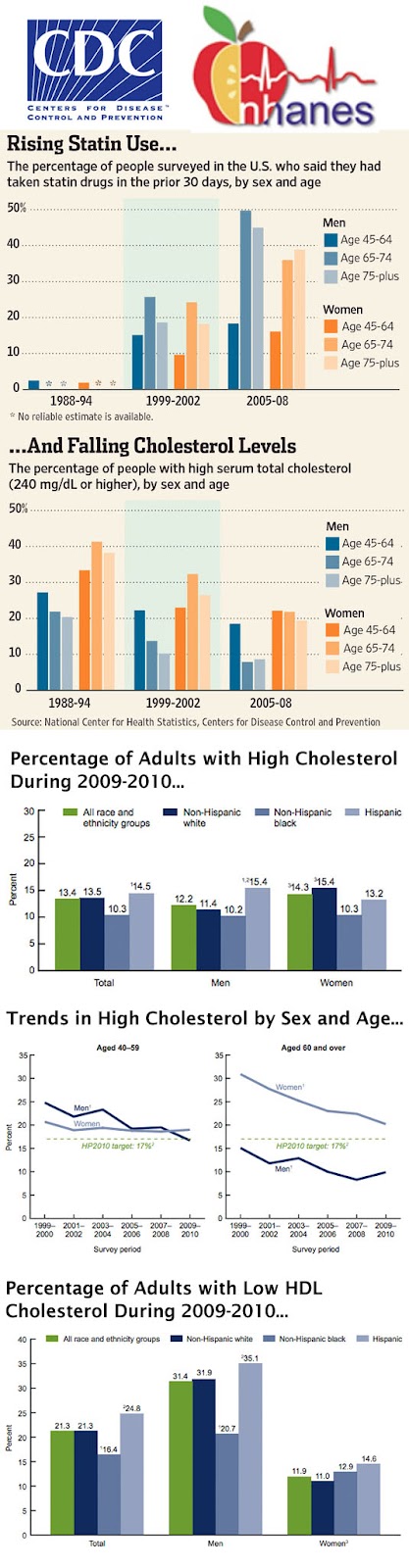
There's lots of other interesting data in the CDC report. I've gathered my favorite charts into the infographic shown here (click here for an enlarged view).
Meanwhile, the prevalence of heart disease, which is the leading cause of death in the U.S., remained steady from 1999–2000 to 2009–2010 among adult women in all age groups, and among men 45–74 years of age. Among men 75 years of age and over, prevalence rose from 39% in 1999–2000 to 45% in 2009–2010.
There goes my rationale for taking statins to lower my risk of heart attack! It seems that the drug industry is not as successful in improving our health as it claims to be.
And new drugs aimed at lowering the risk for heart disease currently being developed may be effective in achieving "surrogate endpoints" in clinical trials but not effective in reducing risk.
That was the takeaway from a new study published online recently in The Lancet. That study provided evidence that increasing the level of HDL ("good cholesterol") does not lead to less risk for heart disease (see "HDL hypothesis is on the ropes right now").
That's not good news for companies that are actively developing and testing drugs that raise HDL -- even if these drugs succeed in that goal they are not likely to help prevent heart disease.
There's lots of other interesting data in the CDC report. I've gathered my favorite charts into the infographic shown here (click here for an enlarged view).
Sunday, May 13, 2012
AstraZeneca's Timely CRESTOR Branded Blog Post: Did It Violate Its Own Policy?
It's unusual for a pharmaceutical company to mention a product by brand name on its corporate blog. It's even more unusual to mention BOTH the product AND its indication -- because that would be promotion regulated by the FDA. But AstraZeneca (AZ) has done just that on its "AZ Health Connections" corporate blog.
The majority of the post "New CDC data shows drop in number of adults with high cholesterol" submitted by Tom Hushen, AZ's External Communications Manager, talks about CRESTOR, AZ's anti-cholesterol drug. The post may have been ghostwritten for "Dr Philip de Vane, Executive Director of Clinical Development at AstraZeneca," whose name appears at the bottom.
After briefly citing the results of the CDC (Centers for Disease Control) study (see below) in the first paragraph, Hushen dedicates the most of the remaining 309 words of the 377-word post to CRESTOR as in:
It's even more interesting considering the AZ Health Connections "Comment Policy" seems to preclude any comments about specific products:
Obviously, now is a good time for AZ to ramp up the promotion of CRESTOR, as it is positioned to take over the number one (or virtually ONLY) statin TOP sales spot (see chart below):
It's also obvious that AZ wants to take some credit for the results reported by the CDC, which are summarized in the following "infographic" (creating infographics is a new obsession of mine):
Some interesting conclusions can be made from the data in this CDC report, which you can find here.
For one thing, women are not doing as well as men in terms of lowering their total cholesterol. This is especially true for women aged 60 and over. Women in that age group have consistently higher percentages of high total cholesterol than men.
The percentage of adults with low HDL cholesterol was higher for men (31.4%) than for women (11.9%).
Although the CDC does study the use of statin drugs by adults and breaks this down by sex and age (see top chart in the infographic), the CDC's analysis that is highlighted in AZ's blog post is based "only on measured cholesterol and does not take into account whether medications are taken."
That's too bad. It would have been interesting to see the correlation between statin use and lowered measured cholesterol.
More important than managing cholesterol levels, however, is whether or not statins actually improve health outcomes such as heart disease. There are results from clinical trials that indicate such a benefit, but how does that correlate with results in the real world?
Just curious.
The majority of the post "New CDC data shows drop in number of adults with high cholesterol" submitted by Tom Hushen, AZ's External Communications Manager, talks about CRESTOR, AZ's anti-cholesterol drug. The post may have been ghostwritten for "Dr Philip de Vane, Executive Director of Clinical Development at AstraZeneca," whose name appears at the bottom.
After briefly citing the results of the CDC (Centers for Disease Control) study (see below) in the first paragraph, Hushen dedicates the most of the remaining 309 words of the 377-word post to CRESTOR as in:
"AstraZeneca applauds this progress and we are proud that when diet and exercise alone aren’t enough, prescription medications like CRESTOR® (rosuvastatin calcium) are able to help patients reach their cholesterol goals. In adults, CRESTOR is prescribed along with diet to lower high cholesterol and to slow the buildup of plaque in arteries."Included in the post is the "fair balance" information required by law:
"CRESTOR is not right for everyone─like people with liver disease or women who are nursing, pregnant or may become pregnant. Tell your doctor about other medicines you are taking. Call your doctor right away if you have muscle pain or weakness; feel unusually tired; have loss of appetite, upper belly pain, dark urine, or yellowing of skin or eyes─these could be signs of rare but serious side effects. See www.CRESTOR.com"Although this is not earth-shaking or in violation of any law that I know of, it nevertheless is the FIRST time a pharmaceutical company has promoted a prescription drug on its official corporate blog -- ie, talked about the drug's benefits.
It's even more interesting considering the AZ Health Connections "Comment Policy" seems to preclude any comments about specific products:
"We want to make sure AZ Health Connections provides a good experience for all visitors. Therefore, we want to keep the content focused on the specific topics being addressed. Comments that don’t directly relate to AstraZeneca or the topics currently being discussed, or comments or questions about specific products (whether or not AstraZeneca products) or ongoing legal or regulatory matters may not be published or may be removed."Could it be that what's good for the "goose" (AZ) is not good for the "gander" (everyone else)? It seems that AZ has relaxed its comments policy, at least this one time. As proof of this, I submitted the following comment, which AZ published:
"I am one of those U.S. adults with high cholesterol that is having problems controlling it with just diet and exercise, which I don’t even try to do :-). But I am worried about taking powerful medicines such as CRESTOR because of the side effects that you mention."AZ published that comment made by this "gander." It is the only comment published so far, so I have no idea if other people have submitted comments that were NOT published. Maybe Tony Jewell, Senior Director of External Communications at AstraZeneca US, will tell us. NOTE: Jewell received the coveted "Pharmaguy Social Media Pioneer Award" in 2011 (see here).
Note: In a personal email, Jewell said: "This post was reviewed, as are all others that mention medicines or disease states. There have been many on the blog, Twitter and Facebook." Upon searching the AZ blog site for other posts that mention CRESTOR, I could not find any post that mentioned the product name AND the disease state (high cholesterol) it is approved to treat. There were, however, a couple of posts that mentioned CRESTOR without its indication.Why did AZ do this at this time? It seems to be very opportunistic considering that it coincides with the release of CDC data that shows improvement to cholesterol levels for many Americans. Also, Pfizer just announced it is no longer promoting Lipitor (see "Pfizer Throws In the Lipitor Marketing Towel" and "Lipitor R.I.P. Infographic").
Obviously, now is a good time for AZ to ramp up the promotion of CRESTOR, as it is positioned to take over the number one (or virtually ONLY) statin TOP sales spot (see chart below):
It's also obvious that AZ wants to take some credit for the results reported by the CDC, which are summarized in the following "infographic" (creating infographics is a new obsession of mine):
Some interesting conclusions can be made from the data in this CDC report, which you can find here.
For one thing, women are not doing as well as men in terms of lowering their total cholesterol. This is especially true for women aged 60 and over. Women in that age group have consistently higher percentages of high total cholesterol than men.
The percentage of adults with low HDL cholesterol was higher for men (31.4%) than for women (11.9%).
Although the CDC does study the use of statin drugs by adults and breaks this down by sex and age (see top chart in the infographic), the CDC's analysis that is highlighted in AZ's blog post is based "only on measured cholesterol and does not take into account whether medications are taken."
That's too bad. It would have been interesting to see the correlation between statin use and lowered measured cholesterol.
More important than managing cholesterol levels, however, is whether or not statins actually improve health outcomes such as heart disease. There are results from clinical trials that indicate such a benefit, but how does that correlate with results in the real world?
Just curious.
Monday, March 5, 2012
Bad News for Potent Cholesterol Drug Users, but Not Me!
Two pieces of bad news for people who take "potent" anti-cholesterol statin drugs came into my email in-box today.
The first was about yesterday's New York Times OpEd piece published by a well-known cardiologist who said Americans are being "over-dosed" with statins to treat high cholesterol (see "We're overdosing on cholesterol-lowering statins says Top(ol) cardiologist").
Merck hoped that the new drug would be better received than Vytorin, which combines a less-powerful statin produced by Merck (Mevacor - also off patent) with Zetia. Vytorin has been dead in the water since 2008, when studies showed that it worked no better than generic Mevacor alone to reduce plaques in arteries (see "Should I Stop Taking Zetia?").
I'm taking all this bad news personally since most of these drugs were recommended to me by my physicians over the past several years.
I've already documented how my GP wanted to switch me from Pravachol -- a weaker statin -- to Crestor and then she recommended I switch to Lipitor when it was about to go off-patent (see "Crestor Grapples to Compete with Lipitor: #Fail!"). Before that, my cardiologist recommended Zetia.
But I have refused to succumb to the "new is better" argument that these physicians were making. I was never impressed by Zetia and thought it was too much trouble to take two pills. Merck has been trying hard to combine Zetia with a generic statin to overcome precisely that adherence problem and to boost Rx sales of Zetia, which is not very effective on its own.
Too bad for Merck. It hasn't had much luck making a purse out of a sow's ear!
Meanwhile, my resistance to taking a stronger statin such as Crestor seems to have been the right decision for me because there is more diabetes in my immediate family than heart disease.
It seems these days that taking advice from a physician is like taking advice from a stock broker -- you can win or lose following their advice, but they win no matter what!
The first was about yesterday's New York Times OpEd piece published by a well-known cardiologist who said Americans are being "over-dosed" with statins to treat high cholesterol (see "We're overdosing on cholesterol-lowering statins says Top(ol) cardiologist").
"It is only with the more potent statins -- Zocor (now known as simvastatin), Lipitor (atorvastatin) and Crestor (rosuvastatin) -- particularly at higher doses, that the risk of diabetes shows up," said Dr. Topol. "The cause and effect was unequivocal because the multiple large trials of the more potent statins had a consistent excess of diabetes."Coincidentally, I also received news that the FDA refused to approve Merck's experimental anti-cholesterol drug "MK-0653C" - an combination of generic Lipitor and Zetia (see "FDA Nixes Merck's New Combo Cholesterol Drug").
Merck hoped that the new drug would be better received than Vytorin, which combines a less-powerful statin produced by Merck (Mevacor - also off patent) with Zetia. Vytorin has been dead in the water since 2008, when studies showed that it worked no better than generic Mevacor alone to reduce plaques in arteries (see "Should I Stop Taking Zetia?").
I'm taking all this bad news personally since most of these drugs were recommended to me by my physicians over the past several years.
I've already documented how my GP wanted to switch me from Pravachol -- a weaker statin -- to Crestor and then she recommended I switch to Lipitor when it was about to go off-patent (see "Crestor Grapples to Compete with Lipitor: #Fail!"). Before that, my cardiologist recommended Zetia.
But I have refused to succumb to the "new is better" argument that these physicians were making. I was never impressed by Zetia and thought it was too much trouble to take two pills. Merck has been trying hard to combine Zetia with a generic statin to overcome precisely that adherence problem and to boost Rx sales of Zetia, which is not very effective on its own.
Too bad for Merck. It hasn't had much luck making a purse out of a sow's ear!
Meanwhile, my resistance to taking a stronger statin such as Crestor seems to have been the right decision for me because there is more diabetes in my immediate family than heart disease.
It seems these days that taking advice from a physician is like taking advice from a stock broker -- you can win or lose following their advice, but they win no matter what!
Thursday, August 4, 2011
Is Over-the-Counter Lipitor in the Cards? One year's sales could cover original R&D costs!
The Wall Street Journal (see here) reports that Pfizer is considering seeking approval from the FDA to sell Lipitor over-the-counter (OTC). Although OTC sales of Lipitor are likely to be only a fraction of the the annual $10 billion in global Lipitor sales currently enjoyed by Pfizer, OTC Lipitor may generate up to $1 billion in annual sales. That's almost enough to cover the original costs of bringing Lipitor to market in the first place; that is, if you accept the industry's estimate of $800 million to $1.2 billion as the cost of development for an Rx drug.
How did I estimate the annual sales of OTC Lipitor? I used the Claritin Rx-to-OTC switch as a model. According the the WSJ article:
But it is unlikely that Pfizer will depend entirely on OTC Lipitor sales to maintain this all important anti-cholesterol brand. It may do what Merck did after Claritin went OTC, which was to develop a new Rx formulation of the drug; ie, Clarinex.
Is Pfizer currently working on a new formulation for Rx Lipitor? I have no idea. It did, however, fail spectacularly to bring a new anti-cholesterol drug (torcetrapib) to market in 2006 (see "torcetrapib: '$800 Million' Failure but Kindler Safe"). Perhaps, after recent cutbacks, Pfizer no longer has the R&D resources to be as innovative as it once was.
One other thing to consider is this: the WSJ articles points out that Merck has been unsuccessful in its attempt to switch its anti-cholesterol statin drug Mevacor from Rx to OTC. FDA shot them down 3 times. The argument against OTC statins such as Mevacor (and presumably Lipitor as well) is that these drugs can be highly toxic to the liver if not used properly and require periodic blood tests to monitor such problems.
Adding to the debate is a benefit/risk analysis of statins based on a little-known but useful statistic, the number needed to treat. You can read more about that here: "The Statin Lottery: Number Needed to Treat Statistic". According to Dr. Jerome R. Hoffman, professor of clinical medicine at the University of California at Los Angeles, people could do as well dieting and exercising to lower cholesterol while avoiding the cost and potential side effects of taking a statin every day. BTW, people pay out of pocket for OTC drugs that were covered by insurance when the drugs were Rx. Those costs could exceed copays.
I note with interest that Pfizer is currently in the middle of a direct-to-consumer (DTC) advertising campaign that disses diet and exercise as a way to lower cholesterol; see "New Lipitor Ads Dis Exercise & Healthy Diet. Are You Kidding Me?". I wonder if the target of this ad campaign is the FDA rather than the general public? Hmmmm....
How did I estimate the annual sales of OTC Lipitor? I used the Claritin Rx-to-OTC switch as a model. According the the WSJ article:
"Merck's Claritin OTC generated $401 million in sales for 2010. In comparison, annual sales of the prescription version of Claritin once exceeded $3 billion before the drug lost U.S. patent protection nearly a decade ago"$3 billion in 2000 dollars is worth about $3.9 in 2010 dollars. Therefore, $401 million represents about 10% of pre-OTC income. If the same OTC/Rx sales ratio holds true for Lipitor, Pfizer can potentially sell $1 billion worth of OTC Lipitor in the first year (keep in mind that Claritin treats seasonal allergies and sales probably spike in the spring, whereas Lipitor sales would be sustained all year long).
But it is unlikely that Pfizer will depend entirely on OTC Lipitor sales to maintain this all important anti-cholesterol brand. It may do what Merck did after Claritin went OTC, which was to develop a new Rx formulation of the drug; ie, Clarinex.
Is Pfizer currently working on a new formulation for Rx Lipitor? I have no idea. It did, however, fail spectacularly to bring a new anti-cholesterol drug (torcetrapib) to market in 2006 (see "torcetrapib: '$800 Million' Failure but Kindler Safe"). Perhaps, after recent cutbacks, Pfizer no longer has the R&D resources to be as innovative as it once was.
One other thing to consider is this: the WSJ articles points out that Merck has been unsuccessful in its attempt to switch its anti-cholesterol statin drug Mevacor from Rx to OTC. FDA shot them down 3 times. The argument against OTC statins such as Mevacor (and presumably Lipitor as well) is that these drugs can be highly toxic to the liver if not used properly and require periodic blood tests to monitor such problems.
Adding to the debate is a benefit/risk analysis of statins based on a little-known but useful statistic, the number needed to treat. You can read more about that here: "The Statin Lottery: Number Needed to Treat Statistic". According to Dr. Jerome R. Hoffman, professor of clinical medicine at the University of California at Los Angeles, people could do as well dieting and exercising to lower cholesterol while avoiding the cost and potential side effects of taking a statin every day. BTW, people pay out of pocket for OTC drugs that were covered by insurance when the drugs were Rx. Those costs could exceed copays.
I note with interest that Pfizer is currently in the middle of a direct-to-consumer (DTC) advertising campaign that disses diet and exercise as a way to lower cholesterol; see "New Lipitor Ads Dis Exercise & Healthy Diet. Are You Kidding Me?". I wonder if the target of this ad campaign is the FDA rather than the general public? Hmmmm....
[This post originally appeared in Pharma Marketing Blog.
Make sure you are reading the source to get the latest comments.]
Subscribe to:
Posts (Atom)