Showing posts with label Novartis. Show all posts

Tuesday, July 31, 2012

The Next New Drug: An FDA-Approved Video Game

Imagine my surprise when I read this in today's Wall Street Journal: "Akili Interactive Labs Inc. of Boston, formed by start-up-creating firm PureTech Ventures, and San Francisco company Brain Plasticity Inc. are seeking Food and Drug Administration approval for a video game treatment they hope clinicians will turn to before prescribing medicines for ADHD" (read the story here).

I've been writing a lot about "gamification" and the pharma industry (see "Pharma & Fun, Not Oxymoronic? Here Comes Gamification!" and "Gamification, Then and Now", for example), but never from the perspective of games designed to compete with drugs such as Novartis' Ritalin, a stimulate indicated for the treatment of ADHD.

Akili -- meaning "wisdom" in Swahili -- is the name of the video game that Akili Interactive Labs hopes will be the first ever video game "treatment" approved by the FDA. The game is designed to run on smartphones and iPads. The company also hopes clinicians will recommend the game to patients before prescribing medicines for ADHD.

Fat chance!

First, fat chance that the FDA will actually approve a video game as an effective treatment for a medical condition. Second, fat chance that even if approved, health insurers/patients will pay for a game treatment after being conditioned all these years to think only of drugs as treatments. Third, fat chance that physicians will prescribe the game to their patients. That would require overturning the entire drug-physician industrial complex!

Nevertheless, Akili co-founder Eddie Martucci said "his company's research shows that people want choices other than today's powerful medicines. 'We would aim to have efficacy and tolerability that outstrips any of the drugs.'"

Wow! Are these guys anti-drug industry? NOPE! Senior Partner, Chairman of PureTech Ventures is Dr. Ben Shapiro who was previously Executive Vice President, Worldwide Licensing and External Research for Merck. Another Senior Partner at PureTech is Dr. John LaMattina, who was previously President, Pfizer Global Research and Development and Senior Vice President, at Pfizer Inc.

LaMattina, who also writes the Drug Truths Blog at Forbes, was once enthusiastic about torcetrapib, a drug that Pfizer hoped would replace LIPITOR. "We believe this is the most important new development in cardiovascular medicine in years," said LaMittina. That was before Pfizer halted development of torcetrapib and after it spent more than $800 million on its development (read "torcetrapib: $800 Million Failure but Kindler Safe"). Hopefully, Akili isn't costing nearly as much to develop as a new drug.

With such experienced drug industry veterans as partners, Akili might have a chance of making it to the FDA. Unless, of course, clinical trials reveal dangerous side effects.

It's not likely such side effects will be similar to those that torcetrapib caused; i.e., death. Some video game critics, however, fear that "electronic media might improve visual attention but impair the ability to sustain attention on a hard or boring task," notes the WSJ article. "The latter type is what teachers need from students, according to ... Douglas A. Gentile, a developmental psychologist at Iowa State University." What teachers DON'T need, however, is for students to claim that playing video games during school is part of their medical treatment!

It's interesting to speculate how FDA-approved video games would be marketed, assuming any will actually be approved by the FDA. Akili, for example, might splurge on exhibits at medical meetings and lure physicians into its booth to play the game. And maybe it would hire physicians to be "consultants" and "speakers" to promote the game to their peers. I'm betting that direct-to-consumer (DTC) TV ads would be out of the question -- much too expensive for a product unlikely to reach "blockbuster" levels of sales.

I do, however, envision that DTC social media could be very cost-effective for marketing FDA-approved video game treatments.

Thursday, June 21, 2012

"Low Hanging Fruit" Keeps FDA Busy & Out of Pharma's Social Media Hair

Another tidbit I picked up this week at CBI's 3rd Annual Forum on Social Media Regulations and Compliance is the notion that the FDA is too busy going after the "low-hanging fruit" of promotional violations to pay much attention to violations of regulations involving social media and other esoteric Internet "tricks" such as the manipulation of meta tag data.

This came up in a discussion I started about the use of meta tags to create organic search results that are effectively branded ads lacking the FDA-required important safety information (ISI). I discussed this in previous blog posts (Who's in Charge of Your "Invisible" Metadata? WARNING: Don't Invoke the "Invisibility Rule" and Are Organic Search Results Next on FDA's Chopping Block?):
Metadata is usually "invisible" content inserted within the header of the HTML code that creates a Web page. This includes a "description" of the page or Web site and keywords. Some of this information is used by search engines to find the page and include a description of the page in the natural search result.
When you do a Google search on "Viagra," for example, you will find a "sponsored" link (i.e., paid search ad) like this:


You will also find this unpaid natural search result:


BOTH the paid ad and the search result contain content that is written and controlled by Pfizer. The natural search result content that begins with "Learn about..." is exactly the content that Pfizer included in its "description" meta tag within the HTML code for the viagra.com home page. Google just lifted that content. Users cannot control this content, only Pfizer can -- by editing the meta tag.
A medical/legal/regulatory (MLR) expert in the audience said: "The fact that the FDA may not be pressing that issue right now is because of the low-hanging fruit." He went on to further speculate that even when FDA issues its long-awaited social media guidance this practice would not be addressed because the FDA is looking at "larger organic issues."

I contend, however, that the FDA has already addressed this issue in a notice of violation (NOV) letter to Novartis regarding the use of meta data to create a "Facebook Share" social media widget that generates Novartis-created information for Tasigna that can be shared with Facebook users (see Implications of FDA’s Warning Letter to Novartis Regarding Facebook Share Widget). Organically speaking, this seems to be equivalent to using meta data to create a search result as described above, no?

Tuesday, May 8, 2012

Have You Met Turbo & Scott? FTC May Want to Meet this eBook for Children Sponsored by Novartis

I just found this tweet from @Novartis:
"US only: Have you met Turbo & Scott? Visit http://t.co/yJDtSvhQ to read the TSC eBook or download Barks and Crafts"
At first, I thought this would be some kind of Rx branded Web site because it was for "US only," which usually means there's some direct-to-consumer (DTC) Rx product information on the site or closely linked to it. But there isn't any hint of a drug mentioned anywhere that I can find.

It's really a site designed for young children who have TSC, "which stands for three big and hard-to-pronounce words, Tuberous Sclerosis Complex."
NOTE: Novartis probably markets the only drug approved by the FDA for treatment of TSC (see press release). Hence, even though the drug is not referenced on this site, FDA may regulate the site as if it were marketing that drug. European regulators also may feel that the TSC site violates their regulations regarding DTC communications.
The eBook is beautifully illustrated and written in the simple language that a child would use. In fact, it's a story told by Turbo, the stuffed dog friend of Scott who is "a real boy and [Turbo's] best friend." Scott has TSC.


I've never heard of TSC before, but apparently, it is a pretty serious hereditary condition that can cause seizures and may require Scott and other kids with TSC to be examined and treated by as many as SEVEN different specialists: Neurologist, Ophthalmologist, Pulmonologist, Nephrologists, Psychiatrist, Cardiologist, and Dermatologist. That's a lot of "gists!" The ebook does a good job explaining to kids what these doctors do.

But what the site does NOT do well (IMHO) is comply with the U.S. Children's Online Privacy Protection Act (COPPA). COPPA "applies to operators of commercial websites and online services directed to children under 13 that collect, use, or disclose personal information from children." Such sites may not collect personally-identifiable information from children without the consent of parents (see COPPA FAQs).

The URL in the tweet above resolves to this URL: http://www.tuberous-sclerosis.com/patient/ebook/ebookhome.jsp which displays this page:


There is a notice from Novartis at the bottom of the screen, which states "Use of this website is governed by the Terms of Use and Privacy Statement. Copyright ©2012 Novartis Pharmaceuticals Corporation. All rights reserved."

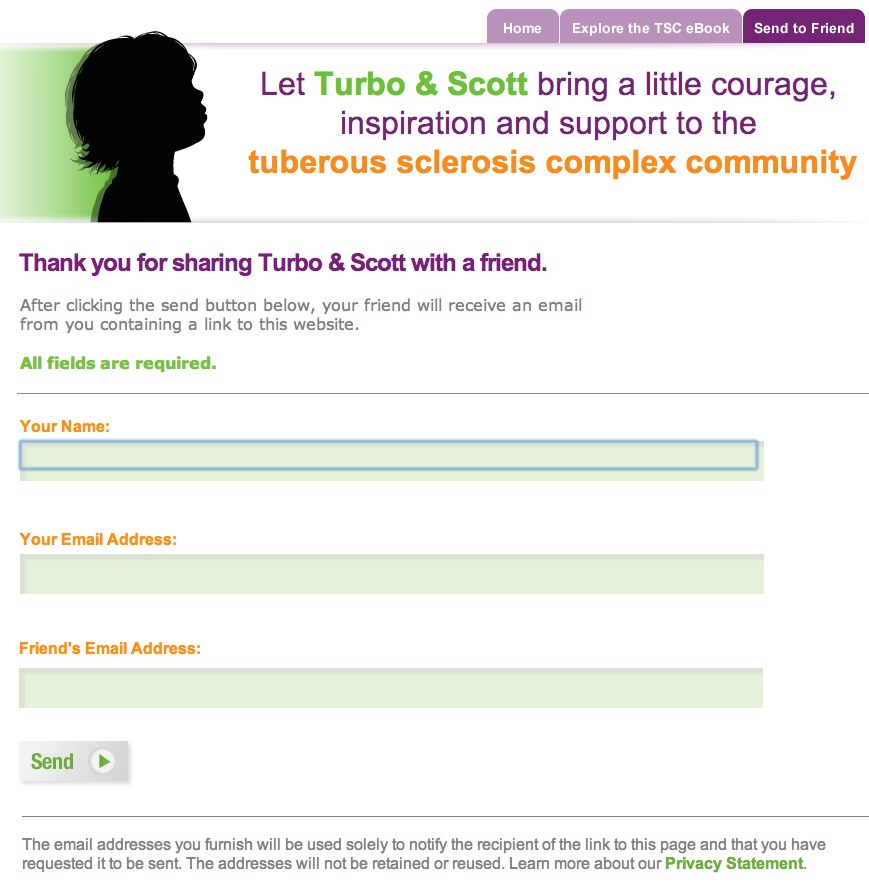
The privacy statement clearly states that "Novartis will not knowingly collect, use or disclose personally identifiable information from a minor under the age of 13, without obtaining prior consent from a person with parental responsibility (parent or guardian)." However, any child (including me) can click on the "Send to Friend" tab and enter his/her name and email address as well as the email address of a friend:


Novartis says "The email addresses you furnish will be used solely to notify the recipient of the link to this page and that you have requested it to be sent. The addresses will not be retained or reused." Since the information is not "retained of reused," this "Send to Friend" feature may be eligible for the "one-time exclusion" allowed by COPPA.

However, another feature of the site allows children to send an email message directly to TSC.Story@novartis.com.

On that page Novartis says: "TSC.Story@novartis.com is to be used to show your interest in further information. We look forward to receiving your email. The personal email information you submit will be used to deliver information about TSC and the TSC eBook program only. By submitting your information you agree to receive information via emails. Please be assured that although we share your information with third parties who work for us on these activities, neither Novartis nor third parties working on our behalf will sell or rent your personal email information. You may unsubscribe at any time by clicking here and specifying Unsubscribe in the subject of the email."

This is clearly an attempt to collect personal information from the children at whom this site is aimed.

I've sent an email to TSC.Story@novartis.com requesting more information about TSC. I signed it "Johnny Mack." So far, I haven't received any response.

P.S. There's a bit of confusion about who is responsible for collecting personal information on the site. I found this statement: "The TSC eBook is sponsored by Novartis Pharmaceuticals Corporation. With the exception of www.TSCStory.com and www.FacingTSC.com, the websites mentioned in this eBook are independently operated and not managed by Novartis, which assumes no responsibility for any information they may provide."

Tuesday, February 14, 2012

Pharma Social Media Silent About Drug Shortage: Boehringer, Novartis, #FAIL!

The pharmaceutical industry is not interested in using social media to inform or support patients using their products. It's only interested in using social media to push out positive news about their companies and products. This is evident by the industry's deafening silence regarding the shortage of cancer drugs such as methotrexate, a drug used to treat children's leukemia among other maladies.

Letters from the American Society of Clinical Oncology, American Cancer Society of Pediatric Hematology/Oncology and Children's Oncology Group, a nationwide network of researchers, were sent to top executives at four U.S. makers of the drug pleading for help. Two of these companies -- Ben Venue Laboratories and Sandoz -- are owned by major non-U.S. Rx pharma companies (Boehringer Ingelhein and Novartis, respectively). The letters state in part:
"As you know, since December we have seen a significant decline in the country’s production of preservative-free Methotrexate (MTX). This drug is critical to the treatment of children with ALL. Approximately 3,500 children and teenagers are diagnosed with ALL each year, with cure rates approaching 90%. Without this drug, patients are at dramatically heightened risk of dying."
As reported in the Chicago Tribune (see here), "the FDA says the main reason for the shortages is manufacturing deficiencies leading to production shutdowns. Shortages also are resulting from companies halting production of drugs with low profit margins, companies consolidating in the generic drug industry and supplies of some ingredients shrinking."

"Established in 1938, Ben Venue Laboratories is the manufacturing arm of Bedford Laboratories, a Boehringer Ingelheim company," says the company's web site. "Bedford Laboratories is one of the largest generic injectable pharmaceutical companies in the United States, offering a broad range of multisource injectables across multiple therapeutic classes."

In November, 2011, Ben Venue Laboratories (Boehringer Ingelheim), for example, shut down its manufacturing and distribution operations at its site in Bedford, Ohio due to significant manufacturing and quality concerns (see here).

Meanwhile, the Twitter accounts of Boehringer and Novartis roll merrily along posting positive tweets about their commitment to cancer patients, while completely ignoring the cancer drug shortage issue. Here are some recent tweets:

  • @BoehringerUS: "@WHO estimates that 84 million people will die of cancer between 2005 and 2015 without intervention. #WorldCancerDay"
  • @Boehringer: "@martin_dudziak Very true. We are also committed and believe in continued research & clin trials as a major key factor in fighting cancer!"
  • @MylanNews: "Mylan Committed to Expanding Access to High Quality, Affordable #HIV/AIDS Treatment. Company Honors #WorldAIDSDay"
  • @Novartis: "Novartis continues to research ways to control tumor growth in advanced #breastcancer"
The Rx drug industry is betting its future on developing complex biologics to treat major diseases such as cancer. If the current crisis is any indication about how successful they will be in (1) manufacturing biologics and (2) using social media to inform the public about the products and support patients who depend on these products, then, IMHO, I  doubt they will be successful.

P.S. Meanwhile, Boehringer is developing a Facebook "game," Syrum, which is designed to "educate" the public on how the drug industry develops drugs (see "Pharma & Fun, Not Oxymoronic? Here Comes Gamification!"). I suggest the company's PR people can better spend time and resources using Facebook to support their patients. Currently, BI's Facebook page does not mention the drug shortage problem nor anything else that can be considered helpful to patients who take their drugs!

Friday, January 13, 2012

Sanofi vs Novartis: Paul Sorvino vs. Paula Deen

It is rumored that celebrity southern-style chef Paula Deen will soon announce that she has diabetes (surprise) and that she is a spokesperson for Novartis's diabetes franchise (see "Rumors Say Paula Deen Has Diabetes, Will Work for Novartis"). She will compete with Paul Sorvino and daughter who are currently the diabetes spokespeople for Sanofi (see "Diabetes Costars").

How Novartis plans to position Deen as a spokesperson for diabetes awareness should really be interesting. She's not much of a proponent for healthy lifestyle changes, which PhRMA recommends should be part of every direct-to-consumer advertising campaign.

According to the article cited above, "Deen has faced withering criticism for the high amounts of fat, salt and sugar in her dishes. When Deen’s cookbook for kids, 'Lunch-Box Set,' was published in 2009, Barbara Walters asked her, 'You tell kids to have cheesecake for breakfast. You tell them to have chocolate cake and meatloaf for lunch. And french fries. Doesn’t it bother you that you’re adding to this?'"

In 2009, I took a road trip down south with my son (see photos here). A highlight was when we had lunch  at "The Lady & Sons" — the restaurant Deen owns in Savannah, Ga. We ate the "fried chicken, ribs, cheesy meatloaf and sweet potatoes" for which the restaurant is famous. Here's the scene that day outside the restaurant (TIP: you may not have to wait for a table if you are willing to eat upstairs in the bar; of course, you have to be thin enough to fit on the stools, which may not work for most of these people waiting on line):


While it's a good idea to have an overweight person as a diabetes spokesperson, it's quite another to have an UNAPOLOGETIC overweight person who recommends cheesecake for kids' breakfasts! It's sort of like having a "vulture capitalist" claim he creates jobs!


**********
UPDATE:
"The rumors that Novartis has signed a multi-million dollar spokesperson deal with Paula Deen for a diabetes treatment are not true," a Novartis rep told CBSNews.com. "Novartis is not working with Ms. Deen."  See "Novartis rep: There's no deal with Paula Deen."
**********

[See "My Bad! Paula Dean Shills for Novo Nordisk, Not Novartis" for a followup to this post.]

Thursday, October 6, 2011

In Memory of Steve Jobs Will Novartis Sales Reps Really Embrace iPads?

Pharmalot reported today that "In a memo this morning, David Epstein, who heads Novartis Pharmaceuticals, wrote that before the end of next year, more than 80 percent of the sales reps will give up their PCs and switch all detailing and related work to iPads.'' The memo, which can be found here, is reproduced below:
Posted on 9:52 AM, 06 October 2011
In memory of Steve Jobs - a role model 
"Today a great man has died - one who has forever changed the world. A great innovator, a corporate leader and a visionary who would not take no for an answer. A man who could perceive customer desire in a very clear way, marry it with technology and compel an organization to execute at the highest level to deliver customers a truly unique and compelling experience. A man I adopted as a role model as we began to galvanize our organization to launch Afinitor at a meeting of our Oncology leadership held in Mexico in 2008. 
"Ultimately, after a long fight, he succumbed to the ravages of PNet (pancreatic neuroendocrine tumor), a cancer for which Novartis now has two approved medicines: Sandostatin LAR and Afinitor. With Steve Job's death it is clear that we cannot rest as we work to discover, develop and commercialize still better medicines. It is medical intervention - great doctors, surgery, medicines and more - that allowed us to enjoy having Steve on this planet just a little bit longer so he could inspire a new generation and give us great inventions like portable digital music, the iPhone, the iPad and iCloud. 
"In his memory we commit today that more than 80 percent of Novartis Pharmaceutical field forces around the world will give up their PCs and be executing their call planning, detailing, emailing, and communicating with each other and physicians via iPads before the end of 2012. Please help me to make this a reality. As a result we will be able to make more impactful calls thus better able to ensure that every patient who should be on one of our medicines has access. Our marketers will be empowered to more quickly update digital detail aids and interactive apps with the latest information. Our marketers will better understand almost instantly what our field forces find helpful in their daily work and what is useless. Our field forces will be able to get more of their work done during the day while waiting for their next appointment rather than doing administrative work later in the day. And there are many other possibilities. Let’s use our positive memory of Steve to do some more good in the world. I know we can."
Not so long ago, I was hearing that pharma companies bought iPADs without having a clear strategy for how they were going to be used. It was believed that thousands of these iPads were housed in warehouses and not deployed.

It seems that Epstein is using the "in memory of Steve Jobs" memo as a tool to empty his warehouses of iPads and encourage reps to use them "to get more of their work done during the day" and "do some more good in the world."

But what are Novartis reps saying about the iPad? Here are some tidbits I found on the Novartis board over at Cafe Pharma:
  • We are the laughingstock. 'Oh look, there goes the reps that are so incompetent in getting their message across, they are replaced by an iPad!' Hey doc, wanna play Angry Birds with me? 
  • Next step in e-detailing is downloading "e-rep" app (doc gets to pick male/female e-rep to interact with,,need samples? click!, need a quick product review? click, heard the latest about managed care in your area? click! 
  • Actually...with iPads why do we need high priced reps? The managers will be fine...you...I wouldn't be too sure. 
  • I'm going to record all calls with the ipads camera & upload to youtube & publish live as soon as the next severence (sic) is paid out
At least pharma reps are not "selling sugar water to kids" as Steve Jobs once said of John Scully when he hired him to run Apple. Scully promptly ran it into the ground.

Does this memo violate FDA Regulations?

P.S. Epstein's memo was posted to a site called FreePDFhosting.com, which allows anyone to upload PDF files for free (duh!). I am not sure who posted Epstein's memo to this site, but I doubt it was Epstein, who probably intended it to remain an internal document. 

However, now that it is a PUBLIC document, easily accessible by any one, is it subject to FDA regulation regarding branded communications?

I notice that the memo refers to Novartis anti-cancer drugs by brand name and includes the FDA-approved indication: pancreatic neuroendocrine tumor. However, the memo does NOT include any fair balance (major side effect information). Technically, therefore, this memo -- as it appears on FreePDFhosting.com -- violates FDA law. Since FreePDFhosting.com has a rule against uploading PDFs that are "illegal or violates any laws," the memo should be removed from the site (hopefully before the FDA sees it).

Wednesday, July 6, 2011

Citizen Petition Filed by Pharma Likely to Delay Indefinitely the Issuance of FDA Social Media Guidance

Allergan, Eli Lilly, Johnson & Johnson, Novartis, Pfizer, Novo, and Sanofi-Aventis filed a "citizen petition" with the FDA yesterday, urging the agency to "establish comprehensive, clear and binding regulations [my emphasis] to guide the industry" in communicating off-label drug information to physicians and payers. You can find the petition here.

Greg Kuetreman, writing about this petition in a post to Lilly's corporate blog (LillyPAD), said "we’re not asking for a change in the regulations -- just clarifications that will help us communicate in a better way." But this is not what the petition says. As I quoted above, the petition is asking for "comprehensive, clear and binding regulations."

In addition to specifically asking for regulations, rather than non-binding guidelines, there are a few other interesting points to make about this "petition" that are relevant to whether or not FDA will be able to issue social media guidance this year (or ever):
The petition asks for regulations regarding manufacturers responses to "unsolicited requests" from physicians for off-label information.

The word "Internet" and the phrase "social media" do not appear in the petition.

"Patients" and "consumers" also are NOT mentioned.
I find these points to be interesting because I recently reported that the FDA 2011 guidance calendar includes guidance for "Responding to Unsolicited Requests for Prescription Drug and Medical Device Information, Including Those Encountered on the Internet" (see "FDA Drops Social Media from Its 2011 Guidance Agenda"). Whether or not such guidance would satisfy the 7 pharma petitioners with regard to "unsolicited" requests is open to debate.

According to the FDA (see here), a citizen's petition is a way to "influence the way FDA does business... change or cancel a regulation, or to take other action." The agency receives about 200 petitions yearly. "Ultimately, FDA management decides whether to grant a petition. But first, agency staffers evaluate it, a process that may take several weeks to more than a year, depending on the issue's complexity. After FDA grants or denies the petition, the agency will notify the petitioner directly. If not satisfied, the petitioner can take the matter to court."

Since this petition specifically addresses the unsolicited request issue for which FDA planned to issue guidance (see "First FDA Social Media Guidance to Address Responding to 'Unsolicited Requests' for Off-label Information"), that guidance will have to be delayed possibly more than a year while the agency reviews the petition.

If the petitioners are not satisfied with how the FDA responds to the petition, they are likely to "take the matter to court" further hamstringing the FDA efforts to issue social media guidance. The number one pharma company and one of the petitioners is already on record opposing any social media guidance on first amendment grounds (see "Pfizer Asks for New FDA Regulations, Not Guidance, for Social Media").

Last week, at the Pharma Virtual Sales & Marketing Summit, I asked Craig Delarge, Director of Healthcare Professional Relationship Marketing at Novo Nordisk, when he thought FDA would issue social media guidance for the industry. His personal opinion was "not in the foreseeable future." That comment surprised me at the time, but now I understand why he said it.

P.S. STRANGE COINCIDENCE?
Pharma's Citizen Petition was filed on the SAME day (July 5) that DDMAC Director, Tom Abrams, said that "publishing social media guidelines for industry is the division's 'highest priority,' and that the document will be 'published as soon as it's vetted.'" Abram's comments were made at the Drug Information Association’s in Chicago (see here).

Lilly's Greg Kuetreman attempted to answer the question "Why Now?" in his blog statement, saying "Because there continues to be some confusion about what companies can - and cannot - say to health care professionals, payers, and patients about new scientific information." Considering that there's ALWAYS been this confusion, Kuetreman's statement fails to answer the question. I think the answer is that pharma anticipated imminent release SM guidelines by the FDA and wanted to delay that release by filing a Citizen Petition.

[This post originally appeared in Pharma Marketing Blog
Make sure you are reading the source to get the latest comments.]

Wednesday, August 11, 2010

Is FDA Playing "Bait & Switch" with Pharma Marketers?

Sensing that there are a lot of pharma marketers out there who are "angry as hell and don't want to take it any more," I decided to host a short, VERY anonymous survey seeking opinions about FDA's recent letter to Novartis regarding its use of metatag text in a Facebook Share button (for background,  see "Implications of FDA’s Warning Letter to Novartis Regarding Facebook Share Widget", "Who's in Charge of Your 'Invisible' Metadata? WARNING: Don't Invoke the 'Invisibility Rule'", and "Update on FDA Regulation of Pharma Metadata & Impact on Search").

My timing could not have been better!

Yesterday, the big story coursing through social media was NOT FDA v. Novartis, but the story of how JetBlue attendant Steven Slater decided he had had enough. He cursed off his passenger nemesis via his plane's PA system, grabbed a beer, and exited via an emergency escape chute. I, among many other people, tweeted about it positively:

"Wouldn't we all love to pull the shute (sic) lever & escape into adventure like this JetBlue flt attendant? http://nyti.ms/bh2deF"

This plus the Tea Party movement may signal a new era of "had enough bullshit!" Which is good way to describe the comments I have collected so far in my little survey. The following is just one example:

"It's bullshit. The issue is not the metadata but the truncating of the data that will occur through any number of sources - and one that you correctly point out is natural search. This is a very slippery slope where the FDA should provide some options. It's a bait and switch that they listen to us and then crush us. What do they have against Novartis? Feels like they've been picking on them lately."

You can find this comment and others here and take the survey yourself here (it's completely ANONYMOUS; no names or IP addresses are collected).

Needless to say, I have my own opinions on this and have stated a few in the posts I have cited. But the responses to my survey open up new issues that I plan to use in a future debate to be aired LIVE on my Pharma Marketing Talk Blog Talk Radio Show. More on that later.

Thursday, August 5, 2010

Implications of FDA’s Warning Letter to Novartis Regarding Facebook Share Widget

You know you are getting old when the FDA knows more about Facebook than you do! In a July 29, 2010 letter to Novartis, FDA cited violations with regard to a "Facebook Share" social media widget that generates Novartis-created information for Tasigna that can be shared with Facebook users (i.e., “shared content”). FDA said: "The shared content is misleading because it makes representations about the efficacy of Tasigna but fails to communicate any risk information associated with the use of this drug."

To help the recipient of the letter -- Lisa Drucker, Director, Regulatory Affairs -- understand what a Facebook Share social media widget is, the letter includes several footnotes that supplied technical details and explanations:
"Facebook Share is a way for users of Facebook to share articles, pages, video, or flash content of a site with other Facebook users. Over two billion pieces of content are shared each week through Facebook. With two clicks, visitors to a website can share any page of that website through Facebook by generating a link to the page, along with a thumbnail image and a brief description (i.e., 'shared content') that will appear on the users’ profiles and, depending on privacy settings, in the home page stream of all of the users’ friends. Each time a link is shared by one user, potentially hundreds of new people may see and/or click through on the link."
and
"As described below, the shared content for Tasigna generated by the Facebook Share social media widget was developed by Novartis and, although Facebook users can add additional comments that are displayed separately from the Tasigna information, the shared content cannot be modified by Facebook users who use this Facebook Share social media widget."
and
"We also note multiple Tasigna web pages contain widgets that allow users to share content via other social media applications offered via the “Share This” tool (http://sharethis.com). Some of the content available to share through these other social media applications raise similar issues to those discussed in this letter."
In a separate document, FDA included a screen shot showing what one of the widgets looked like before Novartis edited its Facebook page:

This looks very much like one of those infamous Google bAdwords (see Lunesta, Google, and "bAdWords")!

Luckily, Digitas Health published a "Facebook Regulatory Alert" that clarified a few issues and sheds some light on how this widget was created.
"The descriptive content displayed by Facebook on the user's page via the Share feature pulled from the [Tasigna] website metadata [my emphasis], which is invisible to most users but relied on by search engines, such as Google, Yahoo!®,and Bing™, to provide a description of the page's content," notes the Digital Health document.
I Warned This May Happen!
In a previous post, I warned that the FDA may cite certain content generated from metadata (see "Are Organic Search Results Next on FDA's Chopping Block?"). While the Novartis example is not exactly what I was talking about, it's pretty close because the FDA is now citing content that is usually hidden but made visible by widgets. If it can do that, why not cite natural search content that is also picked up from metadata tags?

Possibly thinking along the same lines as I am, Digitas Health ended its Alert with this recommendation:
"Because website metadata is used both by search engines in generating organic search listings and by social media channels, such as the Facebook Share functionality, Digitas Health advocates that all site metadata should be included in internal medical/legal/regulatory review and as part of mandatory FDA submissions."

P.S. Novartis has updated its meta tag on the Tasigna Web site. It now reads: "Tasigna (nilotinib) 150-mg and 200-mg capsules from Novartis is a treatment for Ph+ Chronic Myeloid Leukemia in newly diagnosed adult patients in chronic phase or patients in chronic or accelerated phase who are resistant to Gleevec."

FDA had complained about the previous wording: "These statements of Tasigna’s indication are incomplete, and misleadingly imply that the drug is approved to treat all individuals with Ph+ CML, when this is not the case. At the time this shared content was originally disseminated, Tasigna was only approved as a second-line option after failure or intolerance to prior therapy that included imatinib. Furthermore, Tasigna is only approved for use in patients with Ph+ CML in the chronic or accelerated phases."

Monday, April 19, 2010

Voltaren "Adherence Email" Gets FDA Warning Letter: Is It Justified?

As of April 15, 2010, FDA's Division of Drug Marketing, Advertising and Communications (DDMAC) sent out 5 "notice of violation" (aka "warning") letters to drug companies regarding various promotional pieces. One letter is of interest because it concerns a direct-to-consumer (DTC) adherence "wave 5 e-mail" ("Adherence Email") for Voltaren, an NSAID topical gel marketed by Novartis. This may be the FIRST FDA warning letter issued for an email promotion. But is it justified?

Among other violations, the letter cites "minimization of risk information." The letter (find it here) states:
"The Adherence Email prominently presents efficacy claims in large bolded font size and in colorful text and graphics surrounded by a significant amount of white space. In contrast, the risk information is relegated to the bottom of the email and is presented below the indication for use in extremely small black font, and in single-spaced paragraph format that makes the information very difficult to read. Furthermore, while the Adherence Email presents efficacy claims for Voltaren Gel in language that is easily understandable to consumers, it presents risk information using complex medical terminology that is not likely to be comprehended by the same audience (e.g., “cardiovascular thrombotic events” and “hematological effects”). The overall effect of this presentation undermines the communication of important risk information, minimizing the risks associated with Voltaren Gel, and misleadingly suggesting that Voltaren Gel is safer than has been demonstrated."
"For me, that is a little out of left field," said Mark Senak over at EyeOnFDA Blog. "To my knowledge," said Senak, "FDA/DDMAC has not issued any standards on how to do this [present risk information] aptly." I disagree with Senak. The FDA has issued "standards" about presenting risk information.

In my previous analysis of DDMAC warning letters (see "An Analysis of DDMAC Warning Letters Regarding Risk Information in Broadcast Drug Ads"), I noted that the FDA Amendments Act (FDAAA), which was signed into law in 2007, requires that the FDA issue new regulations regarding the presentation of risk information in broadcast (TV and radio, specifically) drug ads directed to consumers (DTC ads). On March 29, 2010, the FDA published the proposed regulations in the Federal Register (see here).

FDA had issued guidance relating to presentation of risk information previously and most experts agree that the proposed regulations pretty closely resemble that guidance (see "Draft Guidance on Presenting Risk Information in Prescription Drug and Medical Device Promotion"; pdf file). Specifically, the regulations focus on determining whether a drug ad's "major statement" (ie, disclosure of the major side effects and contraindications of the drug) is presented in a "clear, conspicuous, and neutral manner" as required by FDAAA. FDA says that a major statement would be considered to be presented in this manner if:
  1. Information is presented in language that is readily understandable by consumers;
  2. Audio information is understandable in terms of the volume, articulation, and pacing used;
  3. Textual information is placed appropriately and is presented against a contrasting background for sufficient duration and in a size and style of font that allows the information to be read easily; and
  4. The advertisement does not include distracting representations (including statements, text, images, or sounds or any combination thereof) that detract from the communication of the major statement.
The Voltaren Adherence Email (find it here) seems to violate "rules" #1 and #3 above. That is, it would violate those rules IF it were in the category of "broadcast" DTC. FDAAA requires FDA to enforce "clear and conspicuous" risk information in TV and radio ads that are broadcast to a mass audience. The Voltaren Adherence Email does not seem to fit in that category of ad because it was not a TV or radio ad and it was likely sent to a select group of consumers, not a mass audience.

However, in the draft guidance mentioned above, FDA states: "Unless otherwise specified in this draft guidance, the principles set forth below apply to all promotional pieces, regardless of the medium used or the target audience."

So I am a bit confused as to whether or not, in the case of the Voltaren letter, the FDA has overstepped the authority given it by Congress to regulate risk information in non-broadcast media. What do you think?