"I believe in states' rights.... I believe we have distorted the balance of our government today by giving powers that were never intended to be given in the Constitution to that federal establishment."
Ever since Ronald Reagan said he believed in "stats' rights" that has been the rallying cry of Republicans up to and including Romney-Ryan.
For pharmaceutical companies, however, states' rights to enforce some federal laws via litigation is a problem. Take for example, the the $181 million settlement reached August 29 between 36 attorneys general and Jannsen Pharmaceuticals (a Johnson and Johnson company). According to a Forbes contributor, this settlement "confirmed that state AGs must indeed be reckoned with on off-label issues. What will get medical product companies’ attention is not the financial settlement, though. The real eye-opener was the precision of the settlement’s conduct requirements, most notably one restraint on speech which goes beyond the dictates of federal law" (see State Attorneys General Step to the Fore on Off-Label Drug "Promotion").
Relating to the distribution of off-label information/reprints about Risperdal (or any "Atypical Antipsychotic"; i.e., all of Jannsen's products that are FDA-approved formulations containing risperidone and/or paliperidone), Jannsen agreed that only Jannsen "Scientifically Trained Personnel" may distribute such materials and NOT sales or marketing personnel UNLESS Jannsen has a "pending filing with the FDA for approval of the new indication described in the reprint." "Scientifically Trained Personnel," according to the settlement are Janssen personnel who are "highly trained experts with specialized scientific and medical , usually with an advanced degree scientific degree (e.g., and MD, PhD, or PharmD)."
"While this specific agreement pertains only to antipsychotics, the principles are obviously applicable at a higher level of generality," said Arnie Friede in a interview with Pharmalot (here). And J&J/Janssen has said they won’t use sales or marketing personnel to disseminate any off-label reprints unless they’ve already submitted an application to FDA covering that particular use and they may well apply the same “rule” in the marketing of other FDA-regulated products. This restriction goes beyond a provision in the FDA Modernization Act that has since expired, which obligated companies to certify that they were conducting studies intended to support a supplemental application before disseminating an off-label reprint, even if peer reviewed, but which did not require actual submission of an sNDA."
Why did J&J/Jannsen agree to this settlement rather than fight the case in court? The Forbes writer suggests it was just a matter of money: "the cost-benefit calculus of fighting vs. settling likely led the companies to resolve the claims."
Perhaps, however, this case is not closed and the settlement could be declared null and void if the "Federealists" have their way: "Unless I’m missing something," said a commenter to the Pharmalot post, "it seems a sure bet that the industry, perhaps via its pals at Federalist Society et al, will file a preemption case that these state requirements interfere with DDMAC’s authority to regulate off-label promo and related. Indeed, I do think the case for federal preemption is considerably stronger here than for preemption of state product liability law. In the meantime, friends-on-the-court could use the case as an opportunity to open the wider issue of off-label promo (for a case down the road)."
It ain't over till the fat lady SUPREMES sings!
Showing posts with label Johnson and Johnson. Show all posts
Showing posts with label Johnson and Johnson. Show all posts
Saturday, September 8, 2012

Wednesday, August 15, 2012
How Johnson & Johnson Uses Twitter for Patient Support: A-plus for Effort, D-minus for Sharing
Every day, I get a synopsis of tweets and newsfeeds from selected pharma companies that I am following (see "News Direct from the Pharma Industry"). Lately, I've been noticing a number of tweets from Johnson and Johnson (@JNJComm) that are direct responses to complaints from consumers about its products. In some cases, complainants have had an extended conversation with JNJ.
However, you won't find these conversations if you look at the @JNJComm Twitter timeline here but you can find them in the PMN Forum archives here. More on this later. Right now I'd like to focus on one of these conversations.
@hiltmon (Hilton Lipschitz) complained about an Acuvue contact lens problem in a tweet posted to @JNJComm. @hiltmon said: "@JNJComm, could you please fwd this to Acuvue team: See the hole in the lens (top right), happened twice now. Thanks. pic.twitter.com/50ML8IrT" The link leads to this photo:

Whether or not this could be classified as a legitimate "adverse event," is a matter for debate, but JNJ responded as if it were: "thanks for alerting use. Please call us at 800-843-2020. It's important that we fully understand what occurred. Thanks! ^DE" Here's a screen shot of the full exchange:

I am not sure what "^DE" means. It appears that JNJComm uses it only at the end of responses to these sorts of complaints. I assume it allows some kind of tracking or followup. [Actually, it indicates the author - in this case Devon Eyer; see UPDATE at the end of this post.] In any case, the end result was one happy (I assume) customer.
I cannot find a legitimate Acuvue Twitter account, although the brand does have a Facebook page. After a quick scan through the Acuvue FB page, I can find no consumer complaints or conversations like the above. It's all good brand "conversations" over there on the Acuvue FB page :-)
The above Twitter conversation might be considered a "brand conversation," which is what brand marketers would like to see (although they would like positive rather than negative conversations about their products). So, JNJ corporate communications people are having these brand support conversations via Twitter, but the brand people -- who presumably manage the FB page -- do not. That's telling in respect to the question I asked in a previous post: "Who's Your Social Media Daddy?"
This conversation is somewhat hidden from most of the nearly 20,000 @JNJComm followers. As I mentioned above, it does not appear in @JNJComm's Twitter timeline because each tweet begins with "@". That makes it a personal conversation in Twitter. Unless you access @JNJComm's Twitter RSS feed as I do, you won't see these tweets. That's unfortunate, IMHO, because it means that the power of social media (e.g., sharing content with followers) is sidestepped. In this case, other consumers may not learn about important safety and other information about Acuvue lenses. Public health would be better served if everyone could learn from the conversation (e.g., the batch number of the faulty lenses).
Of course, it also means that these conversations may not be picked up by the media -- presumably the main audience for @JNJComm and other pharma corporate Twitter accounts -- or by regulators who may like more information about faulty medical products.
 UPDATE: ^DE indicates that the @JNJComm posts were written by Devon Eyer, Director, Corporate Communications, Social Media at Johnson & Johnson (see her LinkedIn profile here).
I have included Devon in my list of contenders for the 3rd Annual Pharmaguy Social Media Award. You can learn more about this award here and/or vote for your favorite here.
However, you won't find these conversations if you look at the @JNJComm Twitter timeline here but you can find them in the PMN Forum archives here. More on this later. Right now I'd like to focus on one of these conversations.
@hiltmon (Hilton Lipschitz) complained about an Acuvue contact lens problem in a tweet posted to @JNJComm. @hiltmon said: "@JNJComm, could you please fwd this to Acuvue team: See the hole in the lens (top right), happened twice now. Thanks. pic.twitter.com/50ML8IrT" The link leads to this photo:

Whether or not this could be classified as a legitimate "adverse event," is a matter for debate, but JNJ responded as if it were: "thanks for alerting use. Please call us at 800-843-2020. It's important that we fully understand what occurred. Thanks! ^DE" Here's a screen shot of the full exchange:

I am not sure what "^DE" means. It appears that JNJComm uses it only at the end of responses to these sorts of complaints. I assume it allows some kind of tracking or followup. [Actually, it indicates the author - in this case Devon Eyer; see UPDATE at the end of this post.] In any case, the end result was one happy (I assume) customer.
I cannot find a legitimate Acuvue Twitter account, although the brand does have a Facebook page. After a quick scan through the Acuvue FB page, I can find no consumer complaints or conversations like the above. It's all good brand "conversations" over there on the Acuvue FB page :-)
The above Twitter conversation might be considered a "brand conversation," which is what brand marketers would like to see (although they would like positive rather than negative conversations about their products). So, JNJ corporate communications people are having these brand support conversations via Twitter, but the brand people -- who presumably manage the FB page -- do not. That's telling in respect to the question I asked in a previous post: "Who's Your Social Media Daddy?"
This conversation is somewhat hidden from most of the nearly 20,000 @JNJComm followers. As I mentioned above, it does not appear in @JNJComm's Twitter timeline because each tweet begins with "@". That makes it a personal conversation in Twitter. Unless you access @JNJComm's Twitter RSS feed as I do, you won't see these tweets. That's unfortunate, IMHO, because it means that the power of social media (e.g., sharing content with followers) is sidestepped. In this case, other consumers may not learn about important safety and other information about Acuvue lenses. Public health would be better served if everyone could learn from the conversation (e.g., the batch number of the faulty lenses).
Of course, it also means that these conversations may not be picked up by the media -- presumably the main audience for @JNJComm and other pharma corporate Twitter accounts -- or by regulators who may like more information about faulty medical products.
I have included Devon in my list of contenders for the 3rd Annual Pharmaguy Social Media Award. You can learn more about this award here and/or vote for your favorite here.
Monday, July 16, 2012
JNJ Attempts YouTube Humor to Promote a DTC Advertising Goal
The goal of every direct-to-consumer (DTC) ad is to get people to visit their doctors and ask about the advertised Rx drug. But are these ads effective?
The drug industry often defends DTC ads, claiming they ARE effective in achieving this goal. Some studies, however, seem to indicate that once people visit their physicians, they do not ask for the advertised drug (read, for example, "Advertisers Don't Know How DTC Works. Say wha?").
But the ads may not even be effective in driving people to see their physicians. Maybe that's why Johnson and Johnson (JNJ) recently promoted a YouTube video it uploaded more that two years ago called "The Appointment." It's an non-branded attempt to use humor. JNJ's corporate Twitter account (@JNJComm) recently posted this tweet:
"Afraid to visit the doctor? Don't be! Watch 'The Appointment' for medicinal laughter - and important info > http://t.co/0PQanPNF @JNJVideo"
On the YouTube page, JNJ introduces the video: "Many people are wary of making a doctors visit. In The Appointment, some extreme humor works to make several important points about why you should visit your doctor and most importantly things you should not be afraid to understand and ask. Enjoy and no, there really isnt a needle that big!"
Here's the video:
A few people do not think the video is funny. One commenter (yes, JNJ accepts comments on its YouTube channel) said:
The drug industry often defends DTC ads, claiming they ARE effective in achieving this goal. Some studies, however, seem to indicate that once people visit their physicians, they do not ask for the advertised drug (read, for example, "Advertisers Don't Know How DTC Works. Say wha?").
But the ads may not even be effective in driving people to see their physicians. Maybe that's why Johnson and Johnson (JNJ) recently promoted a YouTube video it uploaded more that two years ago called "The Appointment." It's an non-branded attempt to use humor. JNJ's corporate Twitter account (@JNJComm) recently posted this tweet:
"Afraid to visit the doctor? Don't be! Watch 'The Appointment' for medicinal laughter - and important info > http://t.co/0PQanPNF @JNJVideo"
On the YouTube page, JNJ introduces the video: "Many people are wary of making a doctors visit. In The Appointment, some extreme humor works to make several important points about why you should visit your doctor and most importantly things you should not be afraid to understand and ask. Enjoy and no, there really isnt a needle that big!"
Here's the video:
A few people do not think the video is funny. One commenter (yes, JNJ accepts comments on its YouTube channel) said:
"I'm not one to start a YouTube spitting contest - I'm just saying that this seems to be a bit (not massively!) insensitive to both the clinicians and the patients who are trying to treat each other better. Your ultimate message in the vid is perfect - it just strikes me as missing the mark in its opening approach."One commenter even said it was "misguided":
"Wow. I'm sure you meant it to be funny, but I have to say, this is the worst-conceived pitch I've ever seen for being an empowered patient. In addition to the patient looking like something of a simpleton, to me it charicatures doctors in the worst possible way too.. I'm sure y'all meant well, but wow, this is misguided."To which JNJ replied:
"I understand and respect your point of view. It was supposed to be a lighthearted reminder to those who might not be practicing preventive care. You are already an informed, empowered patient who has dealt with, and become educated about, a life threatening disease. Although it uses caricutures of doctors and patients, the video is aimed at those who might have misconceptions or fears about visiting their doctors for annual check ups and other routine care."What do you think?
Friday, May 4, 2012
Is 38 Hours Quick Enough to Respond to a Potentially Serious AE Tweet?
Subtitle: JNJ Responds to Adverse Event Reported Directly to @JNJComm via Twitter
There are probably more than 100 pharmaceutical company Twitter accounts such as @JNJComm, which posts news and information from Johnson and Johnson's Corporate Media Relations team (Devon Eyer - @DevonEyer - and Bill Price - @wtprice3).
With such a conspicuous presence on Twitter, I am amazed that I haven't noticed very many complaints from consumers directed at these accounts. I'm specifically talking about complaints that relate to adverse drug reactions. Pharma companies are deathly afraid of having to deal with such complaints via social media mostly because of the FTEs that may be required.
But, really, how big a problem is it? I haven't done a quantitative analysis, but I suspect that if @JNJComm gets one such complaint per month, that would be a lot.
This month, I noticed a complaint made to @JNJComm by @CapeFearPhoto (aka "Chad Heavilyarmed"). At 12:06 AM on May 2, 2012, @CapeFearPhoto tweeted:
Perhaps JNJ could have responded sooner. After all, the "Tweet Response" page was available and the tweet that @JNJComm eventually sent out could have been a MLR pre-approved "boiler plate" response all ready to go. Or was it? Maybe it took @JNJComm so much time to respond because it never before received such a message and had to craft an appropriate response and get it approved before it could be sent!
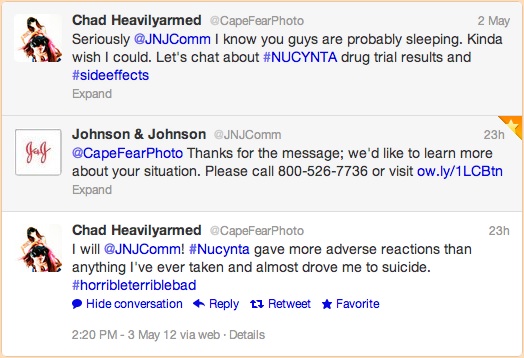
Whatever, just another pharma social media first for me to document. Here's a screen shot of the relevant conversation for the record:
There are probably more than 100 pharmaceutical company Twitter accounts such as @JNJComm, which posts news and information from Johnson and Johnson's Corporate Media Relations team (Devon Eyer - @DevonEyer - and Bill Price - @wtprice3).
With such a conspicuous presence on Twitter, I am amazed that I haven't noticed very many complaints from consumers directed at these accounts. I'm specifically talking about complaints that relate to adverse drug reactions. Pharma companies are deathly afraid of having to deal with such complaints via social media mostly because of the FTEs that may be required.
But, really, how big a problem is it? I haven't done a quantitative analysis, but I suspect that if @JNJComm gets one such complaint per month, that would be a lot.
This month, I noticed a complaint made to @JNJComm by @CapeFearPhoto (aka "Chad Heavilyarmed"). At 12:06 AM on May 2, 2012, @CapeFearPhoto tweeted:
"Hey @JNJComm Can we talk about #sideeffects from your Janssen Pharm products? Please? #stillvomiting #nightterrors #nothappy #NUCYNTA #FAIL"About 20 minutes later at 12:21 AM, @CapeFearPhoto sent another tweet directed to @JNJComm:
"Seriously @JNJComm I know you guys are probably sleeping. Kinda wish I could. Let's chat about #NUCYNTA drug trial results and #sideeffects"Yes, Devon and Bill were probably asleep, but @JNJComm did finally respond at 1:59 PM on May 3, 2012:
"@CapeFearPhoto Thanks for the message; we'd like to learn more about your situation. Please call 800-526-7736 or visit http://ow.ly/1LCBtn"The link leads to Janssen Pharmaceutical's "Tweet Response" page, which was "last modified" on Apr 13 2012. This is the first time I've seen such a Web page. I wonder if other pharmaceutical companies have similar pages to which they direct Twitter users? The page informs visitors that:
"This is in follow up to your recent tweet regarding our product. As a pharmaceutical company, we are required to inform the Food and Drug Administration of any adverse experiences associated with our products. Therefore, our Global Medical Safety department would like to learn additional information about your experience and hope you will contact us at janssenmedinfo@its.jnj.com or at 1-800-526-7736."At 2:20 PM on May 3, 2012, @CapeFearPhoto responded with this tweet:
"I will @JNJComm! #Nucynta gave more adverse reactions than anything I've ever taken and almost drove me to suicide. #horribleterriblebad"I'm not going to get into whether or not this qualifies as a reportable adverse event. But it should be noted that the tweet was directed specifically to @JNJComm and that @JNJComm responded PUBLICLY via Twitter within 38 or so hours.
Perhaps JNJ could have responded sooner. After all, the "Tweet Response" page was available and the tweet that @JNJComm eventually sent out could have been a MLR pre-approved "boiler plate" response all ready to go. Or was it? Maybe it took @JNJComm so much time to respond because it never before received such a message and had to craft an appropriate response and get it approved before it could be sent!
Whatever, just another pharma social media first for me to document. Here's a screen shot of the relevant conversation for the record:

Thursday, April 26, 2012
Device Makers, e.g. Johnson & Johnson, May Benefit Most from FDA User Fee Bill
"Put simply," says AdvaMed, the trade association of the medical device industry, "the [user fee agreement recently reached between FDA and the medical technology industry] is good for FDA; it is good for industry; and most of all, it is good for American patients."
The House version of the FDA user fee bill, which is currently being marked up, is "widely expected to contain more industry-friendly provisions, especially for medical device makers," according to Politico (here).
Details of "FDA’s ability to reclassify the risk level of devices" may be hidden in the bills. One of these details may concern "a loophole in the law that allows [medical device manufacturers] to submit new products to the FDA for instant review as long as they classify them as an upgrade even if the product has changes that could affect safety," says Consumer Reports. "Companies now use the process 90 percent of the time, according to a report published by Rep. Ed Markey, D-Mass., who is an advocate for industry reform."
Meanwhile, the FDA wants to assign a new bar-code-like identification number to medical devices to help it detect malfunctions in devices AFTER they have been approved. By tapping into medical and billing records from hospitals and insurance companies, FDA hopes to identify faulty devices before they cause deaths, such as the 686 deaths from 2009 to last year connected to automated external defibrillators and at least 20 deaths recently linked to surgically-implanted heart defibrillator wires.
One of the leading manufacturers of heart defibrillation devices is Guidant. A few years ago, it had to recall one of its devices that was linked to several deaths (see NYT article). That derailed a takeover bid by Johnson and Johnson (JNJ). Meanwhile, JNJ is actively growing its medical device business and will soon acquire Synthes -- a Swiss manufacturer of orthopaedic devices -- for $21.3 billion. Devices now account for 40% of JNJ's worldwide sales (see chart below; source of data: CNNMoney.com and Q1 2012 financial statement).

JNJ may position itself as a "consumer" products company, but its main business is pharmaceutical drugs and medical devices. With the acquisition of Synthes, which had sales of nearly $4 billion last year, JNJ's device business will be an even bigger slice of its global sales pie (maybe 43%).
The House version of the FDA user fee bill, which is currently being marked up, is "widely expected to contain more industry-friendly provisions, especially for medical device makers," according to Politico (here).
"One in particular is the HELP bill’s efforts to streamline the FDA’s ability to reclassify the risk level of devices. Whether a device is deemed more, or less, risky can dramatically change the amount of clinical data and other studies required for approval.According to Politico, AdvaMed is still pushing something in between "to preserve some of our due process rights,” AdvaMed's head of government relations (ie, chief lobbyist).
"Currently, such reclassification is a long-term rulemaking process that must be cleared by Health and Human Services and the Office of Management and Budget along with the full complement of public hearings and comment periods. The HELP bill would turn that into a faster administrative process without the extra layers of oversight."
Details of "FDA’s ability to reclassify the risk level of devices" may be hidden in the bills. One of these details may concern "a loophole in the law that allows [medical device manufacturers] to submit new products to the FDA for instant review as long as they classify them as an upgrade even if the product has changes that could affect safety," says Consumer Reports. "Companies now use the process 90 percent of the time, according to a report published by Rep. Ed Markey, D-Mass., who is an advocate for industry reform."
Meanwhile, the FDA wants to assign a new bar-code-like identification number to medical devices to help it detect malfunctions in devices AFTER they have been approved. By tapping into medical and billing records from hospitals and insurance companies, FDA hopes to identify faulty devices before they cause deaths, such as the 686 deaths from 2009 to last year connected to automated external defibrillators and at least 20 deaths recently linked to surgically-implanted heart defibrillator wires.
One of the leading manufacturers of heart defibrillation devices is Guidant. A few years ago, it had to recall one of its devices that was linked to several deaths (see NYT article). That derailed a takeover bid by Johnson and Johnson (JNJ). Meanwhile, JNJ is actively growing its medical device business and will soon acquire Synthes -- a Swiss manufacturer of orthopaedic devices -- for $21.3 billion. Devices now account for 40% of JNJ's worldwide sales (see chart below; source of data: CNNMoney.com and Q1 2012 financial statement).

JNJ may position itself as a "consumer" products company, but its main business is pharmaceutical drugs and medical devices. With the acquisition of Synthes, which had sales of nearly $4 billion last year, JNJ's device business will be an even bigger slice of its global sales pie (maybe 43%).
Tuesday, April 24, 2012
Janssen Uses Digital Storytelling, Animation to "Bring Prescription Medicine Labeling to Life." But Not iPhone or iPad Life!
Have you ever seen those animated stories any one can create using a service called "Xtranormal?" According to the web site, "Xtranormal helps you create amazing interactive stories with a few clicks and a little imagination."
The following funny animation about medication adherence was created using Xtranormal Movie Maker by HealthPrize, a company that markets a drug adherence program that was featured Pharma Marketing News (read "HealthPrize Teams Up with RealAge to Improve Adherence"1; use discount code hprze).
Basically, you create a script, choose characters, scenery, gestures, etc. and "Ta-da! You're instantly an animator, poet, pundit, educator or comic. Couldn't be easier," says Xtranormal.
Janssen Therapeutics -- a division of Janssen Products, LP, which is part of Janssen Pharmaceuticals, which in turn is a Johnson and Johnson company -- is currently "piloting" a series of animations that remind me of Xtranormal scripted animations like the one above. The script for the Janssen pilot, however, comes from the patient information sheet that accompanies the prescription medicine PREZISTA® (darunavir), which is used in the treatment of HIV.
To enhance patients’ access to and use of this information, Janssen launched this pilot program -- called The PREZISTA Zone (here) -- designed to "transform the experience of exploring this information online through digital storytelling and animation."
Features include the story of Jacob, a man who has just been diagnosed with a "chronic disease" (ie, HIV infection), told through a series of seven animated clips that help illustrate sections of the Patient Information (read more about this here).
Unfortunately, showing you the animations embedded in this blog post is problematic because they were created with Adobe Flash. If you have a flash-enabled browser, you'll be able to view the "trailer" video created by Janssen. I have embedded that bit of flash code below. If, however, you are viewing the mobile version of this blog on your iPhone or iPad (two of the leading mobile devices used by physicians and by patients like Jacob), you won't be able to see the "trailer." You also won't be able to view any of the animations over on the PREZISTA Zone web site.
You can see why these animations remind me of "movies" created with Xtranormal.
The following screen shot shows Jacob's physician explaining the side effects of PREZISTA to Jacob using what might be an iPad (probably would be in the real world).

Too bad Jacob's physician can't show Jacob the relevant PREZISTA Zone animation. She could be attending other patients while Jacob watched the animation and then answered any questions he may have had when she returned. That would have improved her practice. But she has to go through the list of side effects just as if she were reading them from the patient information sheet. That's what it sounds like when watching this animation, which reminds me of how the characters sound in the Healthprize animation.
Of course, Jacob has a smartphone (most likely an iPhone), which he is seen using in the following frame where he is talking to his sister about how to store PREZISTA:

“As a physician, I know from experience that people tend to learn in different ways, and that can pose different kinds of challenges for patients trying to educate themselves about their medications,” said Bryan Baugh, MD, Medical Director at Janssen Therapeutics. “We designed The PREZISTA Zone to meet a variety of personal preferences for learning and interacting with online information.
Too bad Jacob cannot "learn and interact" with The PREZISTA Zone via his iPhone!
1Healthprize is an advertising client of Pharma Marketing News but I have not been paid to mention Healthprize in this blog post.
The following funny animation about medication adherence was created using Xtranormal Movie Maker by HealthPrize, a company that markets a drug adherence program that was featured Pharma Marketing News (read "HealthPrize Teams Up with RealAge to Improve Adherence"1; use discount code hprze).
Basically, you create a script, choose characters, scenery, gestures, etc. and "Ta-da! You're instantly an animator, poet, pundit, educator or comic. Couldn't be easier," says Xtranormal.
Janssen Therapeutics -- a division of Janssen Products, LP, which is part of Janssen Pharmaceuticals, which in turn is a Johnson and Johnson company -- is currently "piloting" a series of animations that remind me of Xtranormal scripted animations like the one above. The script for the Janssen pilot, however, comes from the patient information sheet that accompanies the prescription medicine PREZISTA® (darunavir), which is used in the treatment of HIV.
To enhance patients’ access to and use of this information, Janssen launched this pilot program -- called The PREZISTA Zone (here) -- designed to "transform the experience of exploring this information online through digital storytelling and animation."
Features include the story of Jacob, a man who has just been diagnosed with a "chronic disease" (ie, HIV infection), told through a series of seven animated clips that help illustrate sections of the Patient Information (read more about this here).
Unfortunately, showing you the animations embedded in this blog post is problematic because they were created with Adobe Flash. If you have a flash-enabled browser, you'll be able to view the "trailer" video created by Janssen. I have embedded that bit of flash code below. If, however, you are viewing the mobile version of this blog on your iPhone or iPad (two of the leading mobile devices used by physicians and by patients like Jacob), you won't be able to see the "trailer." You also won't be able to view any of the animations over on the PREZISTA Zone web site.
You can see why these animations remind me of "movies" created with Xtranormal.
The following screen shot shows Jacob's physician explaining the side effects of PREZISTA to Jacob using what might be an iPad (probably would be in the real world).

Too bad Jacob's physician can't show Jacob the relevant PREZISTA Zone animation. She could be attending other patients while Jacob watched the animation and then answered any questions he may have had when she returned. That would have improved her practice. But she has to go through the list of side effects just as if she were reading them from the patient information sheet. That's what it sounds like when watching this animation, which reminds me of how the characters sound in the Healthprize animation.
Of course, Jacob has a smartphone (most likely an iPhone), which he is seen using in the following frame where he is talking to his sister about how to store PREZISTA:

“As a physician, I know from experience that people tend to learn in different ways, and that can pose different kinds of challenges for patients trying to educate themselves about their medications,” said Bryan Baugh, MD, Medical Director at Janssen Therapeutics. “We designed The PREZISTA Zone to meet a variety of personal preferences for learning and interacting with online information.
Too bad Jacob cannot "learn and interact" with The PREZISTA Zone via his iPhone!
1Healthprize is an advertising client of Pharma Marketing News but I have not been paid to mention Healthprize in this blog post.
Tuesday, April 17, 2012
Will J&J's Gorsky Plead the 5th? Or Send a Minion to Testify Like Bill Weldon?

As revealed by Pharmalot (here), the United States has "respectfully" sent a memo to J&J in "support of its motion to compel the deposition... of Alex Gorsky, who recently became the Chief Executive Officer of J&J, but was the Vice President of Sales and Marketing and then President of J&J’s Janssen unit during the late 1990s and early 2000s, the time period covered by the United States’ Complaint."
The "complaint," reports Pharmalot, concerns a "whistleblower lawsuit, which was joined by the US government, that charges Omnicare [nursing home pharmacy] received kickbacks – in the form of rebates, educational grants and payments for marketing data – so the Risperdal antipsychotic would be prescribed more often. The lawsuit also alleged J&J’s Janssen unit hid the payments from Medicaid to avoid reporting a ‘best price’ that would have triggered rebates to the agency."
"The feds contend that, unlike the lawyers who had difficulty recalling certain key details and interactions [when they were deposed], Gorksy should know a thing or two," reports Pharmalot. "J&J argues that Gorsky 'has no reasonable connection to the subject matter of the government’s complaint and was not involved in the facts underlying this case.' But the feds point out that he was the go-to guy when it came to Omnicare and Risperdal, and no one else possesses the same level of knowledge."

Like Weldon, Gorsky will likely be a no-show and send his own minion instead.
Eventually, Weldon did confront Congress and he even wrote a blog post as a mea culpa. Given Gorsky's reaction to this whistleblower lawsuit and his apparent culpability, it is not likely that he will do what Weldon did or take my advice (see here) and "Start Tweeting, Blogging, and YouTubing." J&J goes back to "old school" communications, circa 1999.
Saturday, March 3, 2012
J&J Lowers Its Reputation Expectations

#JNJ is pleased to rank 12th among @FortuneMagazine’s most admired companies! > cnnmon.ie/xM27z8
Hmmm... JNJ might be pleased that #12 is better than #17, which is where the company stood in last year's most "admired" list of companies.
However, when you look at JNJ's standing within the pharmaceutical industry, you see a different, ie, downward, trend as shown in the chart on the left (click on it for a larger view). A similar trend is seen in the Harris QR data.
So, I don't think JNJ should lower its expectations and be "pleased" with how it is performing against its competitors who are certain to leverage this loss of reputation to their advantage.
Thursday, February 23, 2012
Advice to J&J's New CEO Alex Gorsky: Start Tweeting, Blogging, and YouTubing

Sure, "those who know Mr. Gorsky laud his skills diagnosing problems by reviewing reams of data and visiting the company's front lines, motivating experts on staff to fix the issues and then holding the staffers responsible," but can he tweet? That's what I want to know.
Gorsky should learn from the mistakes of his predecessor, Bill Weldon, who flubbed handling the growing PR crisis by not adequately, IMHO, leveraging social media to assure consumers he was working to resolve the issue. More importantly, however, Weldon did not use social media to interact directly with consumers.
Gorsky should have his own Twitter account, Blog, and YouTube Channel. And ALL of them should allow comments. Open the social media floodgates and learn why J&J is now ranked #7 instead of #1 or #2 in the Harris Poll Reputation Quotient study.
You might object and say that a CEO of a huge corporation such a J&J simply does not have the time to engage in social media. That may be the case. But I advise Gorsky to learn from celebrities and political candidates -- have surrogates (ie, PR people) handle the day-to-day interactions and make sure you approve what they say in your name. But EVERY day make at least one personal tweet or reply to a tweet and every week write a blog post. Once a month, do a YouTube video update. Is that too much to ask of a CEO?
I cannot find a Twitter account for Gorsky, whereas at least 5 J&J junior executives have such accounts according to my "Pharma Social Media Pioneers" database (here).
The only social media account I can find for Gorsky is a LinkedIn page (here). It is out of date! Mr. Gorsky, how come you only have 160 links? Not only should you update your page and start linking to more people on LinkedIn, you should have a "vanity" URL. Mine is www.linkedin.com/in/pharmaguy. How about www.linkedin.com/in/Gorsky? Whoops! That's already taken! What about www.linkedin.com/in/AlexGorsky? That's taken as well. Too bad. You should have thought of this sooner.
Having a personal social media presence, however, is even more important when the NEXT crisis occurs -- and, Mr. Gorsky, it will occur, believe me.
During a previous JNJ PR crisis, I was asked what I would do in JNJ's shoes by Melissa Davies -- a mom and Social Media Practice Lead at Return on Focus, a company that helps companies market their brands. Melissa asked:
"John, could you share some thoughts on what you would advise JNJ to do as part of a more fully developed social media response strategy? Are you thinking the company should have more Tweets, engage on more sites, etc.? I'm curious what you think the ideal roadmap looks like."My response:
"For what it's worth, I believe this situation calls for more information and conversation no matter what the channel or the road.What do you think Mr. Gorsky? Is that good advice? Would you consider doing something along these lines yourself?
But since we are talking about social media, let's stick to that.
Because the CEO has been targeted, is expected to meet with Congress, and posted a message to JNJBTW, he should lead the discussion. In addition to a formal letter posted to the corporate blog, how about opening up a YouTube channel in which he and McNeil executives talk directly to their audience and provide updates. They should allow comments -- and respond to as many as necessary.
Twitter can work with this to keep people informed about what is going on and link to specific videos.
If the CEO talks to Congress, get the transcript and post it before anyone else does. Ask readers to comment on how well or not so well questions were answered by the CEO and what was missing.
Of course, there needs to be some progress if you are going to give updates. Actions speak louder than words. Social media won't solve the problems.
Right now, I feel that JNJ doesn't have a handle on what's causing the problems. At least that's what I suspect from the reports I have heard. Maybe there are complicated manufacturing issues that involve things JNJ doesn't want to be made public (eg, importation of tainted supplies from China)? Maybe this is a good opportunity to provide a virtual tour of a Good Manufacturing facility with interviews of employees.
I don't know if this is a roadmap or not, but when your company's reputation is at stake, the leaders have to be visible. You can't just say "one of our companies has let you down" and leave it at that. What are you going to do about it so that it doesn't happen again? is what people really want to hear from the people who are in charge, not the PR department."
Friday, February 17, 2012
J&J Recalls Grape-flavored Children's Tylenol: Another Missed Opportunity for Social Media
[Great minds think alike! Be sure to read Update at end of this post.]
Here's another case where CHEAP social media -- ie, YouTube -- could have been used by a pharmaceutical company to support patients using its products, but was not.
Johnson & Johnson DID use social media -- Twitter -- to inform followers of its decision to recall of U.S., Infants’ TYLENOL® Oral Suspension, 1 oz. Grape. According to a letter sent to J&J employees' Denice Torres, who’s the President of McNeil Consumer Healthcare, a subsidiary of Johnson & Johnson, said:

The letter was posted on the JNJBTW Blog (see here), to which the Twitter post mentioned above linked. J&J will offer people a refund, which is good. But are they abandoning the new dosing system, which is also a good idea? Perhaps it needs a new design, but even so, it should include instructions for use -- and not just written instructions, which many people won't understand. Video would be better.
So, I immediately thought: "Why didn't J&J post a video on YouTube that showed people how to use the dosing syringe?"
Such a video would be almost as easy and cheap for J&J to create as the post to JNJBTW. And it would be more likely to be seen by consumers because YouTube is the second -- maybe now the first -- most used search engine on the Internet! The video could also be embedded within the product web site. [Or even at the end of blog posts such as this one!]
I did a quick search of the product web site and found no information on how to use the SimpleMeasure™ dosing system and no video.
Last week I attended the ePharma Summit, which included a popular presentation titled "I wish I'd Done That! Social Media." Presenters would review competitors' social media campaigns that they liked.
What we really need is a session on "The Social Media We Should Have Done, But Didn't!." I think I will gather my contenders for this session and post them here!
Meanwhile, I hope this gives J&J an idea.
UpDate:
I just learned learned via a Twitter post from @JNJComm at 10:05 AM that there is a YouTube video on How To Use Infants' TYLENOL® SimpleMeasure™: Watch a video about how to use Infants’ TYLENOL Simple Measure > http://www.youtube.com/tylenol
Here's another case where CHEAP social media -- ie, YouTube -- could have been used by a pharmaceutical company to support patients using its products, but was not.
Johnson & Johnson DID use social media -- Twitter -- to inform followers of its decision to recall of U.S., Infants’ TYLENOL® Oral Suspension, 1 oz. Grape. According to a letter sent to J&J employees' Denice Torres, who’s the President of McNeil Consumer Healthcare, a subsidiary of Johnson & Johnson, said:
"We’re recalling the product at the retail level after receiving a small number of complaints from consumers who reported difficulty using the product’s SimpleMeasure™ dosing system. SimpleMeasure™ includes a dosing syringe, which a parent or caregiver inserts into a protective cover, or “flow restrictor,” at the top of the bottle to measure the proper dose. In some cases, the flow restrictor was pushed into the bottle when inserting the dosing syringe. No adverse events associated with this issue have been reported to date and the risk of a serious adverse medical event is remote."

The letter was posted on the JNJBTW Blog (see here), to which the Twitter post mentioned above linked. J&J will offer people a refund, which is good. But are they abandoning the new dosing system, which is also a good idea? Perhaps it needs a new design, but even so, it should include instructions for use -- and not just written instructions, which many people won't understand. Video would be better.
So, I immediately thought: "Why didn't J&J post a video on YouTube that showed people how to use the dosing syringe?"
Such a video would be almost as easy and cheap for J&J to create as the post to JNJBTW. And it would be more likely to be seen by consumers because YouTube is the second -- maybe now the first -- most used search engine on the Internet! The video could also be embedded within the product web site. [Or even at the end of blog posts such as this one!]
I did a quick search of the product web site and found no information on how to use the SimpleMeasure™ dosing system and no video.
Last week I attended the ePharma Summit, which included a popular presentation titled "I wish I'd Done That! Social Media." Presenters would review competitors' social media campaigns that they liked.
What we really need is a session on "The Social Media We Should Have Done, But Didn't!." I think I will gather my contenders for this session and post them here!
Meanwhile, I hope this gives J&J an idea.
UpDate:
I just learned learned via a Twitter post from @JNJComm at 10:05 AM that there is a YouTube video on How To Use Infants' TYLENOL® SimpleMeasure™: Watch a video about how to use Infants’ TYLENOL Simple Measure > http://www.youtube.com/tylenol
Wednesday, July 6, 2011
Citizen Petition Filed by Pharma Likely to Delay Indefinitely the Issuance of FDA Social Media Guidance
Allergan, Eli Lilly, Johnson & Johnson, Novartis, Pfizer, Novo, and Sanofi-Aventis filed a "citizen petition" with the FDA yesterday, urging the agency to "establish comprehensive, clear and binding regulations [my emphasis] to guide the industry" in communicating off-label drug information to physicians and payers. You can find the petition here.
Greg Kuetreman, writing about this petition in a post to Lilly's corporate blog (LillyPAD), said "we’re not asking for a change in the regulations -- just clarifications that will help us communicate in a better way." But this is not what the petition says. As I quoted above, the petition is asking for "comprehensive, clear and binding regulations."
In addition to specifically asking for regulations, rather than non-binding guidelines, there are a few other interesting points to make about this "petition" that are relevant to whether or not FDA will be able to issue social media guidance this year (or ever):
According to the FDA (see here), a citizen's petition is a way to "influence the way FDA does business... change or cancel a regulation, or to take other action." The agency receives about 200 petitions yearly. "Ultimately, FDA management decides whether to grant a petition. But first, agency staffers evaluate it, a process that may take several weeks to more than a year, depending on the issue's complexity. After FDA grants or denies the petition, the agency will notify the petitioner directly. If not satisfied, the petitioner can take the matter to court."
Since this petition specifically addresses the unsolicited request issue for which FDA planned to issue guidance (see "First FDA Social Media Guidance to Address Responding to 'Unsolicited Requests' for Off-label Information"), that guidance will have to be delayed possibly more than a year while the agency reviews the petition.
If the petitioners are not satisfied with how the FDA responds to the petition, they are likely to "take the matter to court" further hamstringing the FDA efforts to issue social media guidance. The number one pharma company and one of the petitioners is already on record opposing any social media guidance on first amendment grounds (see "Pfizer Asks for New FDA Regulations, Not Guidance, for Social Media").
Last week, at the Pharma Virtual Sales & Marketing Summit, I asked Craig Delarge, Director of Healthcare Professional Relationship Marketing at Novo Nordisk, when he thought FDA would issue social media guidance for the industry. His personal opinion was "not in the foreseeable future." That comment surprised me at the time, but now I understand why he said it.
P.S. STRANGE COINCIDENCE?
Pharma's Citizen Petition was filed on the SAME day (July 5) that DDMAC Director, Tom Abrams, said that "publishing social media guidelines for industry is the division's 'highest priority,' and that the document will be 'published as soon as it's vetted.'" Abram's comments were made at the Drug Information Association’s in Chicago (see here).
Lilly's Greg Kuetreman attempted to answer the question "Why Now?" in his blog statement, saying "Because there continues to be some confusion about what companies can - and cannot - say to health care professionals, payers, and patients about new scientific information." Considering that there's ALWAYS been this confusion, Kuetreman's statement fails to answer the question. I think the answer is that pharma anticipated imminent release SM guidelines by the FDA and wanted to delay that release by filing a Citizen Petition.
Greg Kuetreman, writing about this petition in a post to Lilly's corporate blog (LillyPAD), said "we’re not asking for a change in the regulations -- just clarifications that will help us communicate in a better way." But this is not what the petition says. As I quoted above, the petition is asking for "comprehensive, clear and binding regulations."
In addition to specifically asking for regulations, rather than non-binding guidelines, there are a few other interesting points to make about this "petition" that are relevant to whether or not FDA will be able to issue social media guidance this year (or ever):
The petition asks for regulations regarding manufacturers responses to "unsolicited requests" from physicians for off-label information.I find these points to be interesting because I recently reported that the FDA 2011 guidance calendar includes guidance for "Responding to Unsolicited Requests for Prescription Drug and Medical Device Information, Including Those Encountered on the Internet" (see "FDA Drops Social Media from Its 2011 Guidance Agenda"). Whether or not such guidance would satisfy the 7 pharma petitioners with regard to "unsolicited" requests is open to debate.
The word "Internet" and the phrase "social media" do not appear in the petition.
"Patients" and "consumers" also are NOT mentioned.
According to the FDA (see here), a citizen's petition is a way to "influence the way FDA does business... change or cancel a regulation, or to take other action." The agency receives about 200 petitions yearly. "Ultimately, FDA management decides whether to grant a petition. But first, agency staffers evaluate it, a process that may take several weeks to more than a year, depending on the issue's complexity. After FDA grants or denies the petition, the agency will notify the petitioner directly. If not satisfied, the petitioner can take the matter to court."
Since this petition specifically addresses the unsolicited request issue for which FDA planned to issue guidance (see "First FDA Social Media Guidance to Address Responding to 'Unsolicited Requests' for Off-label Information"), that guidance will have to be delayed possibly more than a year while the agency reviews the petition.
If the petitioners are not satisfied with how the FDA responds to the petition, they are likely to "take the matter to court" further hamstringing the FDA efforts to issue social media guidance. The number one pharma company and one of the petitioners is already on record opposing any social media guidance on first amendment grounds (see "Pfizer Asks for New FDA Regulations, Not Guidance, for Social Media").
Last week, at the Pharma Virtual Sales & Marketing Summit, I asked Craig Delarge, Director of Healthcare Professional Relationship Marketing at Novo Nordisk, when he thought FDA would issue social media guidance for the industry. His personal opinion was "not in the foreseeable future." That comment surprised me at the time, but now I understand why he said it.
P.S. STRANGE COINCIDENCE?
Pharma's Citizen Petition was filed on the SAME day (July 5) that DDMAC Director, Tom Abrams, said that "publishing social media guidelines for industry is the division's 'highest priority,' and that the document will be 'published as soon as it's vetted.'" Abram's comments were made at the Drug Information Association’s in Chicago (see here).
Lilly's Greg Kuetreman attempted to answer the question "Why Now?" in his blog statement, saying "Because there continues to be some confusion about what companies can - and cannot - say to health care professionals, payers, and patients about new scientific information." Considering that there's ALWAYS been this confusion, Kuetreman's statement fails to answer the question. I think the answer is that pharma anticipated imminent release SM guidelines by the FDA and wanted to delay that release by filing a Citizen Petition.
[This post originally appeared in Pharma Marketing Blog.
Make sure you are reading the source to get the latest comments.]
Wednesday, March 16, 2011
IMHO, One Major Pharma Company Should NOT Be On NAFE's List of 50 Top Companies for Women Executives
NAFE -- the National Association for Female Executives -- released it list of the top 50 for-profit companies that that are "paving the way in women's advancement." Women in these companies hold 23 percent of board seats (versus 16 percent at the Fortune 500) and represent 14 percent of CEOs (versus 2 percent).
Pharma companies in the list (find it here) include:
Recall that Johnson and Johnson's male CEO forced a female executive to face a Congressional Committee rather than do it himself (see "J&J's Goggins Takes Bullet for CEO Weldon").
Pharma companies in the list (find it here) include:
- Abbott
- AstraZeneca
- Boehringer Ingelheim Pharmaceutical USA
- Bristol-Myers Squibb
- Eli Lilly and Company
- Johnson & Johnson
- Merck
- Pfizer Inc
- Novartis
- Sanofi-Aventis
- GlaxoSmithKline
- Roche
- Bayer
- Novo Nordisk
In addition to assessing corporate programs and policies dedicated to advancing women, NAFE measured results, examining the number of women in each company overall, in senior management, and on its board of directors. They drew particular attention to the number of women with profit-and-loss responsibility. To be named to the NAFE Top Companies for Executive Women, companies with a minimum of two women on the board completed a comprehensive application that focused on the number of women in senior ranks (compared to men and to the company population), including questions about the programs and policies which support women's advancement.It seems to be a numbers game for the most part. Not taken into account is whether or not women executives were made scape goats by their male superiors. If that had been part of NAFE's methodology, perhaps Johnson and Johnson would not have made the list this year.
Recall that Johnson and Johnson's male CEO forced a female executive to face a Congressional Committee rather than do it himself (see "J&J's Goggins Takes Bullet for CEO Weldon").
Thursday, February 24, 2011
More Pharma Social Media Pioneers Recognized
As evidenced by the first-ever pharma-hosted Twitter Chat (see "OMG! AstraZeneca Hosts Twitter Chat & World Does NOT End!"), there is still plenty of work for Pharma Social Media Pioneers to do and new pioneers to be recognized.
Last year, I awarded the coveted "Pharmaguy Social Media Pioneer Award" to Alex Butler (see "First Pharmaguy Social Media Pioneer Award Given to Janssen's Alex Butler").
I will continue to search out, find, and promote new pioneers, especially those who are actively using Twitter to engage in conversation. The chart below shows the pioneers I currently have in my database (view that database here). You can also follow selected tweets from these pioneers in the ePharma Pioneer Tweets & Posts Forum.

I have included in my list people who are employed by pharmaceutical companies (or very recently so employed) and who have over 200 Twitter followers. If you know someone who should be included and is not, please let me know (click banner below).
UPDATE (12 July 2012): I have dropped the requirement that people have over 200 followers to be on the list -- only a few meet that criterium. Nevertheless, I want to recognize all pharma people who have personal Twitter accounts so the world can see what these people are tweeting about and thus get a more personalized view of pharmaceutical employees who can be the best "ambassadors" for their companies. You know, show the human faces behind the corporate curtains.

Use of Twitter by Pharma Company Employees
[Using the above form/survey, you can also tell me whether you agree or disagree with these statements:
Every pharmaceutical employee should be ENCOURAGED to engage and participate in online discussions to help improve their company's reputation as long as they follow guidelines.
Thanks for your input.]
Most of these Twitter accounts are truly personal views and are not meant to speak for the company. They usually include disclaimers such as:
NOTE: Marc also has a personal Twitter account (@MDMonseau), which is included in the database as well. To be fair, we should really compare this account to the others, which are also personal accounts (except for Rob Halper's, which is @JNJVideo). Marc is kind of a special case. From day 1, his @JNJComm tweets were very personal and mostly were free of "corporate speak" language.
It's interesting to see how some accounts have grown over time (see @Alex__Butler vs. @JNJComm in the chart below).

@TonyJewell, who was responsible for the AstraZeneca #rxsave Twitter chat (see my interview of Tony here), is a recent addition to my list. I notice that before the #rxsave chat, Tony was adding about 1 follower per day. Afterward, he is adding maybe 2 followers a day. Which goes to prove that hosting a Twitter chat can DOUBLE the rate at which you add followers! I don't think, however, that Tony will surpass Alex any time soon.
Although there was an "anomalous" spike in followers of Alex Butler in January, it wasn't as dramatic a spike that @Pfizer_news experienced back in December 2010 (see "How Did Pfizer Get So Many Twitter Followers?").
Addendum: Tweets vs. Followers
Just out of curiosity, I also plotted the number of followers vs. number of tweets for these pioneers to get the following scatterplot:

I notice right away that the top two accounts in terms of followers -- @JNJComm and @Alex__Butler (labeled "A" in the chart) -- have attracted a large number of followers but have not posted very many tweets. Their Follower to Tweet ratio is 4.7 whereas the norm is closer to 0.35 (that is, # followers = 0.35 x # of tweets). The "B" people are also somewhat off the norm. Obviously, it's not about the quantity of your tweets, but could be about the quality.
"C" (@shwen) is way out their on his own. Shwen has posted an incredible 13,280 tweets! But he has been doing this probably longer than anyone else.
Addendum: Followers vs. Following
Another factor to consider is how many people these pioneers follow. We always praise those pharma people who follow a lot of other people on Twitter. It indicates they are listening to many points of view. Here's another chart:

There's definitely a "gang of five" pioneers that stand out from the crowd in this regard:
Addendum: Followers vs. Klout
Another parameter that is often used to rate Twitter accounts is the "Klout" score, which measures overall online influence. The scores range from 1 to 100 with higher scores representing a wider and stronger sphere of influence. Klout uses over 35 variables on Facebook and Twitter to measure True Reach, Amplification Probability, and Network Score. You can find anyone's Klout score by typing "http://klout.com/[twitter name]" as in http://klout.com/pharmaguy.
In the chart below, I plotted # of Followers vs. Klout to see if there was a relation between the two:

There doesn't seem to be much relation between a person's Klout score and the number of followers of that person (ie, having many followers doesn't guarantee you will have a proportionately high Klout score and vice versa).
In this case, there is a "gang of three" pharma Twitter pioneers that stand out from the crowd:
Klout says that @brainygirlnyc is an Explorer who actively engages in the social web, constantly trying out new ways to interact and network. She's exploring the ecosystem and making it work for her. Her level of activity and engagement shows that she "gets it." Klout predicts she'll be moving up.
There must be many other ways to measure the "influence" these pioneers have besides the number of followers, followings, and tweets. What I intend to do is pay closer attention to what these people are saying on Twitter and give each of them my own unique "Pharmaguy Influence" rating, the parameters of which are yet to be determined.
Last year, I awarded the coveted "Pharmaguy Social Media Pioneer Award" to Alex Butler (see "First Pharmaguy Social Media Pioneer Award Given to Janssen's Alex Butler").
I will continue to search out, find, and promote new pioneers, especially those who are actively using Twitter to engage in conversation. The chart below shows the pioneers I currently have in my database (view that database here). You can also follow selected tweets from these pioneers in the ePharma Pioneer Tweets & Posts Forum.
I have included in my list people who are employed by pharmaceutical companies (or very recently so employed) and who have over 200 Twitter followers. If you know someone who should be included and is not, please let me know (click banner below).
UPDATE (12 July 2012): I have dropped the requirement that people have over 200 followers to be on the list -- only a few meet that criterium. Nevertheless, I want to recognize all pharma people who have personal Twitter accounts so the world can see what these people are tweeting about and thus get a more personalized view of pharmaceutical employees who can be the best "ambassadors" for their companies. You know, show the human faces behind the corporate curtains.
Use of Twitter by Pharma Company Employees
[Using the above form/survey, you can also tell me whether you agree or disagree with these statements:
Every pharmaceutical employee should be ENCOURAGED to engage and participate in online discussions to help improve their company's reputation as long as they follow guidelines.
- Every pharma company should have Twitter/Social Media GUIDELINES (rules) for their employees to follow.
- Pharma employees should ALWAYS reveal their employment status in their Twitter profiles, even if they do not tweet about their companies or products.
- More pharma companies should host their own Twitter CHATS such as the #rxsave chat hosted by Astrazeneca
Thanks for your input.]
Most of these Twitter accounts are truly personal views and are not meant to speak for the company. They usually include disclaimers such as:
"All tweets are my own and do not necessarily represent my employer's view."A few are sanctioned by the company such as Marc Monseau's @JNJComm.
"Opinions tweeted are my own; not those of my employer"
"These tweets=Me and not my company"
NOTE: Marc also has a personal Twitter account (@MDMonseau), which is included in the database as well. To be fair, we should really compare this account to the others, which are also personal accounts (except for Rob Halper's, which is @JNJVideo). Marc is kind of a special case. From day 1, his @JNJComm tweets were very personal and mostly were free of "corporate speak" language.
It's interesting to see how some accounts have grown over time (see @Alex__Butler vs. @JNJComm in the chart below).

@TonyJewell, who was responsible for the AstraZeneca #rxsave Twitter chat (see my interview of Tony here), is a recent addition to my list. I notice that before the #rxsave chat, Tony was adding about 1 follower per day. Afterward, he is adding maybe 2 followers a day. Which goes to prove that hosting a Twitter chat can DOUBLE the rate at which you add followers! I don't think, however, that Tony will surpass Alex any time soon.
Although there was an "anomalous" spike in followers of Alex Butler in January, it wasn't as dramatic a spike that @Pfizer_news experienced back in December 2010 (see "How Did Pfizer Get So Many Twitter Followers?").
Addendum: Tweets vs. Followers
Just out of curiosity, I also plotted the number of followers vs. number of tweets for these pioneers to get the following scatterplot:

I notice right away that the top two accounts in terms of followers -- @JNJComm and @Alex__Butler (labeled "A" in the chart) -- have attracted a large number of followers but have not posted very many tweets. Their Follower to Tweet ratio is 4.7 whereas the norm is closer to 0.35 (that is, # followers = 0.35 x # of tweets). The "B" people are also somewhat off the norm. Obviously, it's not about the quantity of your tweets, but could be about the quality.
"C" (@shwen) is way out their on his own. Shwen has posted an incredible 13,280 tweets! But he has been doing this probably longer than anyone else.
Addendum: Followers vs. Following
Another factor to consider is how many people these pioneers follow. We always praise those pharma people who follow a lot of other people on Twitter. It indicates they are listening to many points of view. Here's another chart:

There's definitely a "gang of five" pioneers that stand out from the crowd in this regard:
- @jimlefevere (Jim LeFevere)
- @durbaniak (Dennis Urbaniak)
- @shwen (Shwen Gwee)
- @JNJComm (Marc Monseau)
- @Alex__Butler (Alex Butler)
Addendum: Followers vs. Klout
Another parameter that is often used to rate Twitter accounts is the "Klout" score, which measures overall online influence. The scores range from 1 to 100 with higher scores representing a wider and stronger sphere of influence. Klout uses over 35 variables on Facebook and Twitter to measure True Reach, Amplification Probability, and Network Score. You can find anyone's Klout score by typing "http://klout.com/[twitter name]" as in http://klout.com/pharmaguy.
In the chart below, I plotted # of Followers vs. Klout to see if there was a relation between the two:

There doesn't seem to be much relation between a person's Klout score and the number of followers of that person (ie, having many followers doesn't guarantee you will have a proportionately high Klout score and vice versa).
In this case, there is a "gang of three" pharma Twitter pioneers that stand out from the crowd:
- @shwen (Shwen Gwee)
- @JNJComm (Marc Monseau)
- @Alex__Butler (Alex Butler)
Klout says that @brainygirlnyc is an Explorer who actively engages in the social web, constantly trying out new ways to interact and network. She's exploring the ecosystem and making it work for her. Her level of activity and engagement shows that she "gets it." Klout predicts she'll be moving up.
There must be many other ways to measure the "influence" these pioneers have besides the number of followers, followings, and tweets. What I intend to do is pay closer attention to what these people are saying on Twitter and give each of them my own unique "Pharmaguy Influence" rating, the parameters of which are yet to be determined.
Thursday, September 23, 2010
Did J&J Troll Social Media Sites to Ensure Its Motrin "Recall" was a Secret?

But when I was searching Pharma Marketing Blog for another story (ie, J&J's new scandal about the safety of the Ortho Evra birth control patch: "Did J and J Hide birth control patch risks?"), I came across a post about J&J Agents Trolling for Adverse Events on the Internet. In that post I recounted a story of a person who applied to be an agent for JNJ "where if chosen, [she] agreed to notify J and J if [she] became aware of any negative talk about their products" on the Internet.
At the time I wrote that post, I was mainly interested in how drug companies may be using social media to proactively learn about adverse events associated with their products in general. The fact that JNJ was doing this suggested to me at the time that the company was doing the right thing to ensure that it kept informed about any adverse events reported by patients.
The person ("Christine B.") who was contacted by BzzAgent about being a JNJ Internet/social media trolling agent posted her story to the Arthritis Foundation Forum, where she is a member (see the post here).
I immediately connected the dots: arthritis ... pain ... Motrin! Bingo!
The timing is right -- the post was made on Tuesday, September 22, 2009. JNJ's agents began secretly buying up Motrin in stores in the Spring of 2009. It's logical that "Christine B." and other people/patients who may frequent pain-related online forums was contacted soon afterward to see if the story had "leaked out" to the patient community.
JNJ contends that it did not intend to deceive the FDA or the public. However, if it was employing agents to ensure that its "phantom recall" was under the radar of patients who take pain pills, then JNJ may indeed intend to deceive the public, if not the FDA.
Of course, this is not a smoking gun, but perhaps the House Oversight and Government Reform committee should look into this and see if it can find evidence. The first place to look should be emails between BzzAgent and JNJ.
BTW, I suggest BzzAgent rebrand itself. "Agent" is beginning to take on some negative connotations!
Tuesday, September 21, 2010
Are Secret Drug Recalls Common?

In an exclusive interview with ABC News, Lynn Walther, who works for a Portland, Ore., inventory company, said that he was "hired by a contractor to walk into convenience stores and quietly buy specific lots of Motrin IB caplet eight-count vials. Though he said his purchases often were met with puzzled looks from store owners, Walther said he had been told not to give the stores an explanation" (see the video below and "Contractor Questions Order to Remove Motrin From Shelves").
Walther was following the instructions he'd been given. "You should simply act like a regular customer while making these purchases," the document said. "There must be no mention of this being a recall of the product. Run in, find the product, make your purchase and run out."
This "secret recall" program was authorized by Colleen A. Goggins, Worldwide Chairman, Consumer Group, Johnson & Johnson. Goggins testified before Congress that there was no effort at concealment. Since then, Goggins has fallen on the sword for J&J and tendered her resignation as of March 2011 (see here). I imagine that she is not likely to appear before Congress again for fear of facing perjury charges.
J&J defends itself by claiming it's actions were NOT secret at all -- it did the "recall" with the full knowledge of the FDA, a claim the FDA seems to deny. Listen to the ABC interview for the details.
One wonders how common it is for drug companies to engage in secret recalls like this?

Saturday, September 18, 2010
J&J's Goggins Takes Bullet for CEO Weldon
The New York Times reports that Colleen A. Goggins, who testified this spring before a Congressional committee investigating the recalls, will retire in March. Recall that I likened Googins testimony to that of a deer caught in the headlights (see "Parallels Between BP and J&J") and that J&J's CEO Weldon should take his medicine like a man and appear before Congress (see here). Ninety-three percent (93%) of my readers taking a poll agreed.
The NY Times reported: Mr. Weldon, who did not testify at the first hearing because he was recovering from back surgery, said he would appear for the next round. “I will definitely testify,” Mr. Weldon said. “I wanted to testify at the last one.”
Sure you did Bill. But you let poor Colleen take the bullet for you. I don't imagine that you are giving Colleen a gold watch for her retirement -- although you are probably giving her a golden parachute or maybe one of these?

Here's how it works.
Googins goes before Congress and is not quite truthful: Congress has invited Goggins back to testify because "when you appeared before the committee on May 27, 2010, you testified that you were not aware of the behavior of the contractors who conducted the phantom recall. However, after that hearing the committee obtained a Johnson & Johnson//McNeil document that instructed the contractors how to behave while conducting the phantom recall."
Goggins subsequently announces "her decision" to "retire."
Weldon then announces he will "definitely testify."
During his testimony Weldon will claim no knowledge of the phantom recall and imply that it was something "previous" management was responsible for and since then things have changed.
In other words, Goggins is expected to figuratively use the corporate Hari Kari sword and assume responsibility.
"Ms. Goggins," says the NY Times, "could not be reached for comment."
The NY Times reported: Mr. Weldon, who did not testify at the first hearing because he was recovering from back surgery, said he would appear for the next round. “I will definitely testify,” Mr. Weldon said. “I wanted to testify at the last one.”
Sure you did Bill. But you let poor Colleen take the bullet for you. I don't imagine that you are giving Colleen a gold watch for her retirement -- although you are probably giving her a golden parachute or maybe one of these?

Here's how it works.
Googins goes before Congress and is not quite truthful: Congress has invited Goggins back to testify because "when you appeared before the committee on May 27, 2010, you testified that you were not aware of the behavior of the contractors who conducted the phantom recall. However, after that hearing the committee obtained a Johnson & Johnson//McNeil document that instructed the contractors how to behave while conducting the phantom recall."
Goggins subsequently announces "her decision" to "retire."
Weldon then announces he will "definitely testify."
During his testimony Weldon will claim no knowledge of the phantom recall and imply that it was something "previous" management was responsible for and since then things have changed.
In other words, Goggins is expected to figuratively use the corporate Hari Kari sword and assume responsibility.
"Ms. Goggins," says the NY Times, "could not be reached for comment."
Tuesday, July 20, 2010
Will Janssen-Cilag's ADHD YouTube Video Go Viral and Win an Award?
I, and others, have often criticized pharms's forays into social media as being "inauthentic" because no real dialogue is allowed (see, for example, "Pharma "Social Networks": Close But No Cigar Award"). Without the dialogue, social media campaigns are not likely to reach full potential by "going viral," which is the point recently made by my Twitter friend @jonmrich during an #hcsmeu discussion last Friday. "Here's a hint for pharma," said Jon, "Nothing will go viral if you don't allow 'Likes' or comments. Guaranteed."
There are, however, a few pharma social media sites that DO allow comments and Johnson & Johnson (JNJ) leads the pack in that regard.
Today, I discovered (hat tip to @andrewspong) that Janssen-Cilag, Ltd, part of the Johnson & Johnson family of companies, is probably the first European pharmaceutical company to produce a non-branded disease awareness YouTube video that allows comments and "Likes." The video is entitled "ADHD: A day in the life by Janssen-Cilag Ltd." You can view the video here or see embedded version at end of this post. But just in case it is pulled in the future, here's a screen shot:

According to the channel notes "This new short film, produced by Janssen‐Cilag Ltd , tackles some of the issues surrounding Attention Deficit Hyperactivity Disorder (ADHD) from the perspective of a child with the condition. For more information visit www.livingwithadhd.co.uk.
"The film was made after talking to groups of doctors, patients, parents and teachers, who told us that too often people think 'ADHD' is just an excuse for 'badly behaved kids'. The film should help people understand what it's like to actually have ADHD.
"If you know anybody affected by ADHD, please do share this film with them. Together, let's make sure all families get the help and support they need."
The "Commenting Policy" states "All submissions will be reviewed and may not be posted if deemed inappropriate. Comments which are off-topic, offensive, or promotional, will not be posted. Please note that we will not post comments about any specific products or treatments, whether they are sold by Janssen-Cilag Ltd or not."
@garymonk, who apparently is the person responsible for this YouTube site, says that Janssen-Cilag has published the "vast majority" of comments. I believe it because there is "a couple of spats boiling away" according to @andrewspong, another Twitter friend of mine.
The site also allows visitors to vote whether or not they "Like" the video. As of today only 51 votes have be cast (43 like the video, 8 do not like it).
Will this video go viral? So far the video has been viewed 58, 624 times since it was uploaded on June 9, 2010.
It's interesting to note that the Johnson & Johnson (JNJ) YouTube video, "Brad's Story: A 12-year old with ADHD," is at the top of the list of related videos. It also allows comments and "Likes." The JNJ ADHD video was uploaded to YouTube back on June 22, 2009 and has been viewed 62,983 times (150 "Likes" vs 12 dislikes). So, by that measure, the Janssen-Cilag video is doing rather well. It should be pointed out that JNJ's YouTube Health Channel includes 302 videos. In all, the total upload views for JNJ's videos is 2,170,352.
JNJ Health Channel's Rob Halper, Director, Video Communication at Johnson & Johnson, is a "Friend" of Janssen-Cilag's Living with ADHD. "Great channel! Terrific contribution to You Tube," said Rob. BTW, Rob Halpert is one of the people nominated (by me) to receive the coveted Pharmaguy Social Media Pioneer Award (see the announcement below).

We might be tempted to give Janssen-Cilag a reward for launching "ADHD: A day in the life" social networking campaign. But instead of having awards for specific pharma social media sites or campaigns, why not give awards to the pioneers who have lead the way? We can learn more from how these pioneers overcame the obstacles to launch social media projects or promote social media than from the end result – even if the end result is flawed. People tend to live much longer than their creations and pharma social media pioneers are no exception. They may move on to new positions and spread their influence far and wide.
Who is @garymonk, for example? I want to know more about this person. How did he get to be in charge of the Janssen-Cilag YouTube ADHD channel? What are the issues he had to deal with? Etc.
That is what the Pharmaguy Social Media Pioneer Award is all about. Let's discover the pioneers and hear their stories. Please use this online form to nominate candidates. The introduction explains the rules for nominating candidates and you can also vote on a dozen or so candidates that I have already chosen.
P.S. I found out who @garymonk is. He is Gary Monk, a Product Manager (Marketing) at Janssen Cilag and, according to his LinkedIn profile, he has already won a few awards such as: The "2009 PM Society Digital Awards - Triple Award Winner (1) Best overall promotional solution (2) Best Integrated Campaign (3) Best Edetail." Nevertheless, I added his name to the nominees for the Pharmaguy Social Media Pioneer Award.
There are, however, a few pharma social media sites that DO allow comments and Johnson & Johnson (JNJ) leads the pack in that regard.
Today, I discovered (hat tip to @andrewspong) that Janssen-Cilag, Ltd, part of the Johnson & Johnson family of companies, is probably the first European pharmaceutical company to produce a non-branded disease awareness YouTube video that allows comments and "Likes." The video is entitled "ADHD: A day in the life by Janssen-Cilag Ltd." You can view the video here or see embedded version at end of this post. But just in case it is pulled in the future, here's a screen shot:

According to the channel notes "This new short film, produced by Janssen‐Cilag Ltd , tackles some of the issues surrounding Attention Deficit Hyperactivity Disorder (ADHD) from the perspective of a child with the condition. For more information visit www.livingwithadhd.co.uk.
"The film was made after talking to groups of doctors, patients, parents and teachers, who told us that too often people think 'ADHD' is just an excuse for 'badly behaved kids'. The film should help people understand what it's like to actually have ADHD.
"If you know anybody affected by ADHD, please do share this film with them. Together, let's make sure all families get the help and support they need."
The "Commenting Policy" states "All submissions will be reviewed and may not be posted if deemed inappropriate. Comments which are off-topic, offensive, or promotional, will not be posted. Please note that we will not post comments about any specific products or treatments, whether they are sold by Janssen-Cilag Ltd or not."
@garymonk, who apparently is the person responsible for this YouTube site, says that Janssen-Cilag has published the "vast majority" of comments. I believe it because there is "a couple of spats boiling away" according to @andrewspong, another Twitter friend of mine.
The site also allows visitors to vote whether or not they "Like" the video. As of today only 51 votes have be cast (43 like the video, 8 do not like it).
Will this video go viral? So far the video has been viewed 58, 624 times since it was uploaded on June 9, 2010.
It's interesting to note that the Johnson & Johnson (JNJ) YouTube video, "Brad's Story: A 12-year old with ADHD," is at the top of the list of related videos. It also allows comments and "Likes." The JNJ ADHD video was uploaded to YouTube back on June 22, 2009 and has been viewed 62,983 times (150 "Likes" vs 12 dislikes). So, by that measure, the Janssen-Cilag video is doing rather well. It should be pointed out that JNJ's YouTube Health Channel includes 302 videos. In all, the total upload views for JNJ's videos is 2,170,352.
JNJ Health Channel's Rob Halper, Director, Video Communication at Johnson & Johnson, is a "Friend" of Janssen-Cilag's Living with ADHD. "Great channel! Terrific contribution to You Tube," said Rob. BTW, Rob Halpert is one of the people nominated (by me) to receive the coveted Pharmaguy Social Media Pioneer Award (see the announcement below).
The Pharmaguy Social Media Pioneer Awards

We might be tempted to give Janssen-Cilag a reward for launching "ADHD: A day in the life" social networking campaign. But instead of having awards for specific pharma social media sites or campaigns, why not give awards to the pioneers who have lead the way? We can learn more from how these pioneers overcame the obstacles to launch social media projects or promote social media than from the end result – even if the end result is flawed. People tend to live much longer than their creations and pharma social media pioneers are no exception. They may move on to new positions and spread their influence far and wide.
Who is @garymonk, for example? I want to know more about this person. How did he get to be in charge of the Janssen-Cilag YouTube ADHD channel? What are the issues he had to deal with? Etc.
That is what the Pharmaguy Social Media Pioneer Award is all about. Let's discover the pioneers and hear their stories. Please use this online form to nominate candidates. The introduction explains the rules for nominating candidates and you can also vote on a dozen or so candidates that I have already chosen.
P.S. I found out who @garymonk is. He is Gary Monk, a Product Manager (Marketing) at Janssen Cilag and, according to his LinkedIn profile, he has already won a few awards such as: The "2009 PM Society Digital Awards - Triple Award Winner (1) Best overall promotional solution (2) Best Integrated Campaign (3) Best Edetail." Nevertheless, I added his name to the nominees for the Pharmaguy Social Media Pioneer Award.
Wednesday, June 23, 2010
Should J&J's CEO Weldon Take His Medicine Like a Man and Appear Before Congress as Requested?
Johnson & Johnson CEO William Weldon was asked yesterday to appear before the House Committee on Oversight and Government Reform for a second time to testify on product recalls at its McNeil Consumer Healthcare subsidiary in Fort Washington, Pa. The hearing is scheduled for June 30 in Washington.
Recall that Weldon declined to testify previously claiming he was recovering from back surgery and could not make the trip (see "JNJ's CEO Weldon May Send Underling to Congress. The Aching Back Excuse"). Instead, he sent Colleen A. Goggins, Worldwide Chairman, Consumer Group, Johnson & Johnson, in his place. Ms. Goggins looked like a deer caught in the headlights as she faced lawmakers at that hearing (see "Parallels Between BP and J&J").
This time, Weldon should take notice of the attachment to the invitation that says "Witnesses with disabilities should contact Committee staff to arrange any necessary accommodations." [See "The Video Option" at end of this post.]
I think that Weldon should take his medicine like a man and testify in person. What do you think? Please take my little poll and let me know:
The Video Option
Aileen Katcher (@AKatcher), a healthcare PR specialist, tweeted me: "You don't give the option of appearing via video feed should his condition require." Maybe that would be an option, but I am afraid Weldon might emulate Clinton and respond to inquires about McNeil's "phantom recall" with "It depends on what you mean by 'recall'". [For more on the phantom recall, see "Parallels Between BP and J&J".]
Recall that Weldon declined to testify previously claiming he was recovering from back surgery and could not make the trip (see "JNJ's CEO Weldon May Send Underling to Congress. The Aching Back Excuse"). Instead, he sent Colleen A. Goggins, Worldwide Chairman, Consumer Group, Johnson & Johnson, in his place. Ms. Goggins looked like a deer caught in the headlights as she faced lawmakers at that hearing (see "Parallels Between BP and J&J").
This time, Weldon should take notice of the attachment to the invitation that says "Witnesses with disabilities should contact Committee staff to arrange any necessary accommodations." [See "The Video Option" at end of this post.]
I think that Weldon should take his medicine like a man and testify in person. What do you think? Please take my little poll and let me know:
The Video Option
Aileen Katcher (@AKatcher), a healthcare PR specialist, tweeted me: "You don't give the option of appearing via video feed should his condition require." Maybe that would be an option, but I am afraid Weldon might emulate Clinton and respond to inquires about McNeil's "phantom recall" with "It depends on what you mean by 'recall'". [For more on the phantom recall, see "Parallels Between BP and J&J".]
Friday, June 4, 2010
Kellogg Engages in Serial Advertising Misbehavior

What's disturbing is the fact that Kellog went ahead with its questionable Rice Krispies campaign while being investigated by the FTC for other "cereal" health claims:
"We are concerned that while Kellogg was developing its questionable Rice Krispies campaign last year, it was simultaneously negotiating with the FTC to resolve earlier allegations that the company had deceptively marketed Frosted Mini-Wheats as improving children’s attentiveness," said FTC Commissioner Julie Brill and Chairman Jon Leibowitz in a concurring statement. "What is particularly disconcerting to us," said Brill and Leibowitz, "is that at the same time that Kellogg was making promises to the Commission regarding Frosted Mini-Wheats, the company was preparing to make problematic claims about Rice Krispies."
This makes Kellogg a "serial" misbehaving "cereal" advertiser, if you get my drift.
This is another example of "a trusted, long-established company with a presence in millions of American homes" (FTC Commissioner's words) that makes products we put into the mouths of our children "[shirking] its responsibility to do the right thing" (FTC Commissioner's words). The other company is Johnson & Johnson (see "Parallels Between BP and J&J").
Friday, May 28, 2010
Parallels Between BP and J&J
 In another life or in the Bizzaro World I might be a successful blogger about the oil industry, which has many parallels with the drug industry, including:
- Both provide essential services to the public
- Both suffer dismal reputations among consumers
- Both engage in research to find new solutions and sources of income
- Both have very high profit margins and are accused of "gouging" the public
- Both are highly regulated by government agencies
- Both have huge lobbying budgets and are accused of "buying" politicians
- Regulators of both industries are accused of having "cozy" relations with the industries they regulate
- Both are globally focused
- Both do a lot of DTC advertising
- etc., etc.
For the past several weeks the parallels between the drug and oil industry have been brought to the front burner of my mind due to two unfolding stories: the Gulf oil spill caused by BP and the product recall by McNeil (a J&J company).
Of course, the effect of McNeil's product recall on public health pales in comparison with BP's failure. That's an insignificant parrell.
But the causes of both fiascos seem to have been poor decisions by management. That's the first significant parallel I noticed.
BP admitted that mistakes were made by its management just prior to the oil rig disaster and McNeil admitted it made "significant organizational changes in order to augment the quality and operations leadership on the management team and in all McNeil facilities."
McNeil's admission came during testimony yesterday before before the Committee on Oversight and Government Reform in the U.S. House of Representatives. Testifying was Ms. Colleen A. Goggins, Worldwide Chairman, Consumer Group, Johnson & Johnson. Also see JNJBTW blog post "McNeil Consumer Healthcare’s Plans to Assess and Address Quality Issues".
The fact that both company's executives were summoned to testify before Congress is another parallel.

Ms. Googins was sent to testify in place of Bill Weldon, JNJ's CEO, who declined to attend due to medical problems (see "JNJ's CEO Weldon May Send Underling to Congress. The Aching Back Excuse").
I learned today that some BP executives also said they would not testify before Congress due to "medical conditions." According to a NY Times story "Three scheduled witnesses have changed their plans to testify, according to the Coast Guard. Robert Kaluza, a BP official on the rig on the day of the explosion, declined to testify on Thursday by invoking his Fifth Amendment right not to incriminate himself. Another top ranking BP official, Donald Vidrine, and James Mansfield, Transocean’s assistant marine engineer on the Deepwater Horizon, both told the Coast Guard that they had medical conditions" (see story here).
The medical excuses used by both J&J and BP executives is a bizarre parallel that probably has no significance other than the fact that corporate executives at both companies have circled their wagons and refuse to be held publicly responsible.
Perhaps another parallel is that both J&J and BP initially tried to cover up the extent of the problems. BP originally reported that only 1,000 barrels of oil were leaking per day, whereas now independent estimates place it at 12-19,000 barrels a day. McNeil also publicly admitted much less of a problem with its products early on and only when confronted by the FDA did it expand its recall. BTW, McNeil has been accused of quietly engaging in a "phantom recall" during which its agents went to stores to purchase all of the painkiller Motrin on shelves without notifying FDA. These agents were said to have told store owners to remain silent about the activity (see "J&J ‘Phantom Recall’ Shows Motrin Troubles Go Back to 2008").
FDA is now considering "additional enforcement actions against [Johnson and Johnson] for its pattern of non-compliance which may include seizure, injunction or criminal penalties," according to Joshua Sharfstein, FDA Deputy Commission. He made his remarks during yesterday's testimony (see J&J's Manufacturing Deficiencies Could Draw Criminal Action From FDA).
Federal investigators are also likely to file criminal charges against BP.
What other parallels do you see?
Subscribe to:
Posts (Atom)